Sports rehabilitation has taken a qualitative leap thanks to the convergence of body scanning, parametric design, and additive manufacturing. Today, an athlete with a ligament injury or stress fracture can receive a custom orthosis or lightweight exoskeleton manufactured in less than 48 hours, with a millimeter-perfect fit to their anatomy. This technology not only accelerates the return to the field but also redefines the standards of comfort and biomechanical effectiveness.
From 3D scanning to functional exoskeleton: the technical workflow 🚀
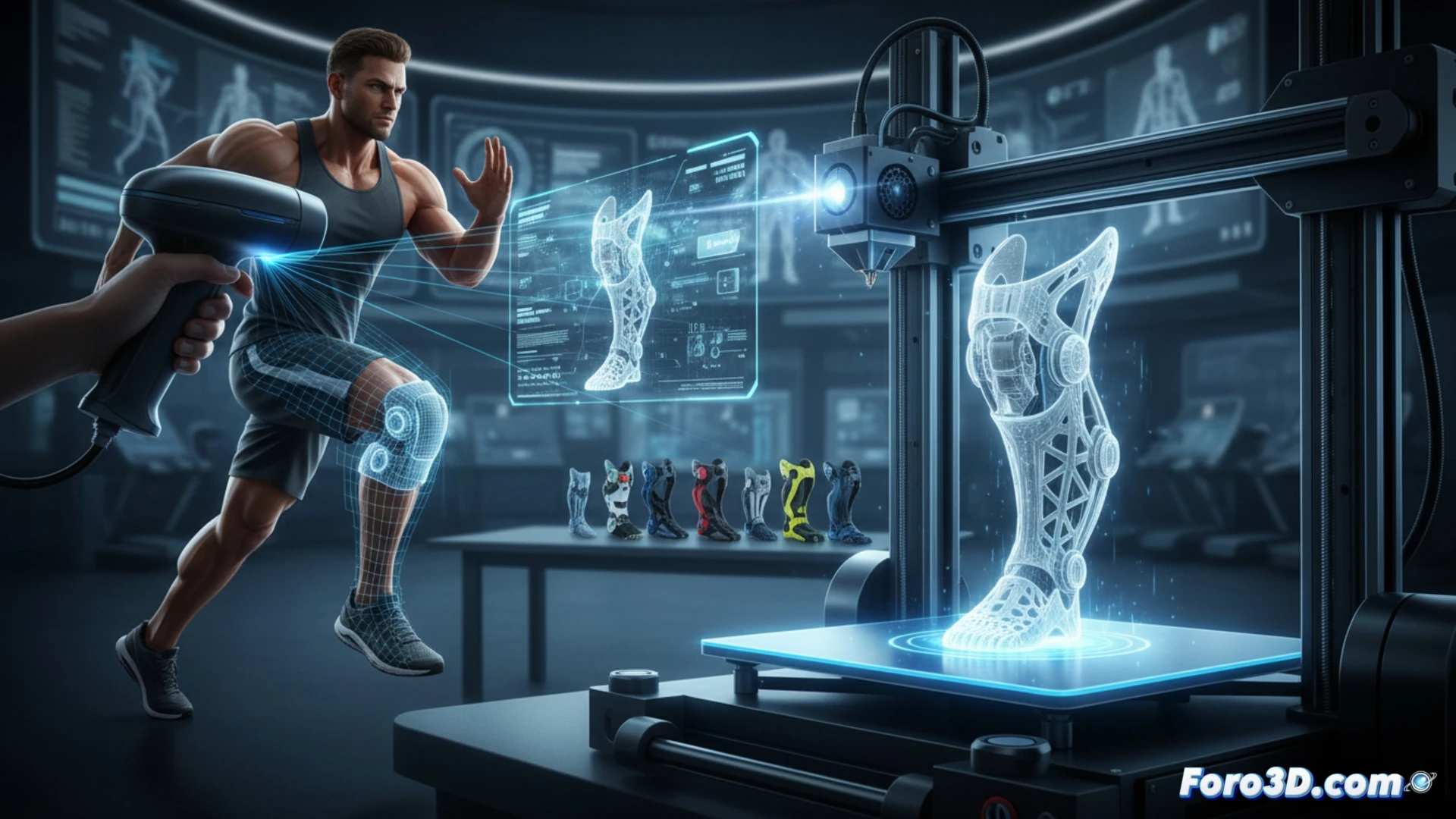
The process begins with a structured light 3D scanner or photogrammetry that captures the exact geometry of the injured limb, including support points and offloading zones. With this data, parametric design software (such as Fusion 360 or Rhino with Grasshopper) generates a lattice or cellular structure that minimizes weight without sacrificing rigidity. Printing with filaments like PETG, carbon fiber-reinforced nylon, or flexible TPU allows for creating everything from ultra-light wrist splints to ankle exoskeletons that assist movement. A real-world case is trail runner Miguel Ángel, who reduced his recovery from a fibula fracture from 12 to 6 weeks using a TPU-printed orthosis with integrated pressure sensors. Compared to traditional casts, the 3D device allows for showering, adjusting compression, and monitoring load in real time—data that the physiotherapist uses to modify the exercise plan.
Total customization: the end of one-size-fits-all in rehabilitation 🎯
The major advantage over conventional methods is the elimination of pressure points and chafing. A plaster cast or generic thermoformed orthosis rarely fits perfectly, causing discomfort and delaying recovery. With 3D printing, the cost per unit drops by up to 40% in small batches, and design time is reduced to just a few hours. Additionally, the material can be recycled and reprinted if swelling decreases—something impossible with casts. This technology is not only faster and cheaper but also restores patient autonomy, allowing them to continue with low-impact exercises while the injury heals. Rehabilitation is no longer a forced pause but an integrated process within training.
What do you think about this advancement?