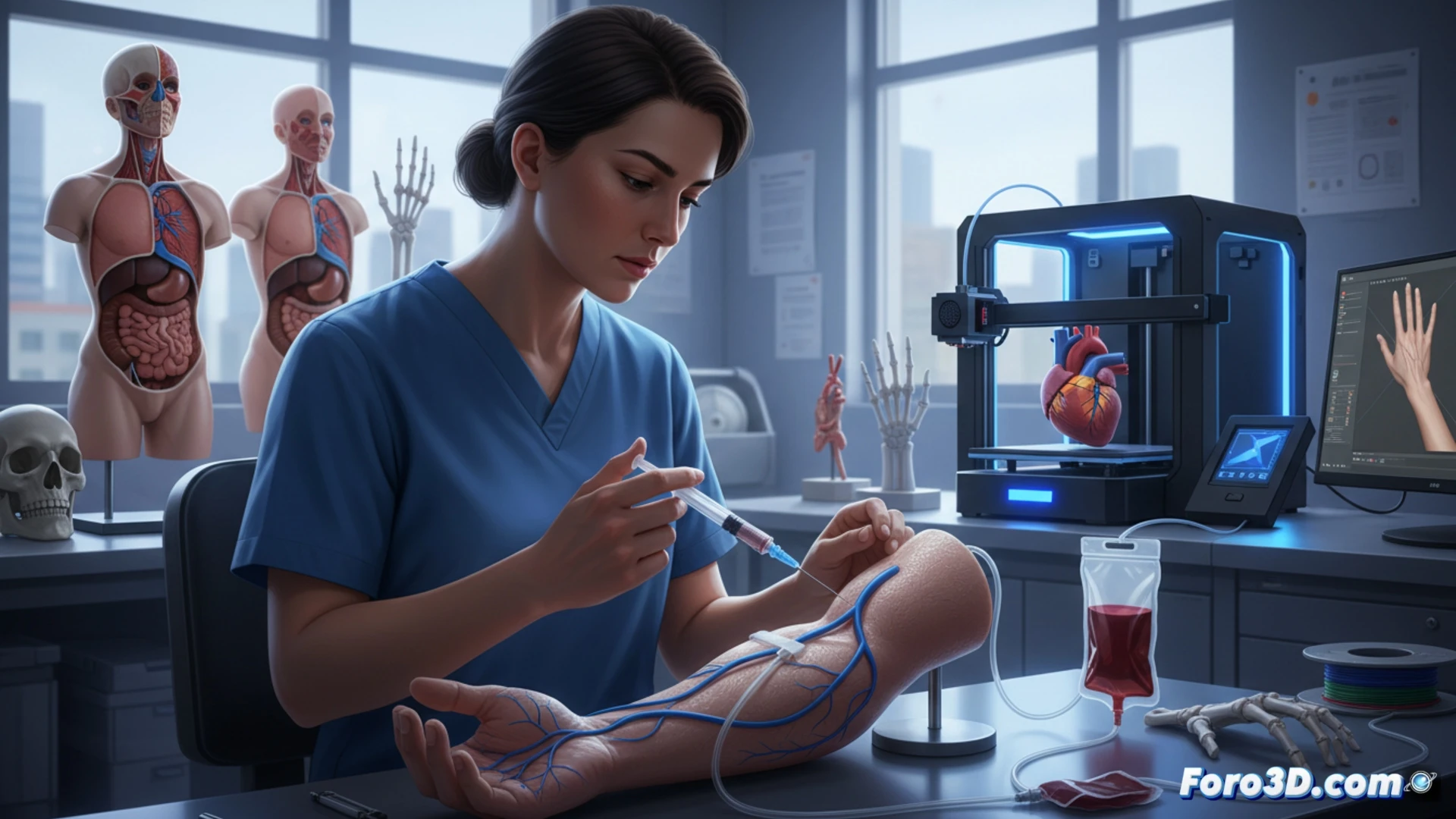
3D technology is transforming nursing training by enabling the creation of precise anatomical models and procedure simulators. They no longer rely solely on generic mannequins or cadavers. With a printer and appropriate software, they can manufacture replicas of organs or veins to practice catheterizations, injections, or wound care without risk to the patient. A clear example is the printing of arms with artificial veins to train intravenous puncture.
Programs and workflow for creating medical simulators 🛠️
To design these models, programs like Blender or Meshmixer are used to edit STL files obtained from CT scanners or repositories like Embodi3D. They are then processed with a slicer such as Cura or PrusaSlicer to generate the printer's G-code. Recommended materials are flexible filaments like TPU to simulate skin or tissue texture, and soft resins in SLA printers for fine details. The process requires calibrating density and temperature to achieve realistic consistency.
When the practice mannequin glares at you with resentment 😅
The advantage is that you can print an arm with visible veins, fail ten times in a row, and the plastic patient won't complain or file a complaint. The disadvantage is that if you forget to add supports to the print, the model will come out with holes and look like Swiss cheese instead of a human arm. At least, when you miss the vein, no real blood will come out, just a little dye liquid that will stain your lab coat.