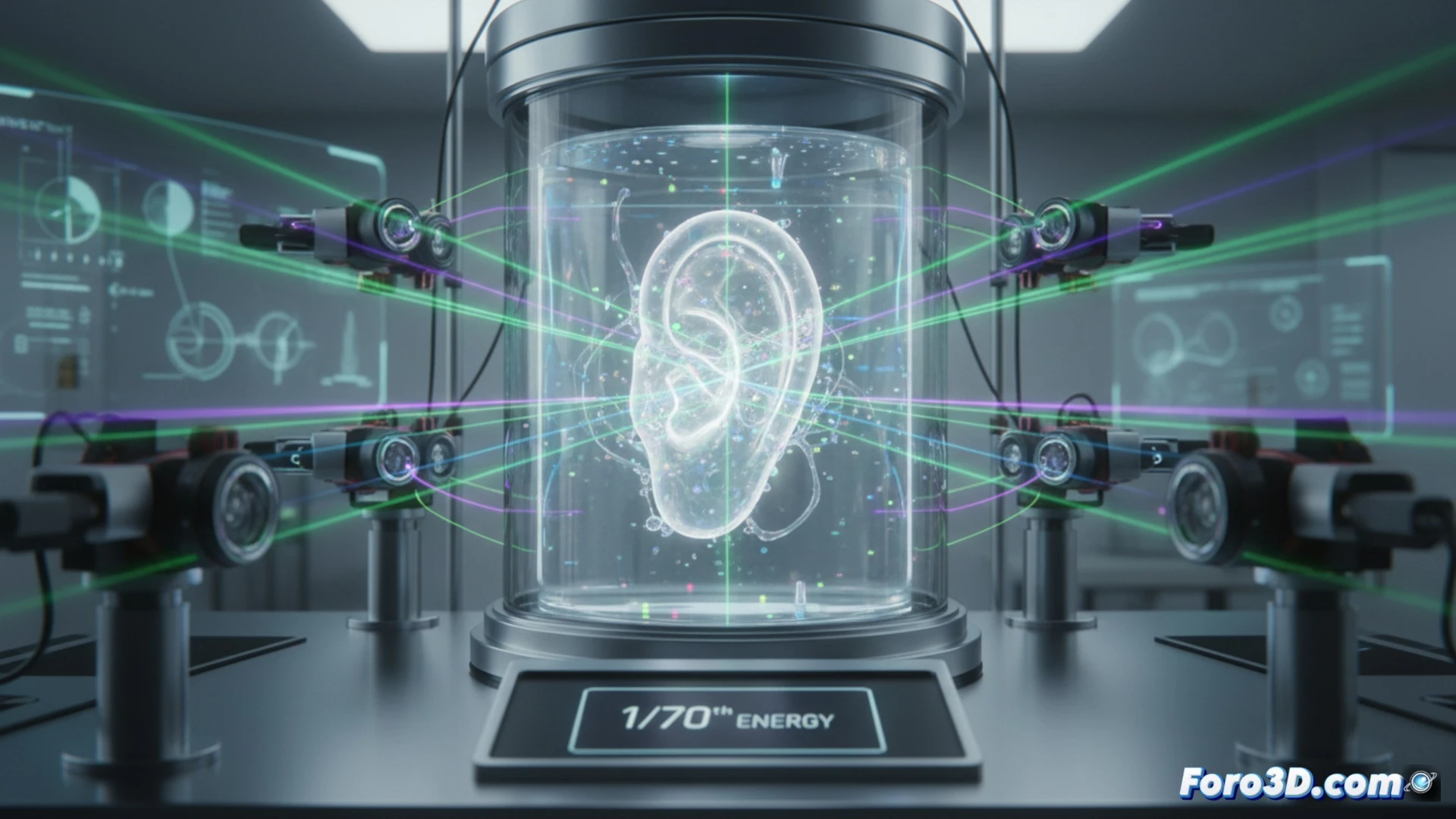
EPFL researchers have created a holographic 3D printing system that uses 70 times less energy than previous methods. With this technique, they managed to print a full-size human ear, a breakthrough with potential for bio-printed implants in reconstructive medicine. The key lies in controlling the phase of the light beam instead of its brightness, preserving more laser power.
Phase control and cell viability in dispersive media 🧬
The system manipulates the phase of light, not its intensity, allowing the laser to conserve its power and penetrate light-scattering media, such as those containing living cells. In one test, a construct with embedded cells maintained its viability after six days and formed organized networks. This brings volumetric printing closer to real medical applications, where precision and cell survival are basic requirements.
The printed ear that doesn't need batteries, but does need light 🤖
Finally, an ear that not only looks real but also doesn't require a battery or a firmware update. The EPFL invention prints tissues with laser holograms, which sounds like 80s science fiction, but it works. However, if you were hoping for an ear that hears better than yours, you'll have to wait: for now, it's just a test construct, albeit one with living cells that form networks as if planning to take over the body.