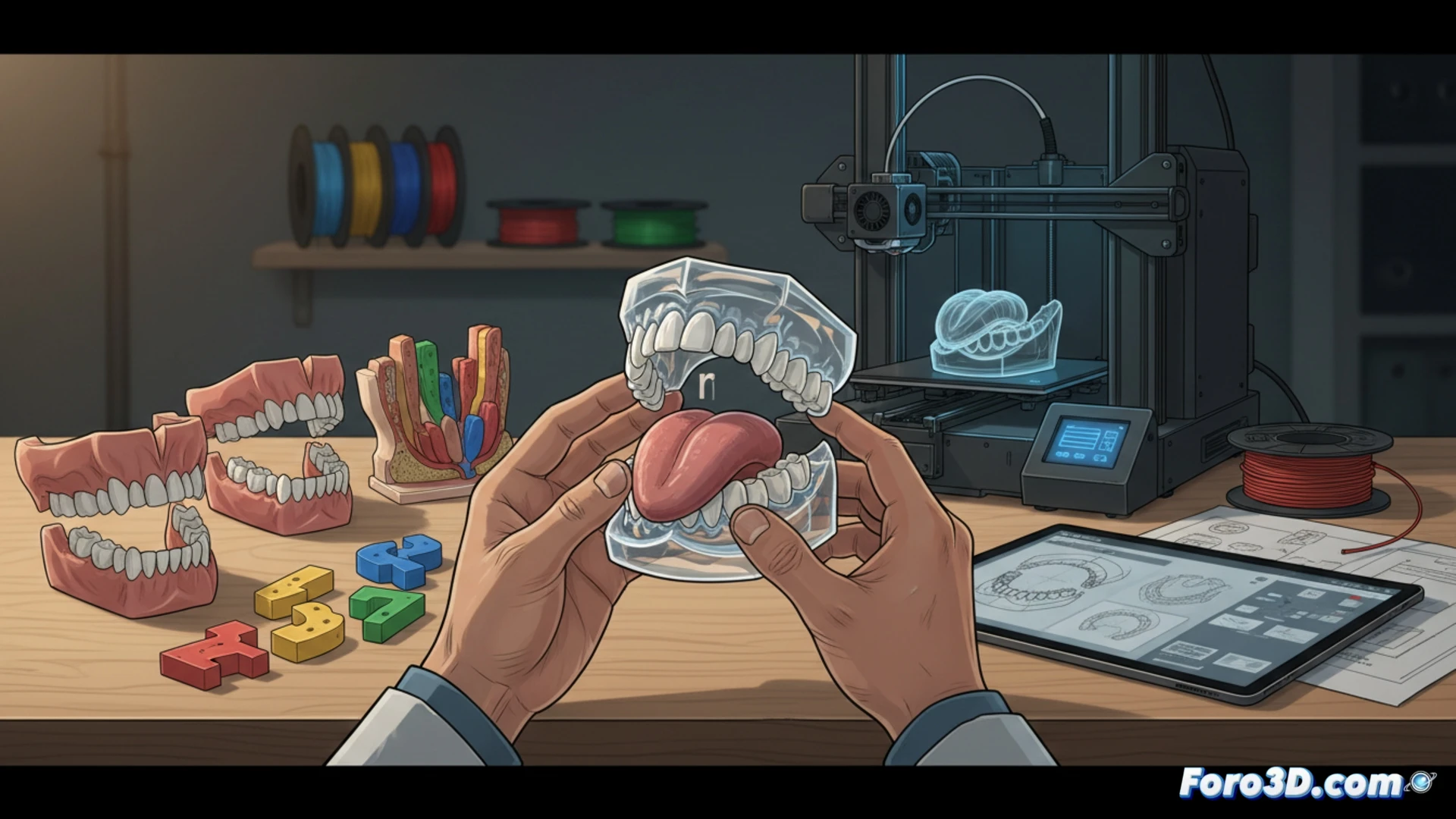
Speech therapy focuses on correcting speech, voice, and swallowing issues, often using visual or physical materials. 3D technology allows for the creation of customized objects that facilitate patient understanding. For example, a speech therapist can print an anatomical model of the oral cavity to show the exact position of the tongue when pronouncing a specific phoneme.
Modeling and software for exercise customization 🖨️
To design these supports, programs like Blender or Tinkercad are used to model the pieces. A practical case: an artificial palate with ridges is printed to guide the tongue towards the correct articulation point for the /r/ sound. The speech therapist scans the patient's mouth with a low-cost 3D scanner, adapts the design, and sends it to an FDM printer with PLA filament, a safe and economical material for clinical use.
When the patient demands a phoneme in matte PLA 😅
Sure, nothing like seeing a five-year-old reject the 3D palate because the color doesn't match their favorite superhero. The speech therapist, with a poker face, explains that sky blue filament does not affect pronunciation, but the little one insists on red. In the end, you reprint the piece and console yourself thinking that at least you didn't have to model a cape. Technology advances, but childhood negotiations are eternal.