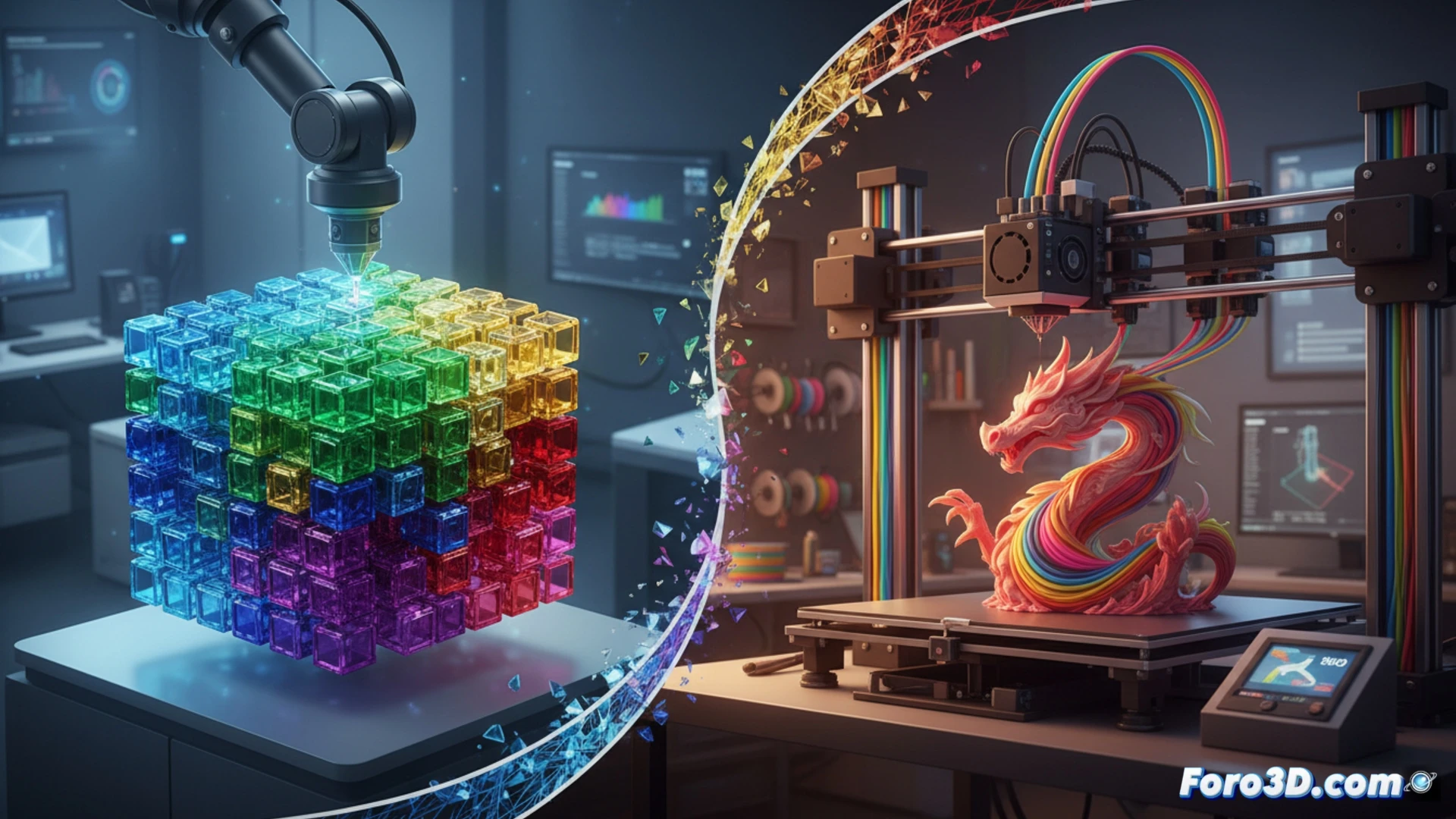
Color 3D printing advances along two opposing paths. On one hand, voxel-level injection promises millimeter precision, but its price puts it out of reach for the average user. On the other, filament extrusion offers a realistic entry point, with printers under $500 achieving color through interchangeable heads or material mixing.
The technical dilemma: precision vs. real cost 🎯
The voxel method injects colored resin layer by layer, achieving gradients and exact shades, but requires complex hardware and costly maintenance. The filament alternative uses multiple heads that alternate PLA materials of different colors, or mixing systems that melt two or more strands in the nozzle. Quality is lower, with possible artifacts from abrupt transitions, but the price and ease of use make it the viable option for home workshops.
When your printer looks like a plastic cocktail shaker 🍸
Sure, filament mixing sounds great until your printer decides that magenta and yellow should merge into a brown shade you didn't ask for. The interchangeable head isn't far behind either: you change the filament, re-level the bed, pray it doesn't clog, and end up with a piece that looks like it came from a child's watercolor. But hey, for $400, you can't ask it to paint like Van Gogh.