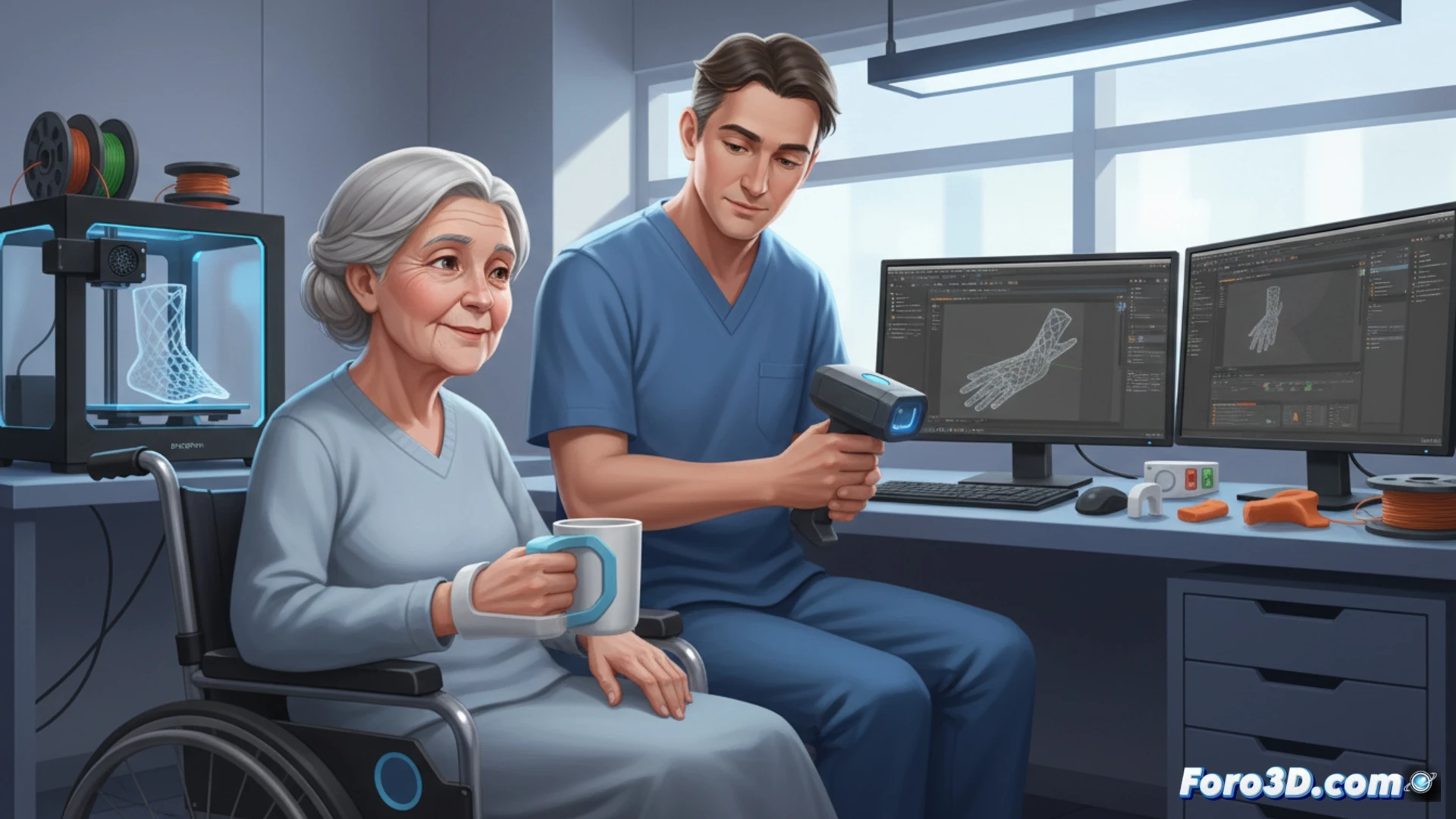
3D technology allows geriatric assistants to customize support objects and simulate care environments. A 3D scanner captures the patient's morphology to design lightweight splints or adapters for wheelchairs. The necessary programs are Blender for modeling, Cura for slicing, and a scanner like the Revopoint POP 3. A practical example: creating an ergonomic support to hold a cup in cases of severe arthritis.
Digital workflow for rapid prototyping 🖨️
The process begins by scanning the patient's hand with the Revopoint POP 3. The data is imported into Blender to clean the mesh and design the coupling. It is then exported to Cura to define printing parameters: 0.2 mm layer height, 30% infill, and supports for overhangs. Flexible PLA is used to prevent chafing. Printing on an Ender 3 V3 takes 4 hours. The result is sanded and tested with the user. The design is adjusted if necessary, iterating until comfort and grip are achieved.
When your patient wants a cup and you give them a plastic toy 😅
The first prototype looked so nice that Mrs. María used it to bang on the table asking for more coffee. Good thing the flexible PLA didn't break anything. The second model had the finger hole poorly measured and looked like a shoehorn. After three iterations and a couple of laughs, we achieved a functional support. The important thing is that now she holds the cup without spilling, although she insists it looks like a giant Lego piece.