The recent implosion of an underwater data center has brought the structural integrity of submerged modules under scrutiny. The collapse, attributed to hydrostatic pressure, points to a premature failure in the titanium seals. The main hypothesis is accelerated galvanic corrosion at stress points not anticipated during the original design. To verify this, a technical workflow combining underwater photogrammetry with advanced material fatigue simulation has been deployed.
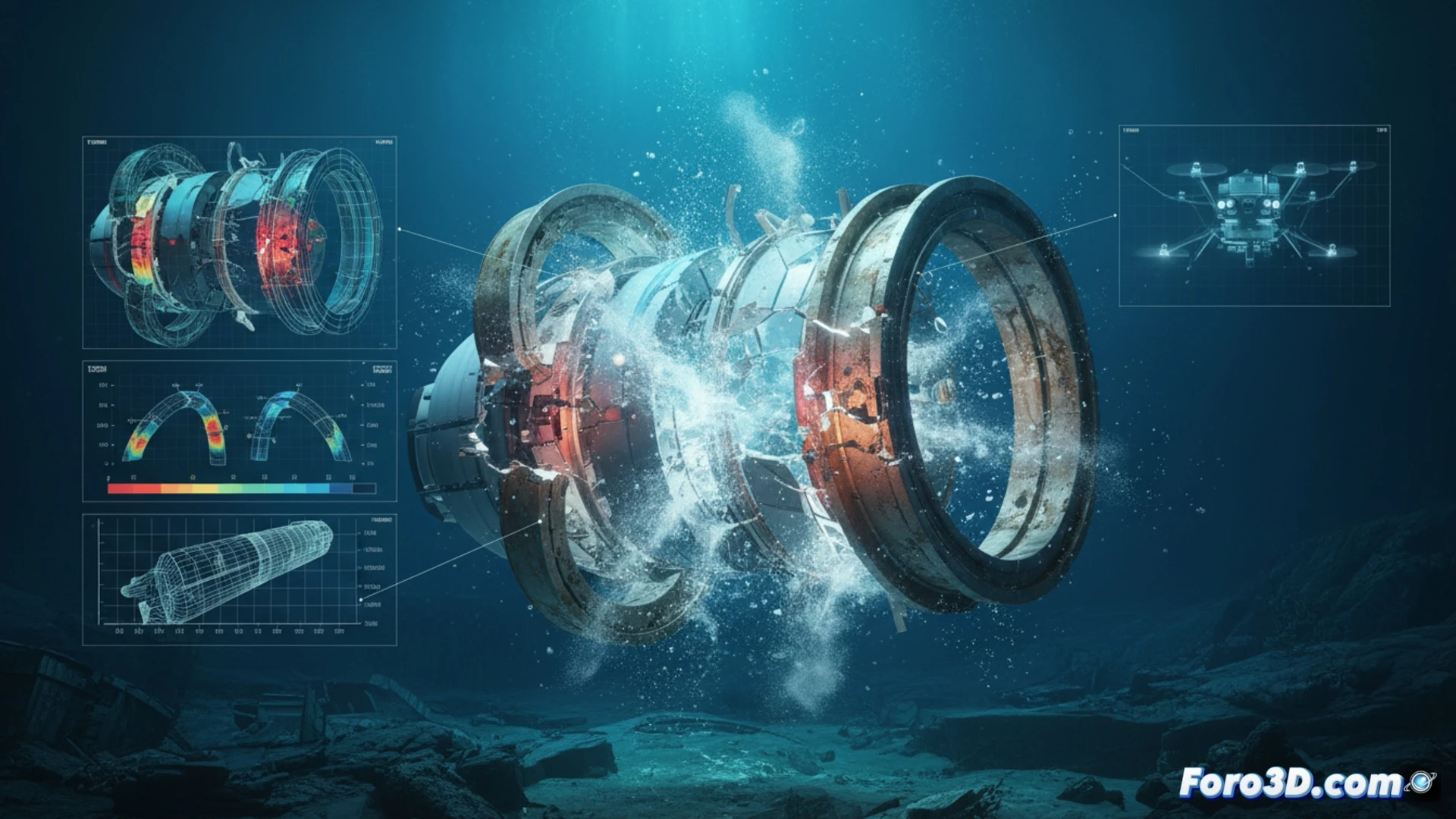
Technical Workflow: From Point Cloud to FEM Simulation 🤖
The process begins with an ROV equipped with high-resolution cameras. The images are processed in Agisoft Metashape to generate a detailed 3D model of the collapsed housing. The resulting point cloud is imported into EIVA NaviModel, where turbidity artifacts are filtered out and the geometry is aligned with engineering plans. This precise mesh is exported to SolidWorks Simulation. There, pressure loads equivalent to the operating depth are applied, and galvanic currents are modeled as a progressive degradation of the titanium's elastic modulus at the joints. The finite element analysis (FEM) identifies stress concentration points where cyclic fatigue and synergistic corrosion exceeded the yield strength, causing the implosion.
Visualizing the Failure: The Importance of Visual Narrative 🎥
To communicate the results to a non-specialist audience, Autodesk Maya is used to create a forensic animation. The deformed mesh from SolidWorks is imported, and the failure progression is simulated: from the micro-crack in the titanium seal, through the gradual water ingress, to the catastrophic collapse. This visualization not only illustrates the mechanics of the disaster but also allows engineers to visually validate the correlation between the simulated fatigue zones and the actual fracture patterns on the recovered housing.
As a fatigue modeler for titanium seals under extreme pressures, which simulation methodologies do you consider most accurate for predicting long-term implosion failure in submarine modules?
(PS: Material fatigue is like yours after 10 hours of simulation.)