A research habitat at 500 meters depth suffered a catastrophic partial implosion. The main hypothesis points to degradation by hydrolysis in the polymer matrix of its basalt fiber dome. To confirm this, an ROV was deployed, capturing thousands of images of the collapse, initiating a forensic engineering workflow that combines high-precision photogrammetry with finite element simulation.
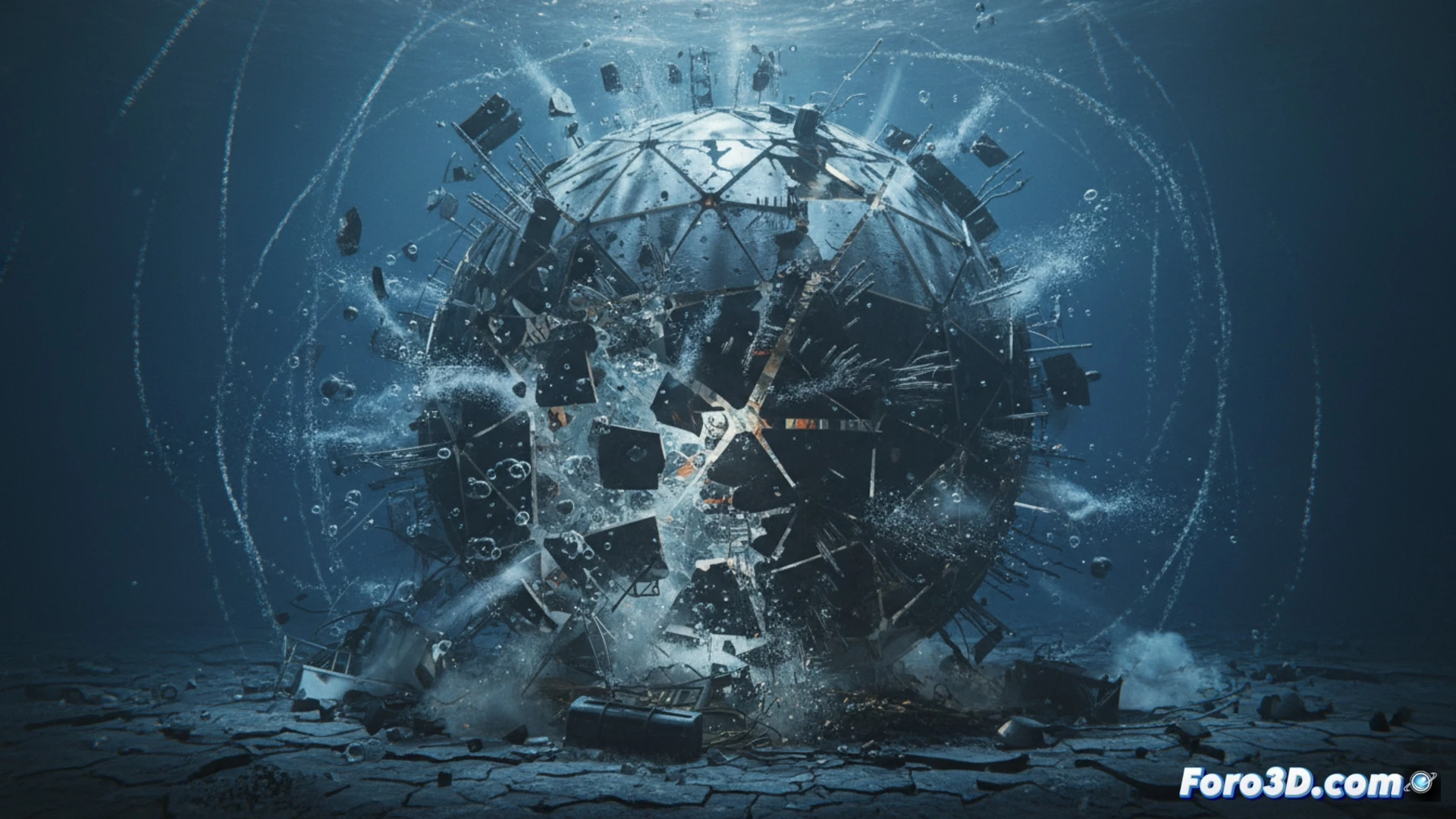
Forensic Photogrammetry and Simulation in Abaqus 🧊
The process began with the 3D reconstruction of the collapsed dome in RealityCapture, using the ROV footage to generate a high-density mesh. This geometry was imported into Abaqus to simulate the composite's behavior under a hydrostatic pressure of 50 atmospheres. The model incorporated a progressive degradation of the polymer matrix, simulating the diffusion of saline water. The results showed a concentration of stresses at the fiber junctions, exceeding the fatigue strength limit by 30% compared to an equivalent fiberglass composite. The simulation confirmed that hydrolysis reduced the load transfer capacity between the fiber and the resin, initiating the cracking that led to the implosion.
Lessons for Deep Habitat Design 🔬
This case demonstrates that basalt fiber, although excellent in dry environments, requires specific moisture barriers for underwater use. The combination of 3D photogrammetry and simulation in Abaqus now allows predicting the service life of these composites under extreme conditions. The developed model will serve as a basis for new accelerated saline corrosion tests, optimizing the selection of polymer matrices for future ocean bases.
Which 3D finite element simulation methodology allows for more accurately modeling the cyclic fatigue of basalt under extreme hydrostatic pressure conditions at 500 meters depth?
(PS: Material fatigue is like yours after 10 hours of simulation.)