Intel has struck again with its special edition i9-14900KS, a processor that breaks the psychological barrier of 6.2 GHz in factory turbo frequency. For 3D professionals, where every second of rendering counts, this figure sounds like a promise of productivity. However, reaching those speeds requires a voltage jump that skyrockets power consumption and demands top-tier cooling, forcing us to ask whether the extra performance justifies the investment in a high-end system.
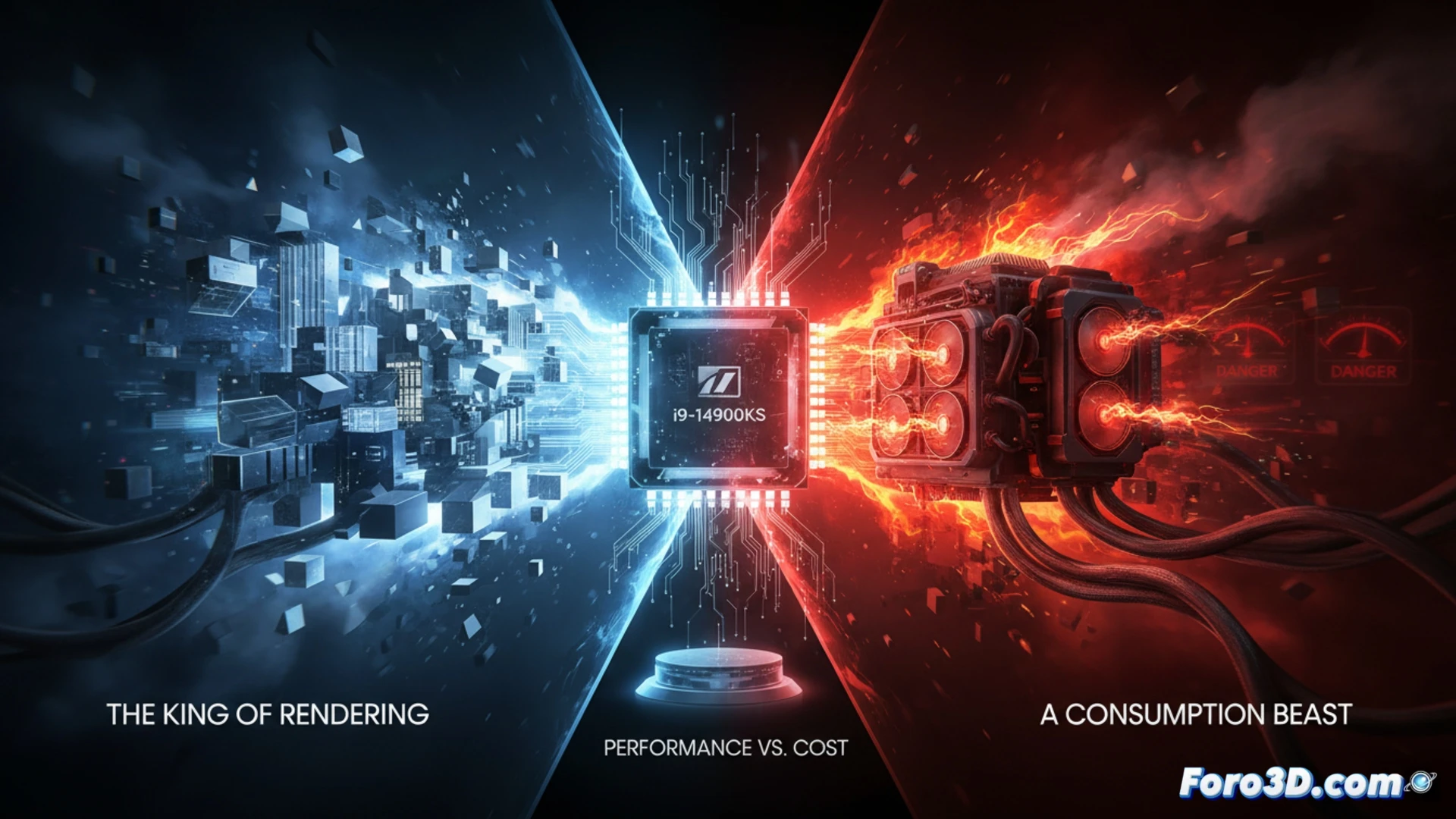
Raptor Lake Refresh architecture and performance in render engines 🔥
The 14900KS retains the Raptor Lake Refresh architecture with 8 high-performance cores (P-cores) and 16 high-efficiency cores (E-cores), totaling 32 threads. In software like Blender (Cycles) or V-Ray, the extra 200 MHz over the i9-14900K translates to a 3% to 5% improvement in complex scenes with ray tracing. However, in physical simulations within 3ds Max or shader compilation in Unreal Engine, the bottleneck is often the cache memory and RAM speed, not just the processor clock. The difference compared to an AMD Ryzen 9 7950X3D is minimal in pure rendering, though Intel gains in tasks that depend on low latency, such as navigating heavy viewports.
Is the premium price worth it for the 3D studio? 💸
The i9-14900KS is a collector's item for overclocking enthusiasts, but for a professional studio, its viability is questionable. You will need a 360mm or larger liquid cooling system to avoid thermal throttling, and a power supply of at least 1000W. If your workflow relies on GPU rendering (like Octane or Redshift), the extra money for the KS would be better invested in a more powerful graphics card. I would only recommend it for users working with real-time CPU-intensive particle simulations or physics who already own the best cooling on the market.
In a real-world rendering workflow with engines like V-Ray or Blender Cycles, does the i9-14900KS offer a tangible improvement over the i9-14900K, or does its marginal frequency gain not justify the increase in power consumption and cost for the professional 3D user?
(PS: Your CPU runs hotter than the Blender vs. Maya debate) 🥵