The HyperX Cloud family has been a benchmark in gaming for years, but its latest wireless iteration presents a compelling argument for the 3D professional. With a battery promising up to 120 hours of continuous use, this headset eliminates one of the biggest friction points in long modeling and rendering sessions: the need to recharge the equipment mid-session. We analyze whether its sound performance and comfort are up to the standards of a technical work environment.
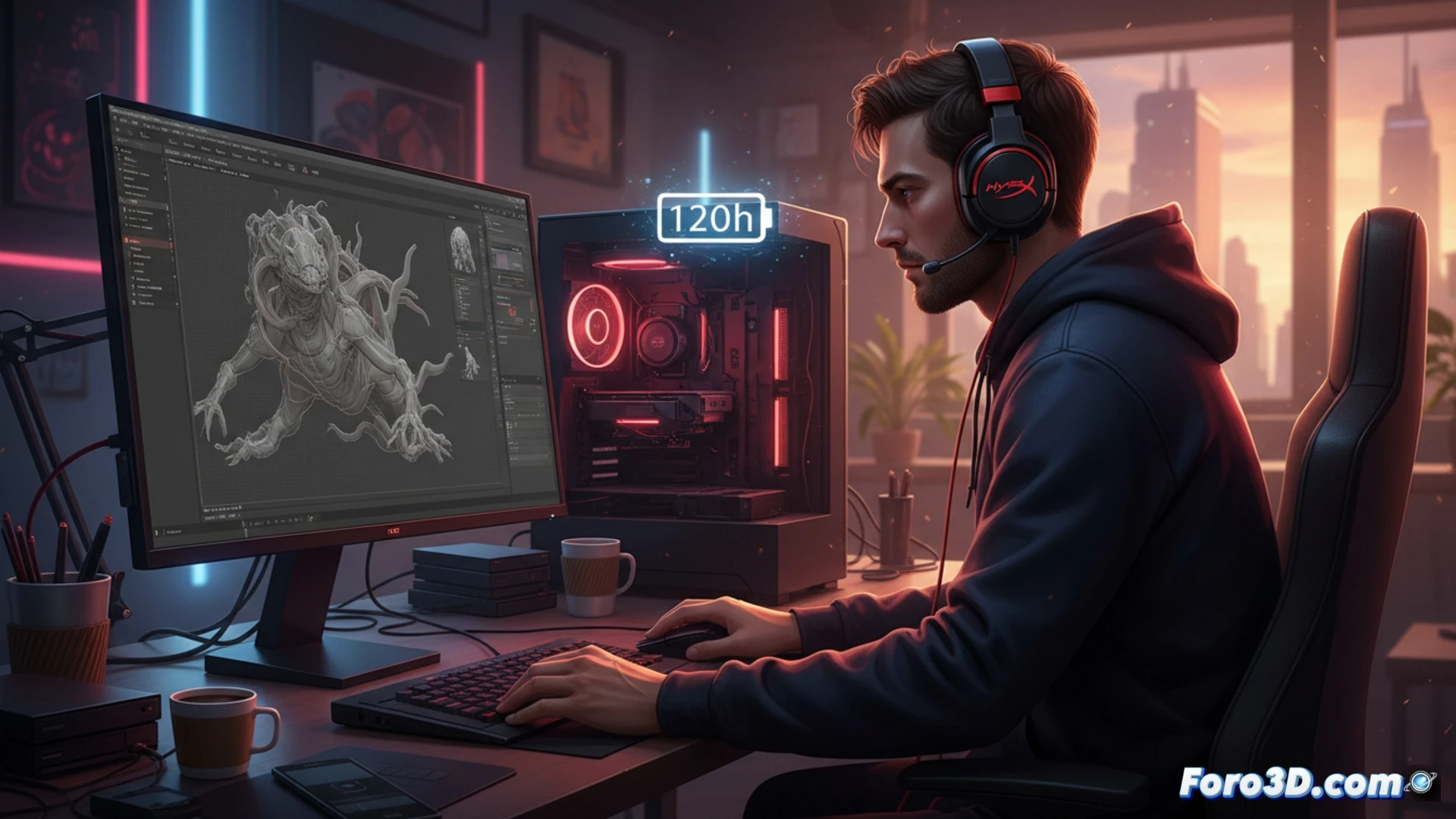
Latency and response in intensive workflows 🎧
For a professional working with simulations or spatial audio editing in 3D post-production, latency is critical. The Cloud III Wireless uses a 2.4 GHz connection with a USB dongle, ensuring transmission without perceptible loss. In tests of distributed rendering and real-time auditory feedback, synchronization remains solid. The sound quality, with 53 mm drivers and a frequency response of 15 Hz to 21 kHz, offers decent channel separation for locating sources in a virtual space. However, it lacks parametric equalization by hardware, forcing the use of third-party software to compensate for the slight bass tilt that could mask mid frequencies in complex audio mixes.
Structural comfort and autonomy as a competitive advantage 🔋
The aluminum headband and memory foam ear cushions covered in synthetic leather offer effective passive isolation, crucial for maintaining focus in a studio without external acoustic distractions. The weight of 330 grams is reasonable for prolonged use, although in sessions exceeding 10 hours, pressure on the upper part of the skull may be noticeable. The device's true technical strength is its battery: 120 hours far surpass rivals like the Logitech G Pro X Wireless (50 hours) or the SteelSeries Arctis Nova Pro Wireless (44 hours with swappable battery). This makes it a viable option for those who prioritize work continuity over the maximum auditory fidelity of professional ranges like Beyerdynamic or Sennheiser.
Can the 120-hour battery life of the HyperX Cloud III Wireless keep a 3D modeler focused during an intensive work week without needing to recharge, and how does this affect productivity in complex modeling workflows?
(PS: If your computer is smoking when opening Blender, you might need more than a fan and faith)