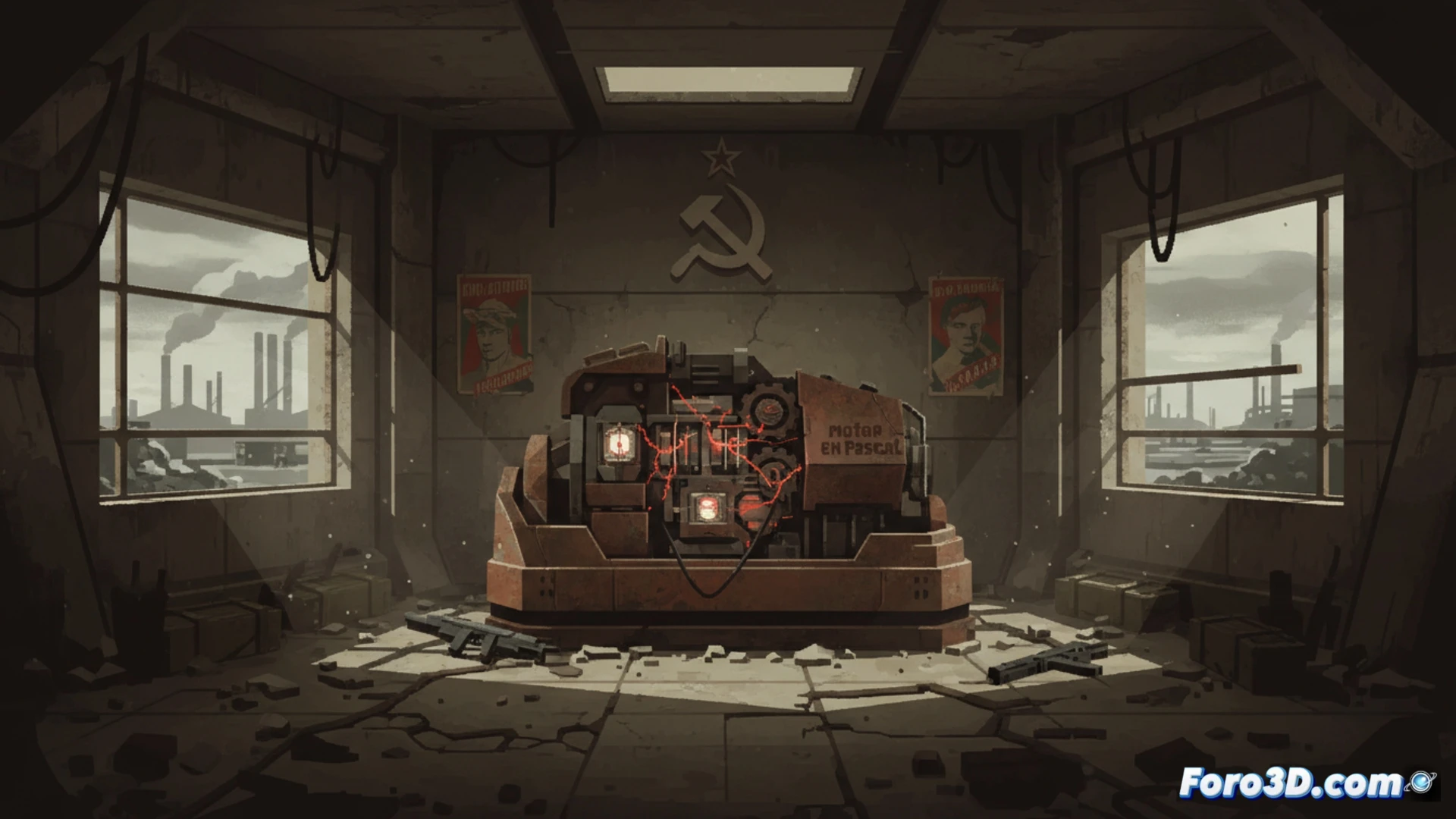
The development of independent video games often seeks nostalgia, but few projects achieve visual coherence as radical as HROT. This FPS uses a custom engine written in Pascal, an uncommon language in today's industry, to emulate the graphical rawness of titles like Quake, but with a brutalist and Soviet identity. The decision to limit the palette to brown, ochre, and gray tones is not a technical error, but an artistic statement that redefines the concept of optimization in retro development. 🎮
Technical analysis: Pascal, limited palettes, and the legacy of Quake 🛠️
From a development standpoint, writing an engine in Pascal involves facing memory and processing limitations that force optimization of every texture and polygon. HROT leverages this constraint to replicate the look of 90s software rendering, where the lack of dynamic lighting is compensated by pre-calculated shadows and static light mapping. The chromatic palette, reduced to earth tones and industrial grays, not only evokes the concrete of Soviet blocks but also reduces GPU load by minimizing color changes per pixel. Combined with proprietary map editors and basic Blender models, the team achieves a stable framerate by sacrificing visual complexity in favor of an oppressive and coherent atmosphere.
Visual coherence as a development driver 🎨
In a market saturated with photorealistic graphics, HROT demonstrates that visual identity is more important than resolution. The decision to use a custom engine instead of Unreal or Unity allows complete control over the aesthetic, avoiding the visual noise of generic assets. For the independent developer, this project is a reminder that technical limitations, when embraced with a clear vision, become the game's artistic signature. Optimization is not just about FPS, but about telling a story through color and texture.
How does the choice of a legacy engine and a language like Pascal affect the efficiency of the development pipeline and the faithful recreation of the Soviet aesthetic in HROT compared to modern engines like Unity or Unreal?
(PS: 90% of development time is polishing, the other 90% is fixing bugs)