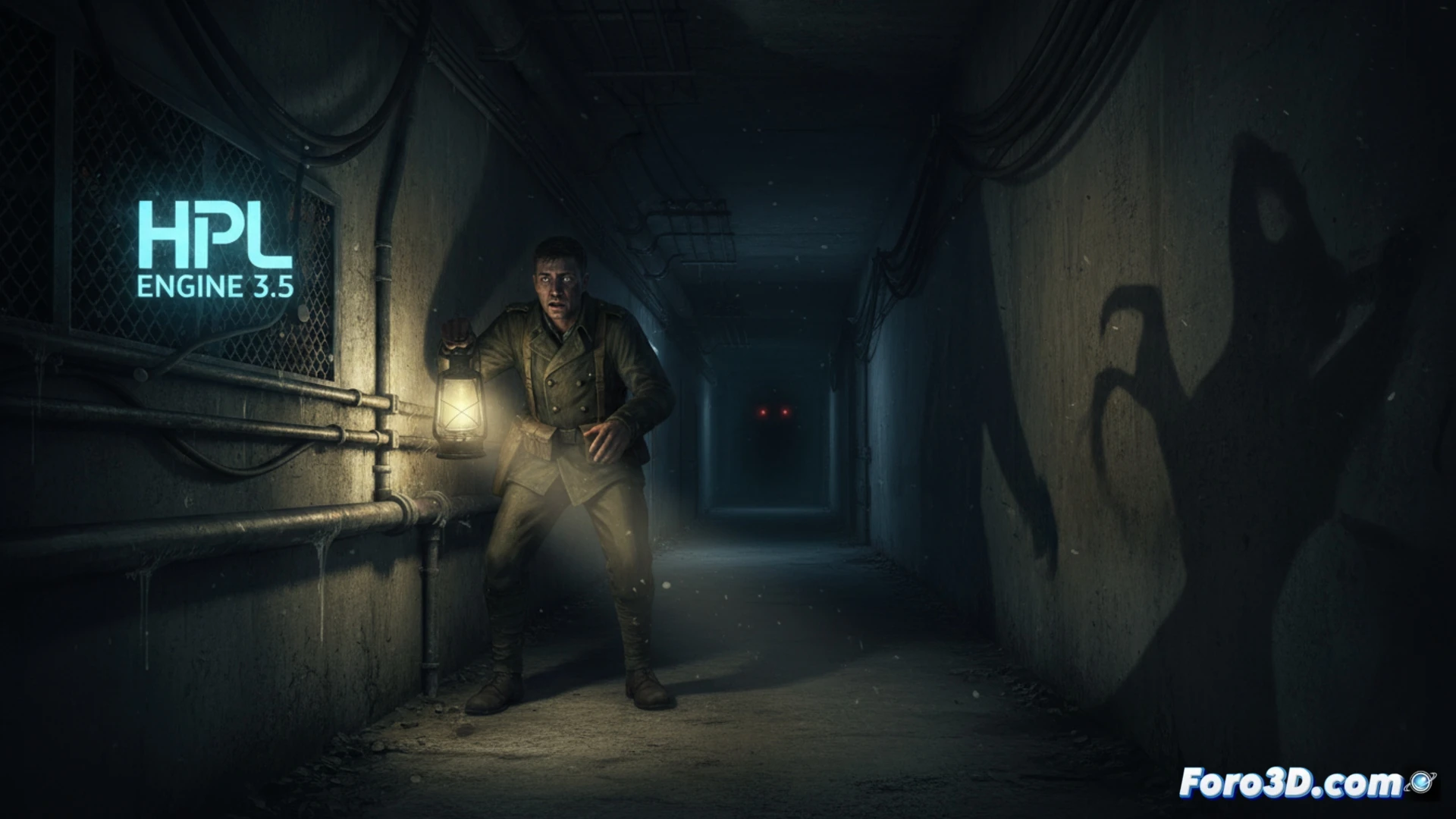
The HPL Engine 3.5 has been the technical pillar that has allowed Frictional Games to take atmospheric horror to a new level in Amnesia: The Bunker. Unlike other titles, here darkness is not a simple visual filter, but an active gameplay element. The dynamic lighting system, centered on real-time projected shadows and ambient occlusion effects, turns every corridor into a tension trap where the lantern is both a tool and a disadvantage.
Level Design and Technical Texturing with Maya and Substance Painter 🛠️
To build the bunker, the team used Autodesk Maya as the primary level modeling tool. The polygonal mesh not only defines the geometry but also dictates how light bounces and hides, maximizing the impact of dynamic shadows. Subsequently, Substance Painter was used to generate textures for worn and rusted materials. The use of roughness and metallic channels, combined with dirt masks, allows the HPL Engine 3.5 lighting to react realistically, making the environment feel alive and hostile without sacrificing real-time performance.
Immersion as a Result of Technical Optimization 🎯
The fascinating aspect of this development is that immersion does not come from ultra-realistic graphics, but from the intelligent combination of software and engine. The HPL Engine 3.5 manages ambient occlusion so that the player never sees a single unnecessary pixel, while Substance Painter textures add visual history without saturating the GPU. Maya, for its part, ensures that every corner has a reason for being in terms of gameplay. Thus, Amnesia: The Bunker demonstrates that technical horror lies in knowing what to hide, not just what to show.
As a developer, what technical aspects of the HPL Engine 3.5 allow for generating the dynamic lighting and object physics that create tension and procedural fear in Amnesia: The Bunker?
(PS: optimizing for mobile is like trying to fit an elephant into a Mini Cooper)