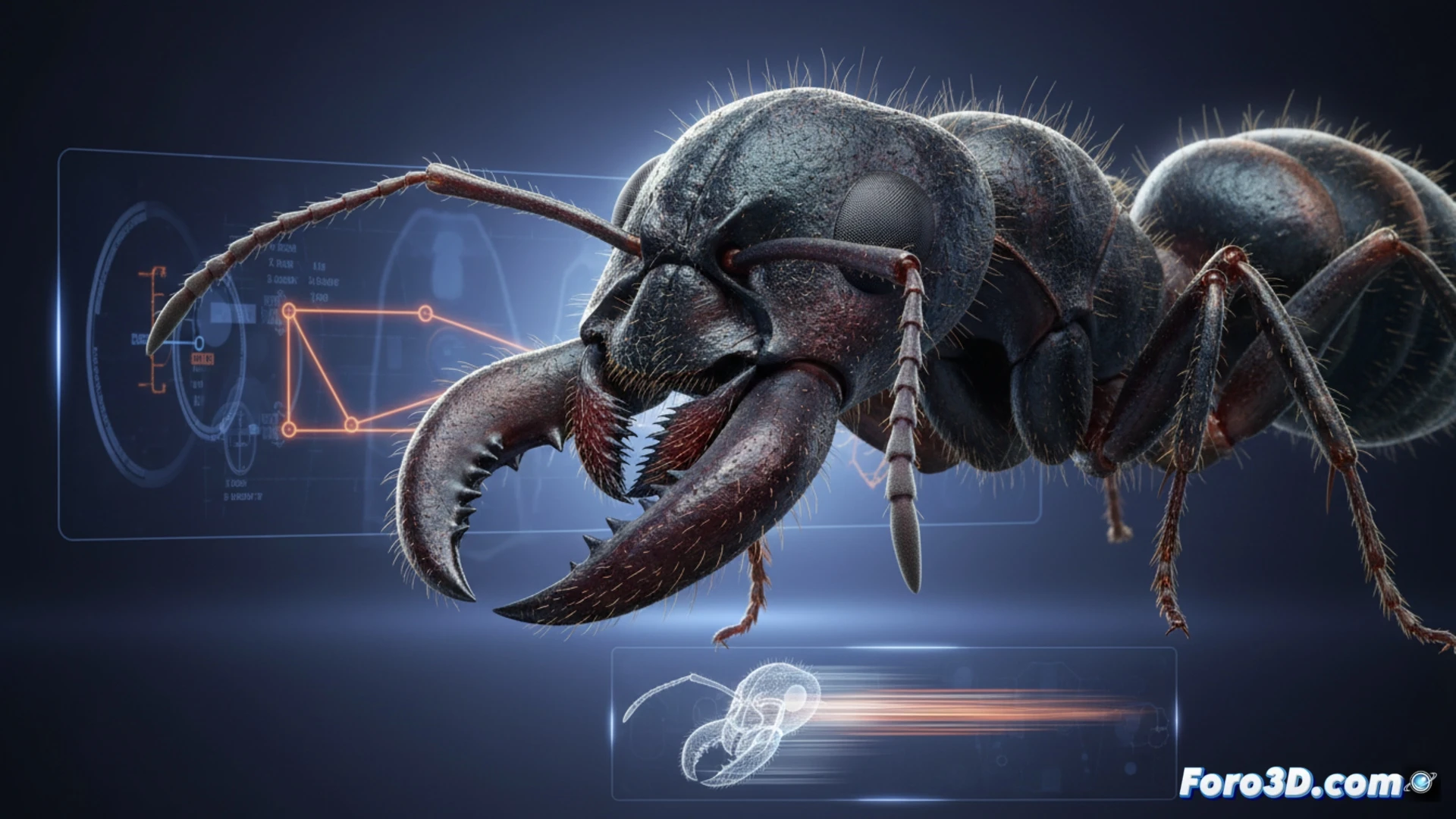
The Strumigenys ayrostricta, known as the Guyana Dracula Ant, has been discovered in the jungles of Suriname. Its main characteristic is its trap-jaw mandibles, capable of closing at supersonic speeds. For scientific visualization, it represents a perfect case study on evolutionary biomechanics. This article explores how to model and simulate in 3D the closing mechanism of its appendages for educational and museum applications.
Anatomical modeling and kinematic simulation 🐜
The technical challenge lies in accurately representing the trap-jaw mandibles. These structures, similar to those of trap-jaw ants, store elastic energy in a biological spring. For 3D modeling, it is recommended to use high-resolution meshes on the exoskeleton and rigging based on inverse kinematics. The closing simulation must include a keyframe that accelerates the movement from 0 to 0.13 milliseconds. Comparatively, this is 5,000 times faster than a human blink. Tools like Blender or Maya allow for slow-motion rendering to visualize the capture of prey such as springtails.
Applications in outreach and evolution 🧬
This 3D model is not just an aesthetic tool. It allows biologists and educators to break down the movement into phases: opening, tension loading, and release. By comparing Strumigenys ayrostricta with other fast-action predators, such as the praying mantis, principles of evolutionary convergence are illustrated. For a virtual museum, an interactive sequence is suggested where the user activates the mandibular strike. The result is an educational resource that unites entomology with materials engineering, showing how nature optimizes speed at a microscopic scale.
How can the ultra-fast closing mechanism of the Dracula Ant's mandible be modeled and simulated in 3D to analyze its biomechanics in scientific visualization?
(PS: at Foro3D we know that even manta rays have better social connections than our polygons)