At the heart of rotating or electrically charged black holes, physics sheds its usual rules. Beyond the Cauchy horizon, a theoretical boundary where causality is reversed, time and space distort to the point where the future can influence the past. These hypothetical environments, unstable to any perturbation, represent a conceptual laboratory where general relativity and quantum mechanics collide, opening doors to alternative realities and time travel.
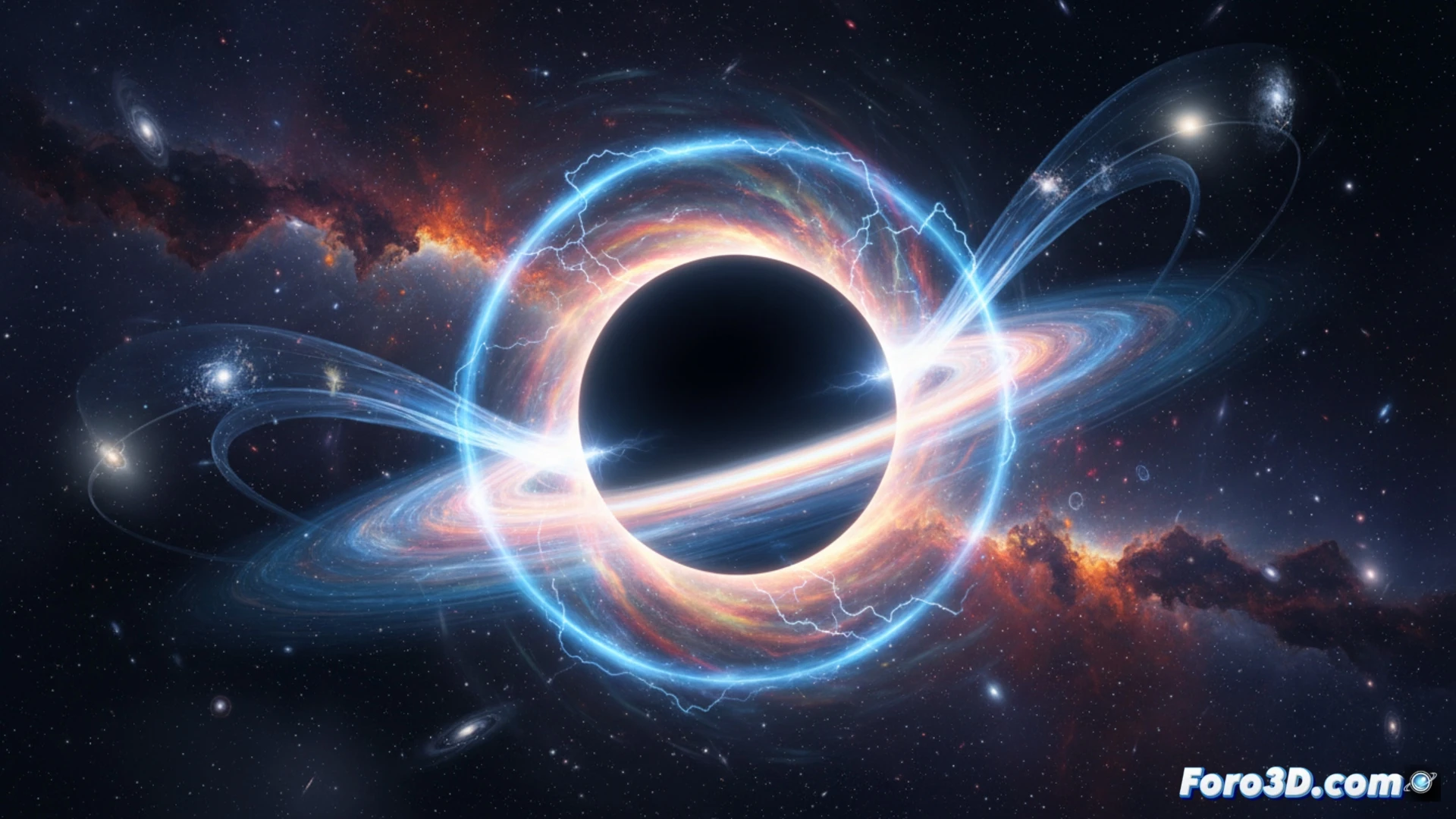
3D Visualization of the Interior of a Kerr Black Hole 🌀
To represent this phenomenon, we propose an interactive 3D visualization of the interior of a Kerr black hole, characterized by its rotation and a ring-shaped singularity instead of a point-like one. The scene must include three key elements: the event horizon as a semi-transparent outer sphere, the Cauchy horizon as a pulsating inner surface with distorted light textures, and the ring singularity as a bright ring at the center. Animations should show time lines curving and causal arrows reversing their direction upon crossing the Cauchy horizon, all accompanied by explanatory legends detailing how extreme gravity deforms spacetime. This model is ideal for planetariums and educational platforms, as it translates abstract concepts into an immersive visual experience.
The Fragility of the Impossible ⚡
Although the Cauchy horizon is a conceptual gateway to the unknown, its existence is extremely unstable. Any small external perturbation, such as a gravitational wave or infalling matter, could collapse this boundary, transforming the black hole into a simpler object. However, its study forces us to ask: if the universe allows regions where causality is reversed, are we limited by our linear perception of time? At the intersection of science fiction and theoretical physics, these horizons remind us that the cosmos holds corners where the impossible becomes conceivable.
How could the causal paradox of a Cauchy horizon in a Kerr-Newman black hole, where information from the future seems to influence the past, be visually represented using volumetric simulation and real-time rendering techniques?
(PS: at Foro3D we know that even manta rays have better social bonds than our polygons)