The recent remaster of Horizon Zero Dawn is not a simple facelift; it is a visual re-engineering that elevates the original title to the level of its sequel, Horizon Forbidden West. This achievement would not have been possible without a deep integration between the Decima Engine and authoring tools like Autodesk Maya, Houdini, and Substance. Let's analyze the workflow that allowed doubling the real-time graphical fidelity.
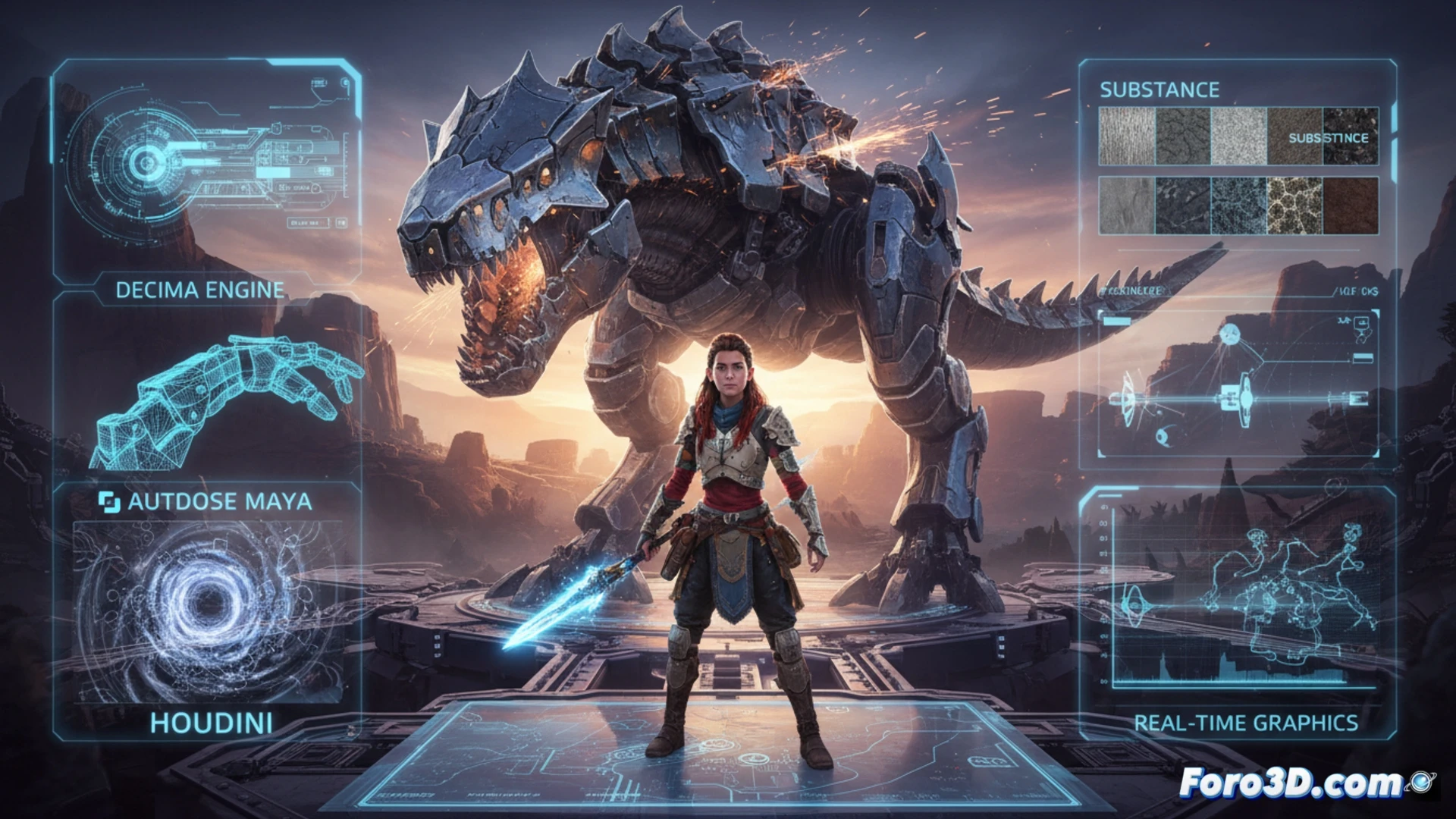
Decima Engine and the Architecture of the Massive Update 🎮
The core of the remaster lies in migrating the shaders and lighting systems of the Decima Engine to the version used in Forbidden West. Volumetric lighting, for example, was rebuilt using scattering volumes in Houdini, which were then baked into 3D textures optimized for the engine. For vegetation, Autodesk Maya was used to retopologize the base models, while Substance Designer generated procedural variation masks that allow Decima to render thousands of unique bushes without repeating textures. The advanced water shaders are the result of a custom shader that combines terrain depth data with pre-calculated wave simulations in Houdini, achieving dynamic refraction and foam without consuming real-time GPU resources.
Lessons for Cross-Platform Development 🛠️
This case demonstrates that an effective remaster does not depend solely on increasing texture resolution, but on restructuring the asset pipeline. The key was using Houdini to generate procedural data (such as rock scattering and grass height) that the Decima Engine interprets as instances, reducing memory load. For developers, the lesson is clear: investing in procedural authoring tools and migrating shaders to the updated engine can deliver next-generation results without needing to rewrite the game from scratch.
How did they optimize the global illumination pipeline and ambient occlusion system in Horizon Zero Dawn Remastered to achieve such a significant graphical leap without compromising performance on previous-generation consoles?
(PS: a game developer is someone who spends 1000 hours making a game that people complete in 2)