Honor has set a new milestone in consumer engineering with the Magic V3, a foldable that closes to just 9.2 mm thick. For 3D professionals, accustomed to dealing with the weight of workstations and robust tablets, this figure is not just a design statistic; it is a statement of intent about extreme portability. We analyze whether its hardware can sustain the demands of modeling and asset visualization on the go.
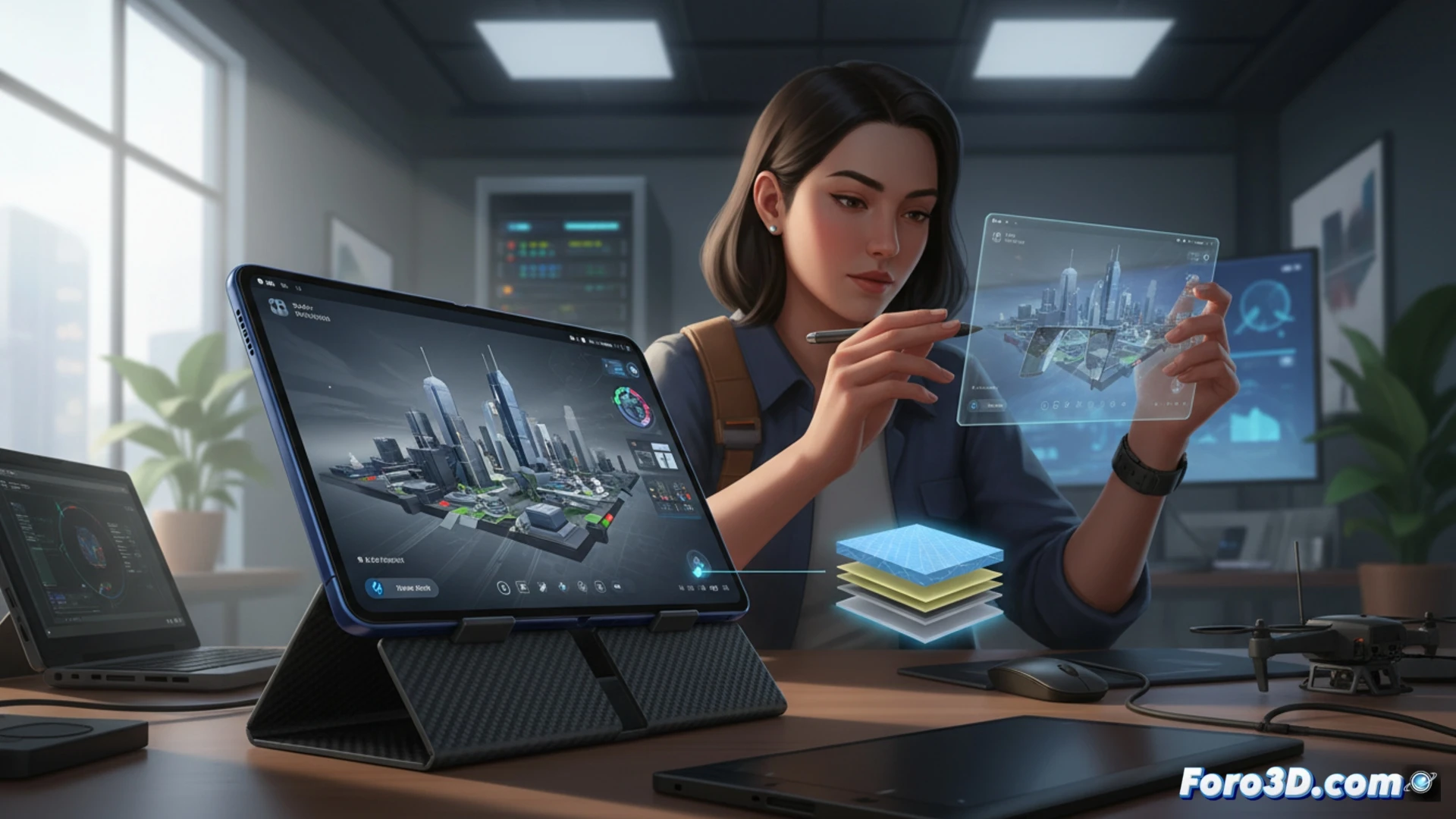
Aerospace-grade hinge and silicon-carbon battery: Engineering applied to performance 🔧
The key to its ultra-thin profile lies in two material innovations. The aerospace-grade steel hinge not only guarantees the durability of the fold (withstanding hundreds of thousands of cycles) but also allows for a gap-free transition, crucial for holding the device in tent mode during blueprint reviews. More relevant to the 3D workflow is the silicon-carbon battery. This chemistry offers higher energy density than conventional lithium batteries, translating into extended sessions of mobile rendering or viewing heavy models in Unreal Engine or Sketchfab without needing to reach for the charger. The ability to keep the GPU powered for hours is a differentiating factor compared to other foldables that sacrifice battery for thinness.
Foldable screen vs. traditional tablet: Where does 3D fit in? 📱
The unfolded screen offers an area close to a small tablet, but with the advantage of fitting in a pocket. For the 3D professional, this allows carrying a high-resolution viewer to show renders to clients on-site without lugging a technical backpack. However, the real challenge is not size, but raw power. Although the Snapdragon 8 Gen 3 integrates an Adreno GPU capable of handling complex geometry in real-time, the 3D software ecosystem for Android remains limited compared to iPadOS or Windows. The Magic V3 is ideal for visualization, annotations on models, and project review, but it still does not replace a laptop for heavy polygonal modeling or detailed UV texturing. It is a high-end complement, not a substitute, that redefines what it means to carry 3D visualization in your pocket.
Could the ultra-thin form factor of the Honor Magic V3 compromise thermal dissipation during prolonged sessions of mobile rendering or complex 3D modeling?
(PS: Your CPU heats up more than the Blender vs. Maya debate)