The manga Historie, by Hitoshi Iwaaki, is not just a biography of Eumenes of Cardia. It is an exercise in visual archaeology that deserves the attention of any professional interested in the digital reconstruction of heritage. The work stands out for its meticulous representation of ancient Greece and Macedonia, from the arrangement of hoplites in a phalanx to the architectural details of the agoras. This level of precision makes the comic a benchmark for those working on the visualization of historical environments, demonstrating how graphic narrative can align with the principles of photogrammetry and 3D modeling applied to military and urban history.
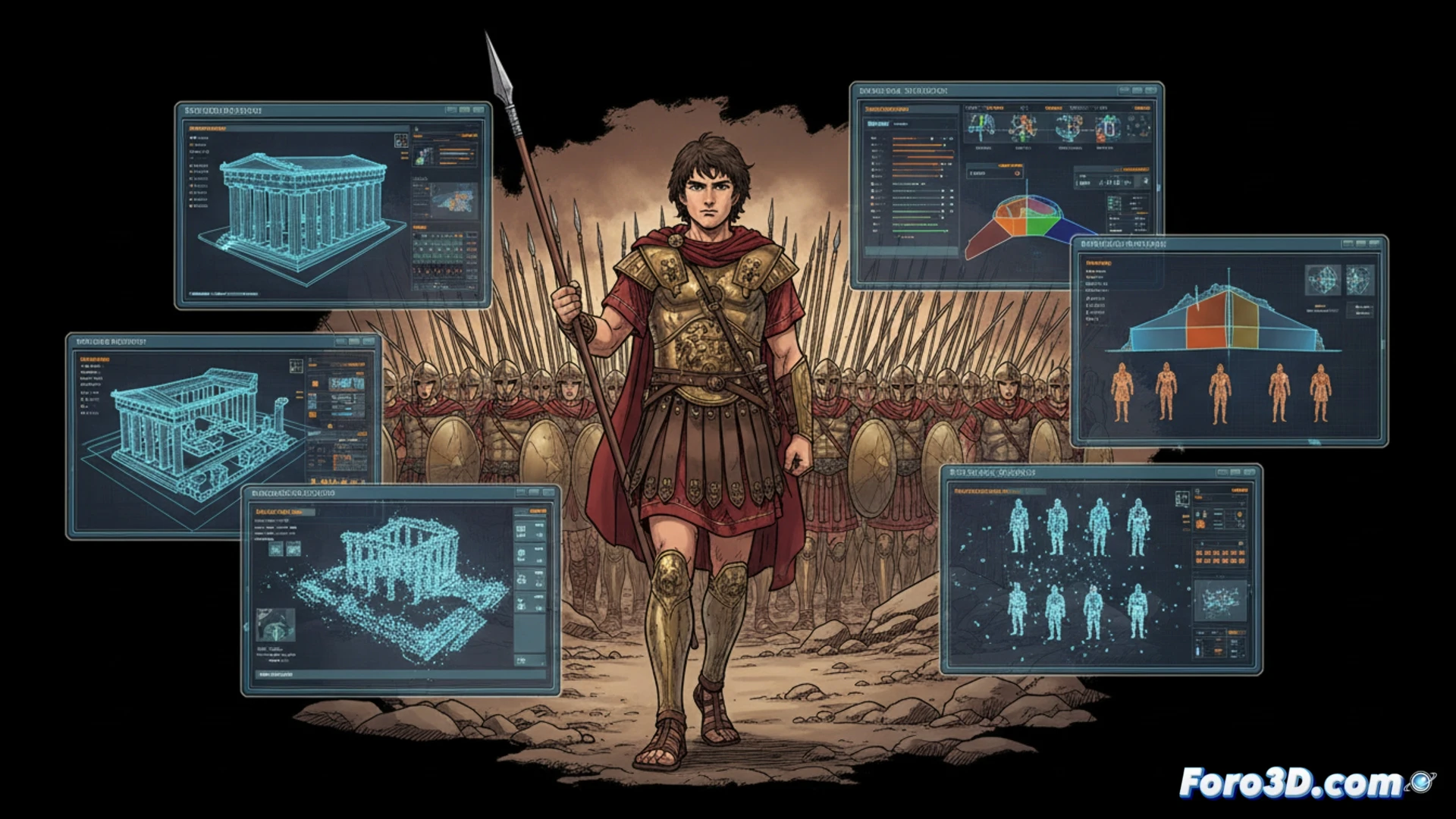
Virtual reconstruction of Hellenistic tactics and environments 🏛️
Iwaaki employs a clean and balanced style that prioritizes strategy over visual drama. This sobriety is key for technical analysis. Reading Historie, one can identify design patterns reminiscent of renders generated by architectural reconstruction software, such as Blender or Agisoft Metashape. The battle lines, the angle of the spears, and the arrangement of light infantry are not random; they respond to a prior study of historical sources like the works of Arrian or Diodorus Siculus. For a digital archaeologist, each panel is a visual dataset that allows comparing how Macedonian military formations are represented in 2D versus how they would be simulated in a 3D environment with particle systems and collision physics. The clothing, shields, and walls are drawn with a consistency that allows extracting data to texture digital assets.
Lessons from Iwaaki for heritage visualization 🎨
The main lesson of Historie for the niche of digital archaeology is that historical accuracy is not at odds with visual readability. Iwaaki manages to make the reader understand the complexity of a battle without overwhelming them with superfluous details. This balance is the same sought by virtual reality specialists when recreating a site like Pella or ancient Thebes. The work demonstrates that, to effectively convey historical knowledge, the reconstruction must be faithful to archaeological data but also functional for the end user. In a field where an excess of polygons or information saturation can break immersion, Iwaaki's style offers a narrative and aesthetic model to follow.
Is it possible to digitally reconstruct the architecture and furniture of ancient Macedonia based solely on the backgrounds and objects depicted in the panels of Historie?
(PS: If you dig at a site and find a USB drive, don't plug it in: it could be malware from the Romans.)