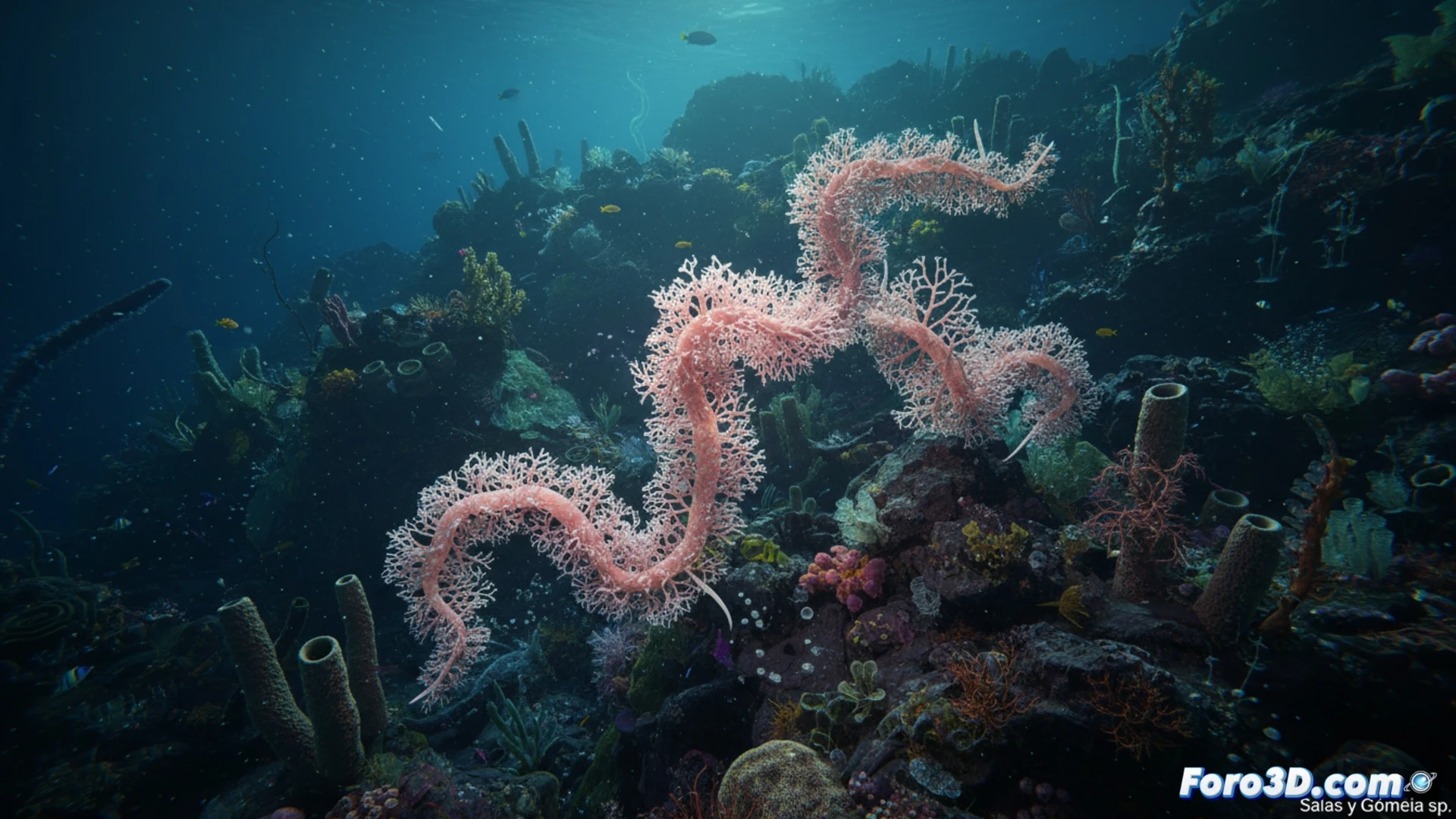
The Salas y Gómez Ridge is home to a colonial organism of extraordinary beauty: the pink lace hydroid (Solanderia sp.). This species, which grows anchored to volcanic rocks, presents a reticular structure reminiscent of delicate lace. Its morphology and geological environment offer a fascinating case for 3D scientific visualization, allowing exploration of the complexity of these marine ecosystems.
Morphological Modeling and Anchoring to the Volcanic Substrate 🌊
3D modeling of Solanderia sp. requires a detailed approach to its colonial structure. The network of polyps, with a characteristic pink hue, branches irregularly, creating a three-dimensional mesh that maximizes the feeding surface. For an accurate representation, it is crucial to model the hydrorhiza, the anchoring base that firmly adheres to the roughness of the volcanic basalt. The recreation of the ecosystem must include the porous texture of the rock, the lighting of the aphotic zone, and the currents that sway the colony. Scientific annotations should detail the taxonomy (Class Hydrozoa, Order Anthoathecata) and the biology of feeding by plankton capture.
Delicacy as a Survival Strategy 🐚
Visualizing this hydroid in 3D is not just an aesthetic exercise; it is a tool for understanding its ecology. Its apparent fragility is actually an efficient adaptation for filtering nutrients in deep, oligotrophic waters. By modeling its environment, from the volcanic substrate to the water column, we can appreciate how form follows function. This representation invites reflection on the hidden biodiversity of oceanic ridges and the importance of preserving these unique habitats.
Which digital sculpting techniques and organic growth simulations are most effective for replicating the fractal structure and translucency of the pink lace hydroid Solanderia sp. in a 3D model intended for scientific visualization?
(PS: at Foro3D we know that even manta rays have better social connections than our polygons)