The development of Hell Is Us represents a fascinating case study on the integration of contemporary sculptural art into a real-time engine. Rogue Factor has opted for a workflow that combines the high fidelity of ZBrush, the versatility of Maya, and the power of Unreal Engine 5 to create a surreal universe populated by biomechanical creatures. This analysis breaks down the technical decisions that allow organic and mechanical design to coexist without sacrificing performance on consoles and PC.
Hybrid Modeling and Optimization for Nanite 🛠️
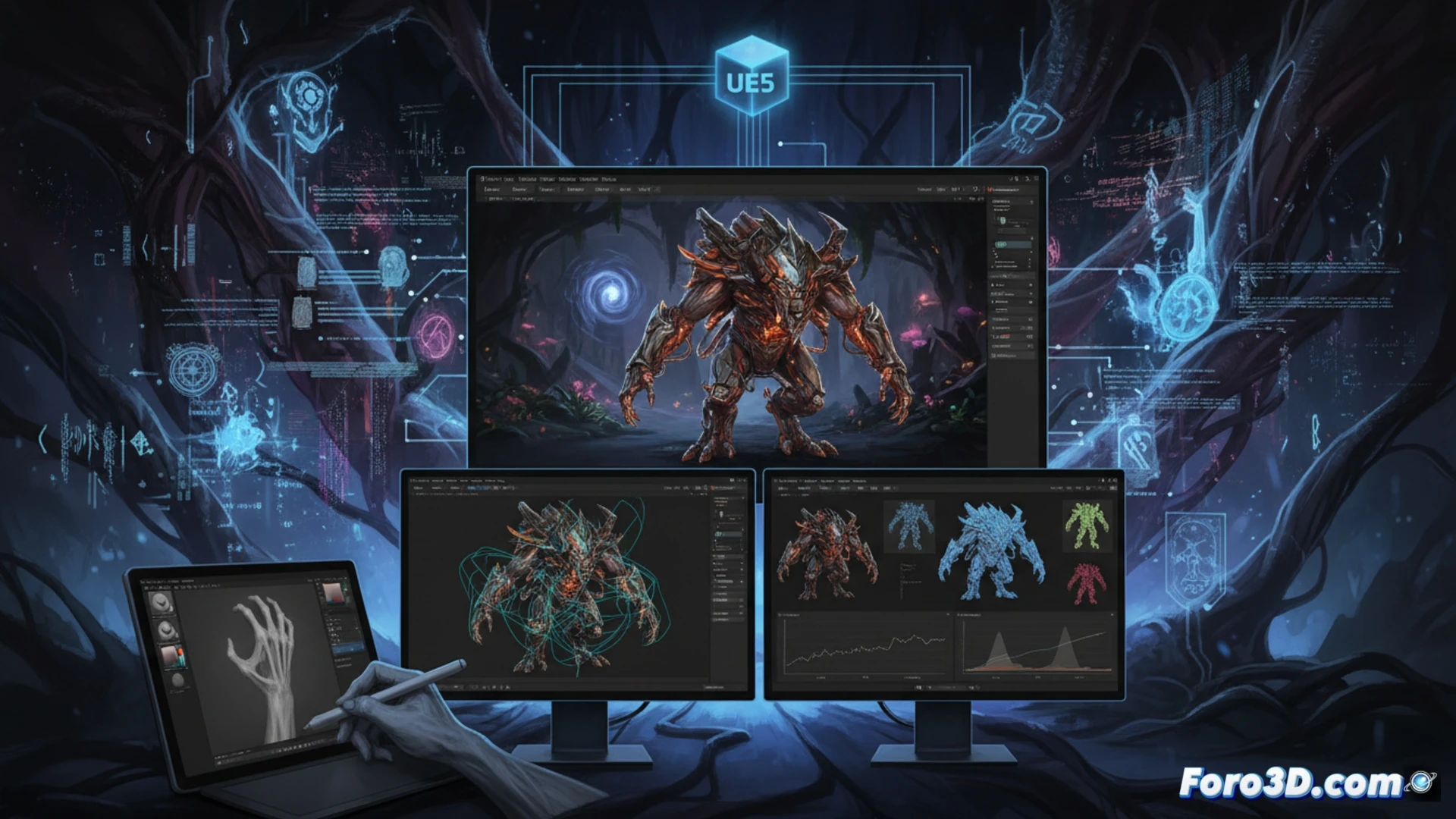
The design of the creatures in Hell Is Us relies on a non-destructive pipeline. Artists begin by sculpting the silhouette and organic details in ZBrush, applying custom alphas to simulate textures of flesh and molten metal. Subsequently, the mesh is retopologized in Maya, where hard edges and mechanical borders characteristic of the biomechanical style are defined. The technical key lies in direct export to UE5 using the Nanite system. By not requiring normal maps for microgeometry, the team can maintain the polygon density of the original sculpt, while Maya handles the creation of deformation rigs and UVs for surface materials. Lighting relies on Lumen to bounce light off these complex surfaces, generating soft shadows that reinforce the surreal atmosphere.
The Paradox of Flesh and Steel ⚙️
The most challenging aspect of Hell Is Us is not technical, but conceptual. The team has managed to make the creatures feel not like simple monsters, but like living sculptures. This effect is achieved through master materials in UE5 that blend subsurface scattering parameters for flesh and metallic roughness for implants. The surreal aesthetic is not a visual accident, but the result of a rigorous modeling discipline that balances the geometric complexity of ZBrush with the readability of the silhouette in motion. In a market saturated with realism, the commitment to such a defined sculptural design demonstrates that solid concept art remains the main driver of graphical innovation.
How was the digital sculpting pipeline optimized for biomechanical creatures in Unreal Engine 5, maintaining the fidelity of the concept art without compromising real-time performance?
(PS: game jams are like weddings: everyone is happy, no one sleeps, and you end up crying)