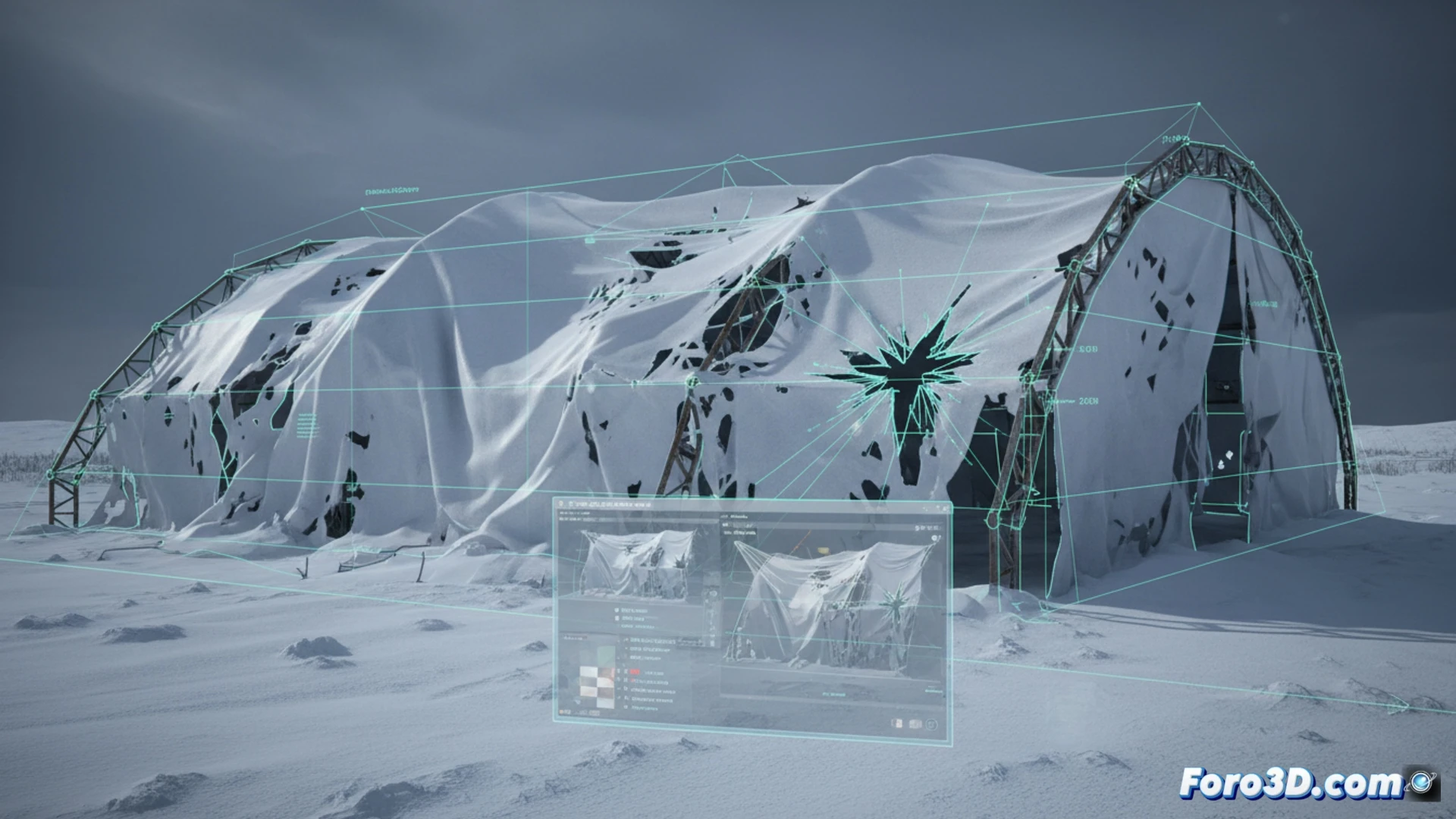
Last winter, a next-generation hangar designed for parking logistics airships suffered a catastrophic structural collapse after a heavy snowfall. Initial hypotheses pointed to a foundation failure, but a forensic engineering team decided to apply a complete 3D workflow to determine the real cause. Using RealityCapture for photogrammetry of the debris, Rhino with Grasshopper for parametric load analysis, and Marvelous Designer for textile simulation, they managed to isolate the exact point of rupture in the PTFE-coated polyester membrane.
Technical workflow: photogrammetry, parametric simulation, and textile validation 🛠️
The process began with data capture using RealityCapture, generating a precise point cloud of the collapsed membrane and the remaining metal structure. This model was imported into Rhino, where Grasshopper executed a surface analysis algorithm. Material properties were defined: tensile strength of the polyester fibers and elastic modulus of the PTFE coating. The real challenge was simulating snow accumulation. Using a parametric script, a non-uniform distributed load was applied that respected the curved geometry of the roof. The results showed a stress concentration in a specific panel. To validate this point, the deformed mesh was exported to Marvelous Designer, where the critical seam was recreated and subjected to a virtual tension test. The textile simulation confirmed that the deformation exceeded the fiber's breaking limit, initiating a progressive tear that led to the total collapse of the hangar.
Reflection on parametric design in tensioned structures 💡
This case demonstrates that 3D simulation is not only useful for designing but also for understanding failure. The membrane did not fail due to a manufacturing defect, but rather due to an underestimation of the snow load in the folds of the geometry. The forensic analysis revealed that the load distribution was not uniform, something a traditional civil engineering calculation would not have detected. The combination of Grasshopper for parametric analysis and Marvelous Designer for textile simulation allowed the critical variable to be isolated. For the Foro3D community, this case is a reminder that precision in simulating flexible materials is as vital as the rigidity of steel.
Which design parameters of the tensioned membrane should be critically reviewed to predict collapse due to asymmetric snow accumulation, considering the interaction between the textile's stiffness and the hangar's geometry?
(PS: Simulating a collapse is easy. The hard part is keeping the program from crashing.)