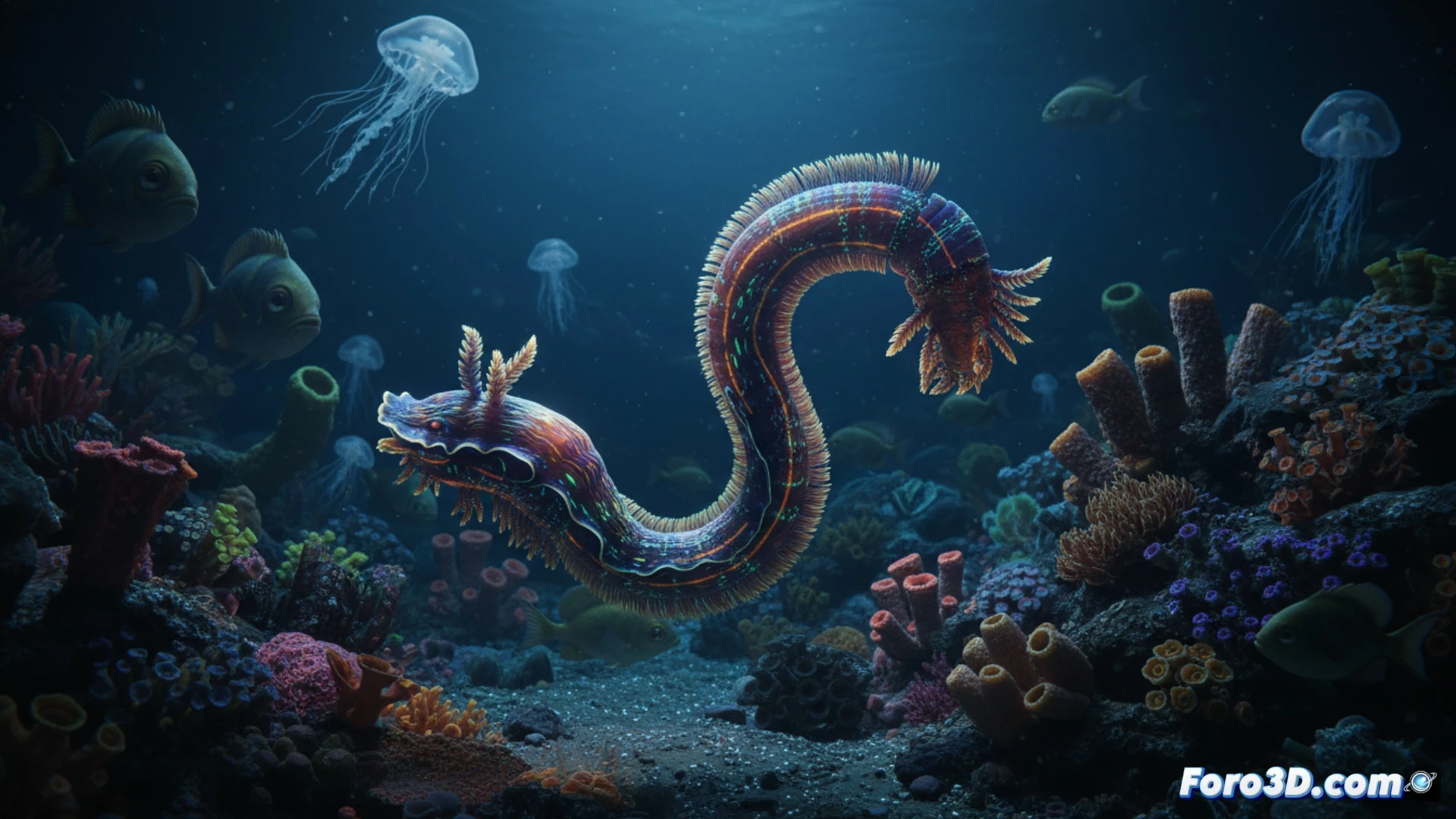
The discovery of Cryptochaetosyllis imitatio, a marine worm that mimics the appearance and movement of other species to avoid being eaten, opens a fascinating door for scientific visualization. This organism, found in the depths of the Sea of Japan, is not only a biological finding but also a technical challenge to recreate its dynamic camouflage strategy and interaction with the ecosystem in 3D.
Animation of mimicry: From biology to the render engine 🐛
To faithfully represent Cryptochaetosyllis imitatio, the modeling must capture two states: its real form, a segmented polychaete with undulating parapodia, and its imitated form, which replicates the silhouette and movement of toxic organisms or those with erratic motions. The technical key lies in bone animation (rigging) with sinusoidal undulation controllers and a particle system to simulate the sediment it stirs up while swimming. Volumetric lighting is crucial to recreate the dimness of the seabed, where sunlight barely penetrates and visual contrast is minimal, making the mimetic deception effective. A translucency shader on the worm's epidermis allows predators to perceive the wrong silhouette.
Ecosystem simulation: The context of deception 🌊
Scientific visualization is not complete without the habitat. The simulation of the Sea of Japan ecosystem must include cold currents, bathyal mud bottoms, and model species that the worm mimics, such as certain nudibranchs or anemones. By rendering the scene from the perspective of a visual predator (a fish or crustacean), we can analyze how the blinking frequency of bioluminescent lights and the worm's movement speed confuse the attacker. This approach not only disseminates the discovery but also allows biologists to test hypotheses about the effectiveness of mimicry in a controlled virtual environment, adjusting variables such as water turbidity or the predator's reaction distance.
As a 3D modeler, what is the greatest technical challenge in recreating the biomechanics of the mimetic movement of Cryptochaetosyllis imitatio to credibly simulate the visual deception of other species in a scientific visualization environment?
(PS: Modeling manta rays is easy; the hard part is making them not look like floating plastic bags)