In 2024, the Nazca Ridge revealed a deep-sea inhabitant that seems to come from a myth: the polychaete Peinaleopolynoe sp., nicknamed the Dragon Scale Worm. Its thick, overlapping scales with an iridescent metallic sheen represent both a challenge and a unique opportunity for scientific visualization. This article explores how photorealistic 3D modeling allows for analyzing its morphology and simulating its extreme environment.
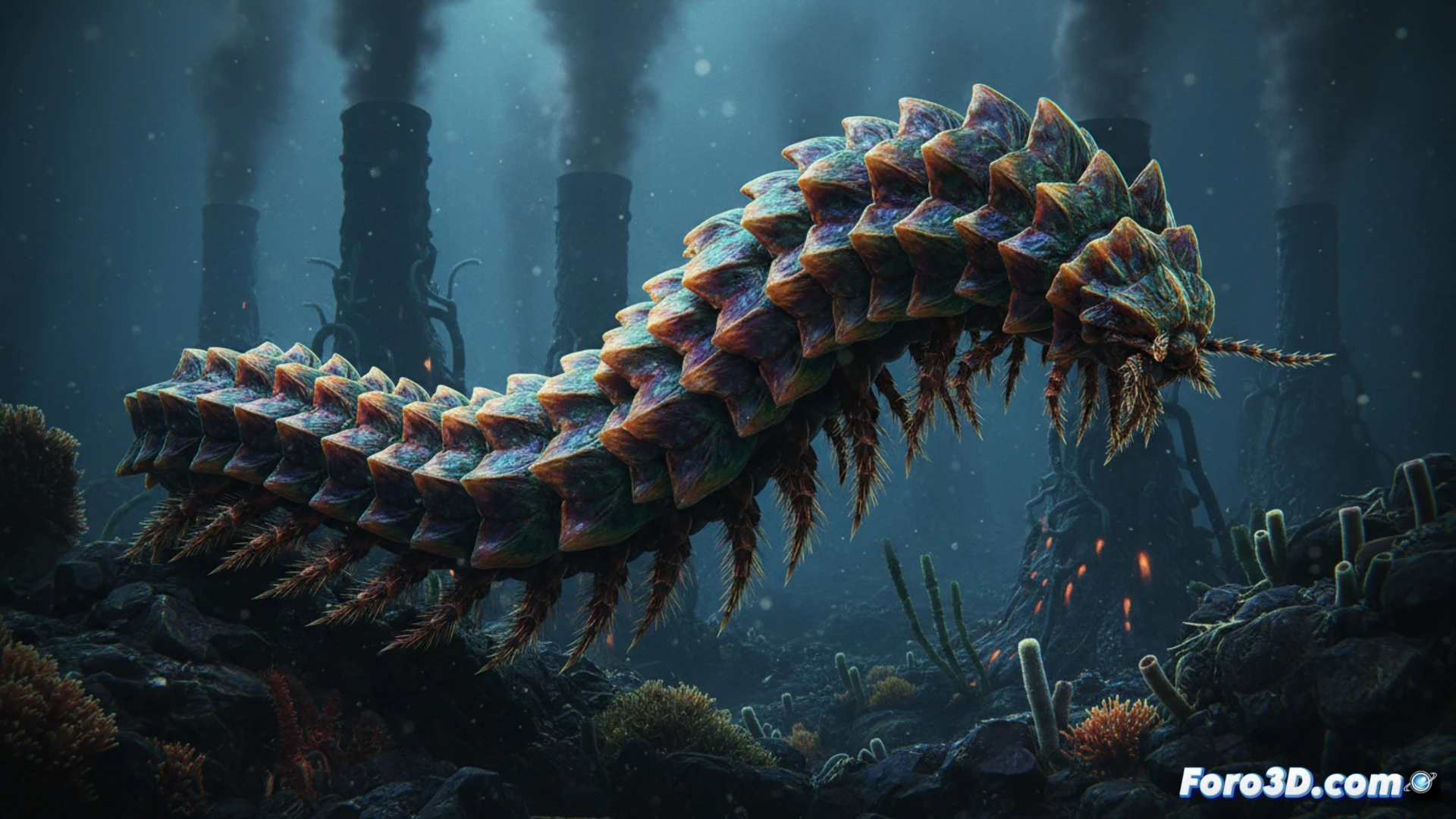
Photorealistic reconstruction and simulation of the extreme habitat 🌊
The key to the 3D model lies in the accurate representation of the scales. Each one must be modeled with variable thickness and an imbricated arrangement, similar to roof tiles. To capture the metallic sheen, shading based on layers of specular reflection and subsurface scattering is required, emulating the animal's modified chitin. The morphological animation should show the undulating movement of the body and how the scales flex and separate slightly. The habitat simulation includes a background of hydrothermal vents with sulfide particles and dynamic lighting that reproduces the flashes of filtered light from the abyssal surface. This reconstruction is vital for researchers who cannot access the physical specimen and for the general public seeking to understand life on oceanic ridges.
Beyond the myth: the power of comparative scale 🐉
An isolated model does not tell the whole story. The true power of 3D visualization in this case is the direct comparison with other polychaetes, such as the fireworm (Hermodice carunculata) or the giant tube worm (Riftia pachyptila). By placing the reconstructions of these species side by side, with interactive camera control, the evolutionary differences in scale structure and adaptation to the environment are illuminated. The Dragon Scale Worm, with its metallic armor, ceases to be a rarity and becomes an understandable link within the incredible diversity of marine annelids.
As a 3D modeler specialized in scientific visualization, what digital sculpting techniques and translucent material simulation do you recommend to accurately recreate the iridescent scales and bioluminescence of the polychaete Peinaleopolynoe sp, considering the challenges of representing its texture in a high-pressure underwater lighting environment?
(PS: fluid physics for simulating the ocean is like the sea: unpredictable and you always run out of RAM)