Exploring the ocean depths reveals creatures that challenge our understanding of biology. Among them, the Galápagos tubeworm (Lamelibrachia sp.) stands out not only for its size, which can exceed three meters, but for its astonishing longevity, potentially reaching 250 years. For an expert scientific visualization writer, this species represents a fascinating technical challenge: capturing in a photorealistic 3D model an organism whose metabolism depends on chemosynthesis in an extreme hydrothermal vent environment. 🌊
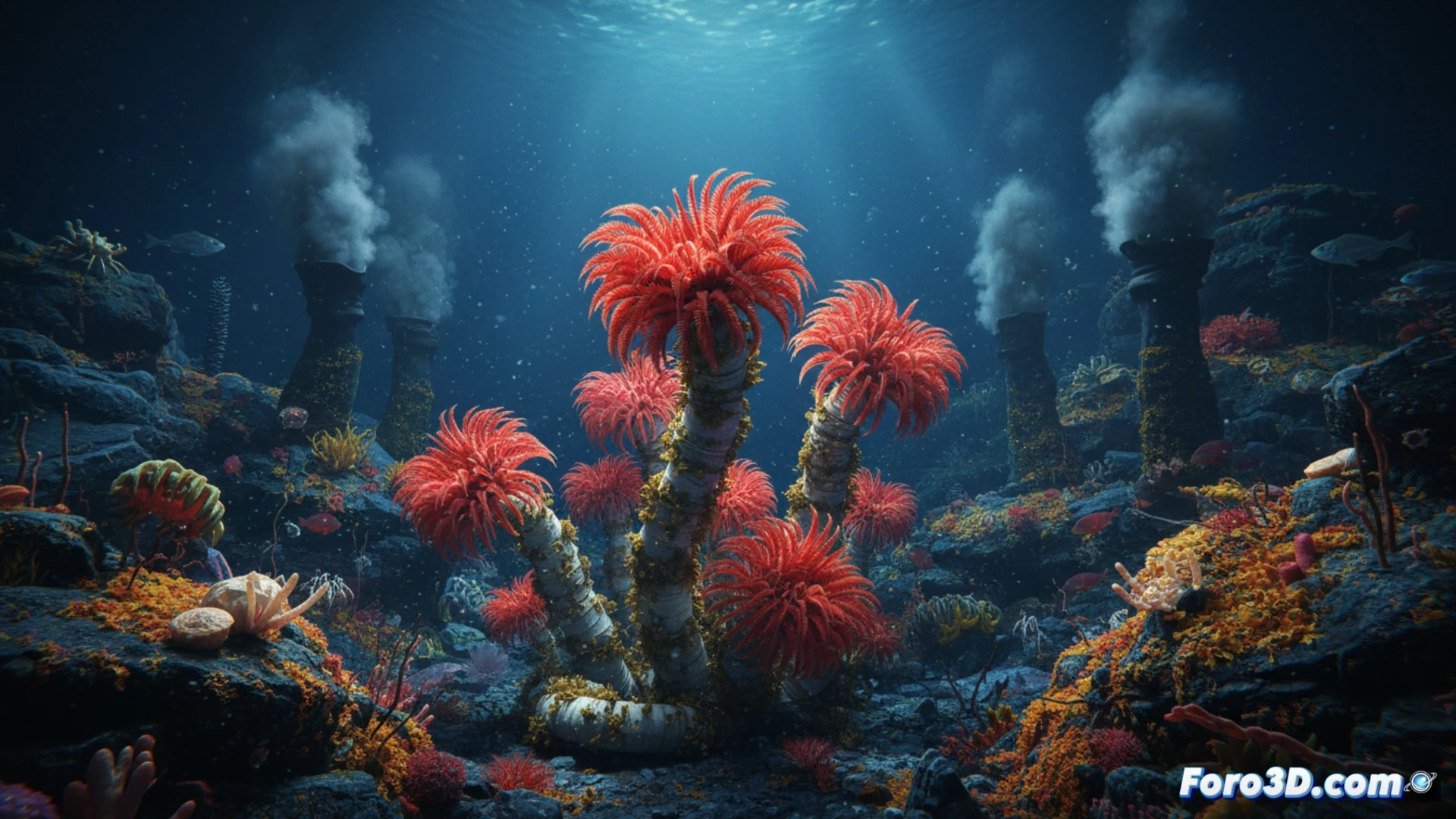
Model Construction: Anatomy and Ecosystem in Unreal Engine 5 🎮
The technical approach for this project focuses on two critical components. First, the representation of the protective tube, which must simulate the chitinous texture and iron sulfide encrustations typical of vents. Second, the branchial plume, a highly vascularized scarlet organ that acts as a chemical exchanger. Using particle systems and node-based shaders, we can simulate the absorption of hydrogen sulfide and its conversion into energy. The animation should show the slow swaying of the plume in thermal currents, while an overlaid data interface (HUD) explains the metabolic process, ideal for an interactive documentary in a virtual museum.
Extreme Longevity: A Narrative Challenge for Science Communication ⏳
Beyond modeling, the true scientific value of this visualization lies in conveying the concept of time. A worm that lives for centuries requires a visual narrative that compresses its life cycle into seconds. We can implement an animated timeline showing the incremental growth of the tube, the accumulation of bacterial biofilm on its surface, and the stability of the surrounding ecosystem. This approach not only educates about the biology of Lamelibrachia sp., but also invites reflection on the resilience of life in seemingly inhospitable conditions, a perfect message for educational virtual reality applications.
What specific technical challenges arise when 3D modeling the structure of the protein tube and gills of the Galápagos tubeworm to accurately reflect its adaptation to chemosynthesis in hydrothermal environments?
(PS: at Foro3D we know that even manta rays have better social connections than our polygons)