The discovery of the Nazca Fireworm (Amphinome sp.) at a depth of 2,000 meters in the South Pacific presents a unique challenge for scientific visualization. This polychaete, endowed with bright white bristles and bioluminescence not yet documented, inhabits fragile deep-sea coral forests. For the 3D modeling community, this species represents a perfect case study for anatomical reconstruction from sonar data and ROV samples, allowing observation of its segmented morphology and interaction with the ecosystem without needing to extract it from its habitat.
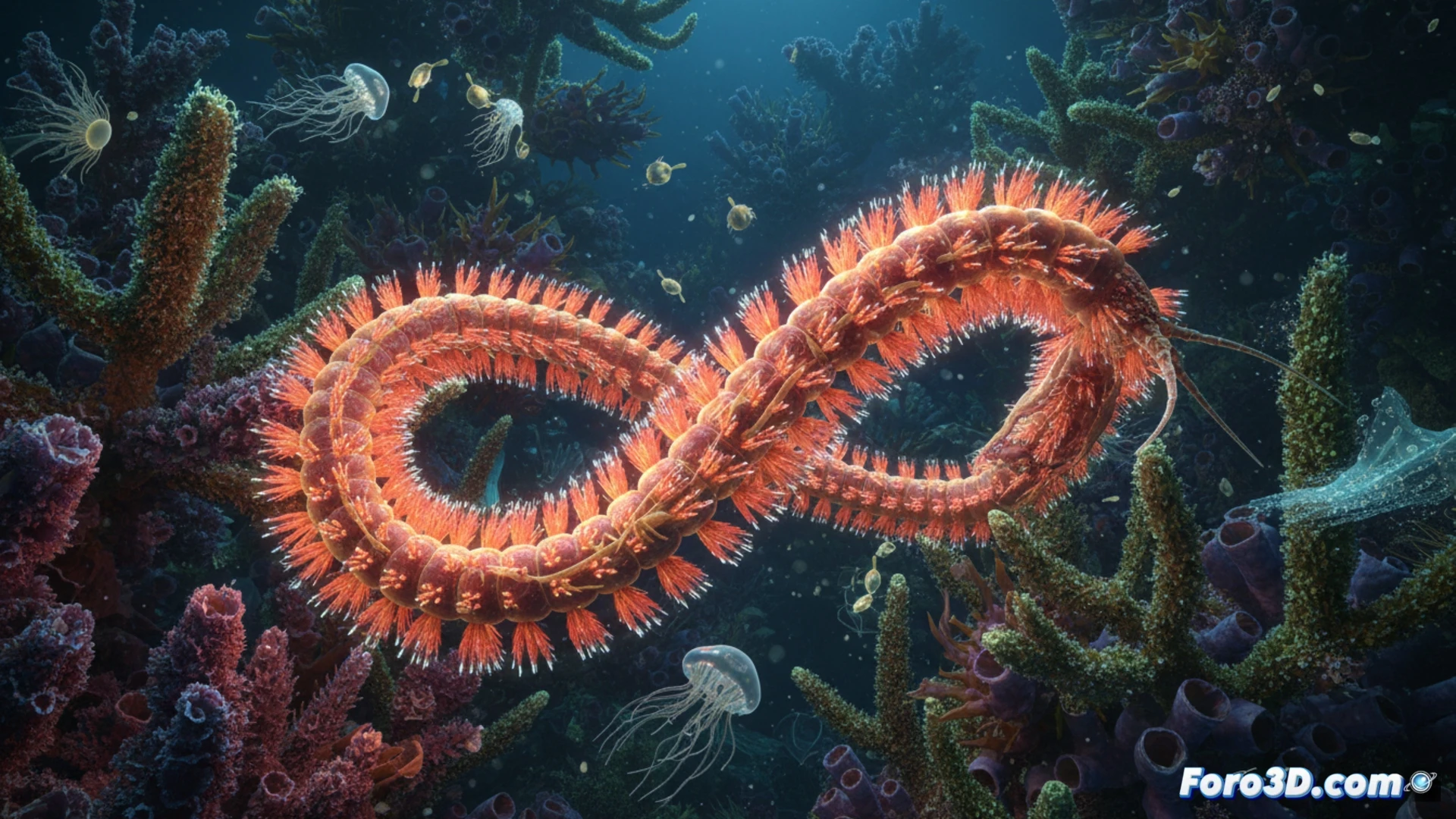
Anatomical reconstruction and simulation of bioluminescent bristles 🐛
The technical key to modeling this species lies in the representation of its bright white bristles, known as notopodia. In 3D modeling, these structures can be simulated using particle systems with subsurface scattering (SSS) properties, replicating the optical effect produced in the abyssal darkness. Unlike other polychaete species such as the bearded fireworm (Hermodice carunculata), which has opaque calcareous bristles, the Amphinome sp. requires textures with high diffuse reflectance. The use of computed tomography (CT) data from fixed specimens allows generating a precise base mesh, while the integration of displacement maps details the cuticle and chaetal patterns that distinguish it as a new species.
Virtual conservation of deep ecosystems 🌊
Beyond aesthetics, 3D modeling of this fireworm has critical applications in marine biology and conservation. By generating digital twins of the coral forests it inhabits, researchers can simulate the impact of deep-sea mining or climate change on this species. Visualization allows comparing its life cycle with that of other polychaetes from the Nazca Ridge, facilitating the identification of ecological vulnerabilities. For the science communicator, rendering these creatures in high definition not only educates the public but also creates an immortal digital record of a species that could become extinct before being fully understood.
What volumetric lighting and bioluminescence simulation techniques do you recommend to faithfully recreate the abyssal environment and the glassy appearance of the Nazca Fireworm in a 3D model intended for scientific visualization?
(PS: fluid physics to simulate the ocean is like the sea: unpredictable and you always run out of RAM)