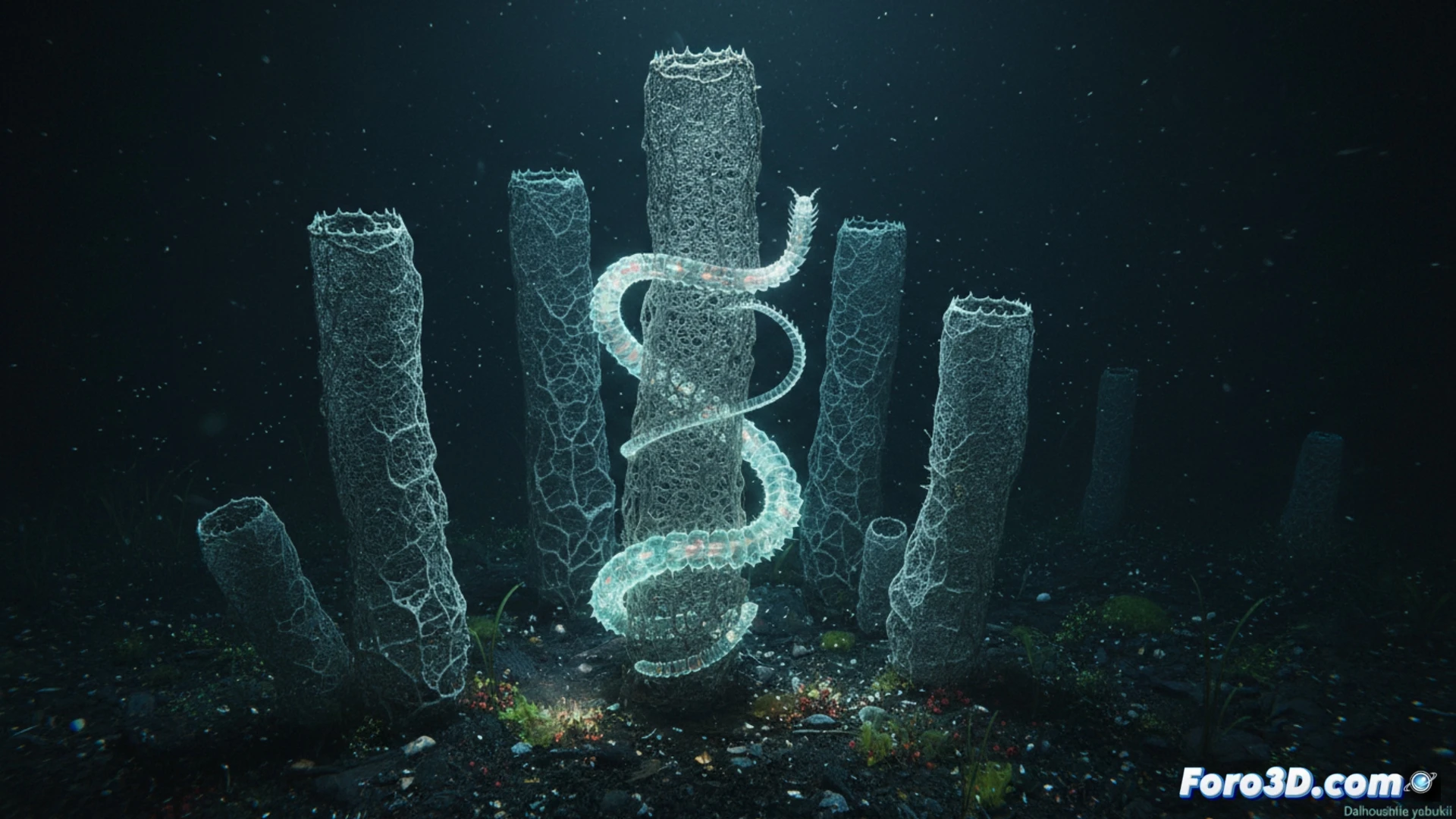
The discovery of the polychaete Dalhousiella yabukii, a resident of glass sponges at 791 meters depth off the coast of Japan, opens a fascinating door for scientific visualization. This worm, which lives inside the delicate silica skeletons of hexactinellid sponges, represents a unique challenge and opportunity for 3D modeling. Recreating this symbiosis not only involves sculpting the anatomy of two extraordinary organisms but also simulating the extreme conditions of pressure, darkness, and chemosynthesis of their abyssal habitat.
Digital Anatomy and Symbiosis Simulation 🐍
For accurate modeling, one must begin with the architecture of the glass sponge, composed of interwoven silica spicules forming a three-dimensional lattice. The technical challenge lies in generating this structure using particle systems or procedural geometry, avoiding making the model computationally heavy. The worm, for its part, requires advanced rigging to animate its serpentine movement within the narrow channels of the sponge. It is recommended to create semi-transparent cross-sections that show the spatial relationship between the polychaete and its host, illuminating the scene with a dim, bluish ambient light, simulating the bioluminescent light of the deep seafloor. The use of subsurface scattering shaders for the worm's body and refraction shaders for the glassy structure of the sponge is crucial for achieving scientific realism.
Beyond the Model: The Value of Outreach 🔬
This visualization project transcends mere aesthetics. By modeling the interaction between Dalhousiella yabukii and the glass sponge, an interactive tool is offered to biologists and educators to explain complex concepts such as symbiosis in aphotic zones. An animated model, showing the worm emerging or retracting within its glass fortress, could be the centerpiece of a documentary or a natural history museum installation. The precision in representing the spicules and the texture of the polychaete not only satisfies public curiosity but also serves as a reference for future taxonomic research.
As a 3D modeler, when facing the reconstruction of an abyssal symbiosis like that of the glass worm, what was the greatest technical challenge in translating the transparency and optical properties of the glass sponge and the bioluminescent tissue of the polychaete into a scientifically accurate and visually striking render?
(PS: if your manta ray animation doesn't excite, you can always add some documentary music from channel 2)