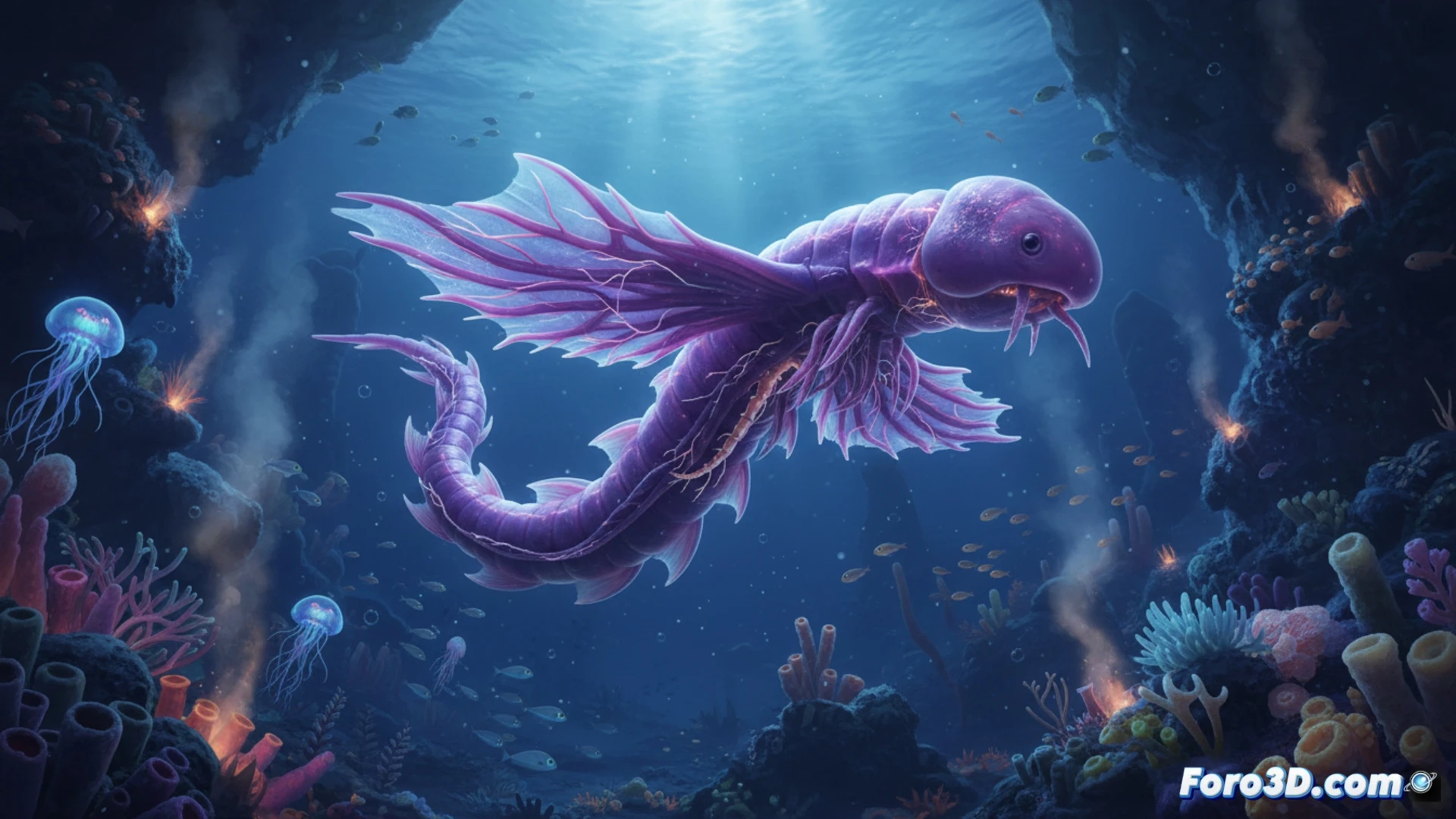
The Glandiceps sp., known as the purple acorn worm, has been captured in the depths of the Bounty Trough displaying a unique behavior: it uses lateral body flaps to move across the seafloor in a motion that evokes a slow, controlled flight. For scientific visualization, this hemichordate represents a fascinating challenge, as its translucent anatomy and intense violet color require advanced rendering techniques to preserve biological details without losing the fidelity of the bathyal ecosystem.
Anatomical Modeling and Simulation of Flap Propulsion 🌊
The development of a 3D model of Glandiceps sp. must prioritize the representation of its acorn-shaped proboscis and the lateral expansions of the collar, which act as hydrodynamic wings. To simulate its movement, it is recommended to use particle systems and smoothed-particle hydrodynamics (SPH) that reproduce the water flow around the flaps. The animation should show an asymmetric undulation cycle: the flaps rise slowly while the body remains rigid, followed by a rapid downward beat that generates propulsion. The Bounty Trough floor, with biogenic sediments and cold-water corals, can be modeled using procedural textures to maintain optimal real-time performance.
Visualization as a Bridge Between Science and Conservation 🔬
Digitally representing this hemichordate not only satisfies taxonomic curiosity but also allows marine biologists to study its biomechanics without interfering with its habitat at depths of over 4,000 meters. By sharing these models in virtual reality environments or open repositories, access to data from expeditions like the Bounty Trough is democratized, fostering a culture of conservation based on the visual understanding of species we rarely see. The purple of its integument ceases to be just a color and becomes an indicator of ecological health.
How did you model the biomechanics of the purple acorn worm's underwater flight in 3D to accurately represent its undulating motion and interactions with water in a scientific visualization environment?
(PS: fluid physics for simulating the ocean is like the sea: unpredictable and you always run out of RAM)