A tour guide no longer depends solely on their voice and a laser pointer. 3D technology makes it possible to recreate ruins, vanished buildings, or historical scenes directly onto the real landscape. For example, when visiting a ruined Roman forum, the guide can show on a tablet or AR glasses what the place looked like in its heyday, with columns, statues, and virtual citizens. This transforms an abstract explanation into a concrete visual experience.
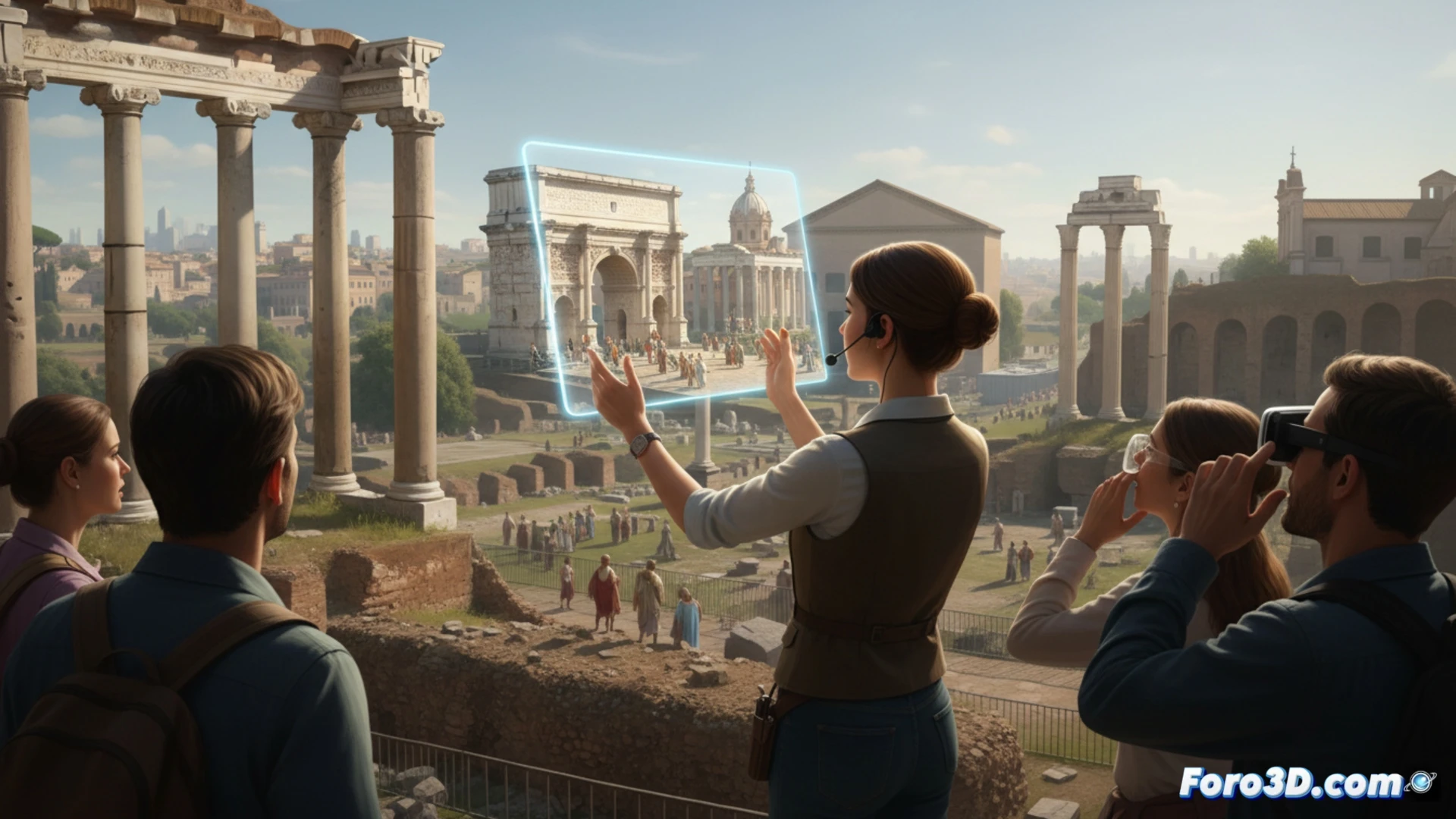
The basic equipment for a guide with digital superpowers 🛠️
This requires a 3D scanner like the LiDAR on an iPad Pro or a camera with photogrammetry (e.g., RealityCapture or Meshroom) to capture the current location. Then, modeling software like Blender (free) or SketchUp allows for reconstructing the historical structure. Visualization is done with real-time engines like Unity or Unreal Engine, or directly with augmented reality applications like ARKit (iOS) or ARCore (Android). The result: the guide overlays the 3D reconstruction onto the real ruin.
The guide who now competes with a hologram 🤖
The point is that the guide can no longer rest on their laurels of a bad joke about Caesar. Now, while pointing at a stone, a tourist asks them: and where is the 3D model of the statue. Or worse, the client puts on the AR glasses and starts ignoring them to look at a virtual gladiator. The guide will have to try twice as hard: be charismatic and, on top of that, a tech support agent. At least, if the battery dies, they can always blame the Roman Empire.