Eikichi Onizuka, the former delinquent who revolutionized teaching with wild methods, is a technical challenge for any 3D animator. His face transitions in seconds from stoic calm to grotesque, contorted expressions. Capturing this duality in a three-dimensional model requires an in-depth study of blendshapes and facial rigging systems that allow smooth transitions between dramatic realism and exaggerated comedy, emulating the dynamic style of Tohru Fujisawa.
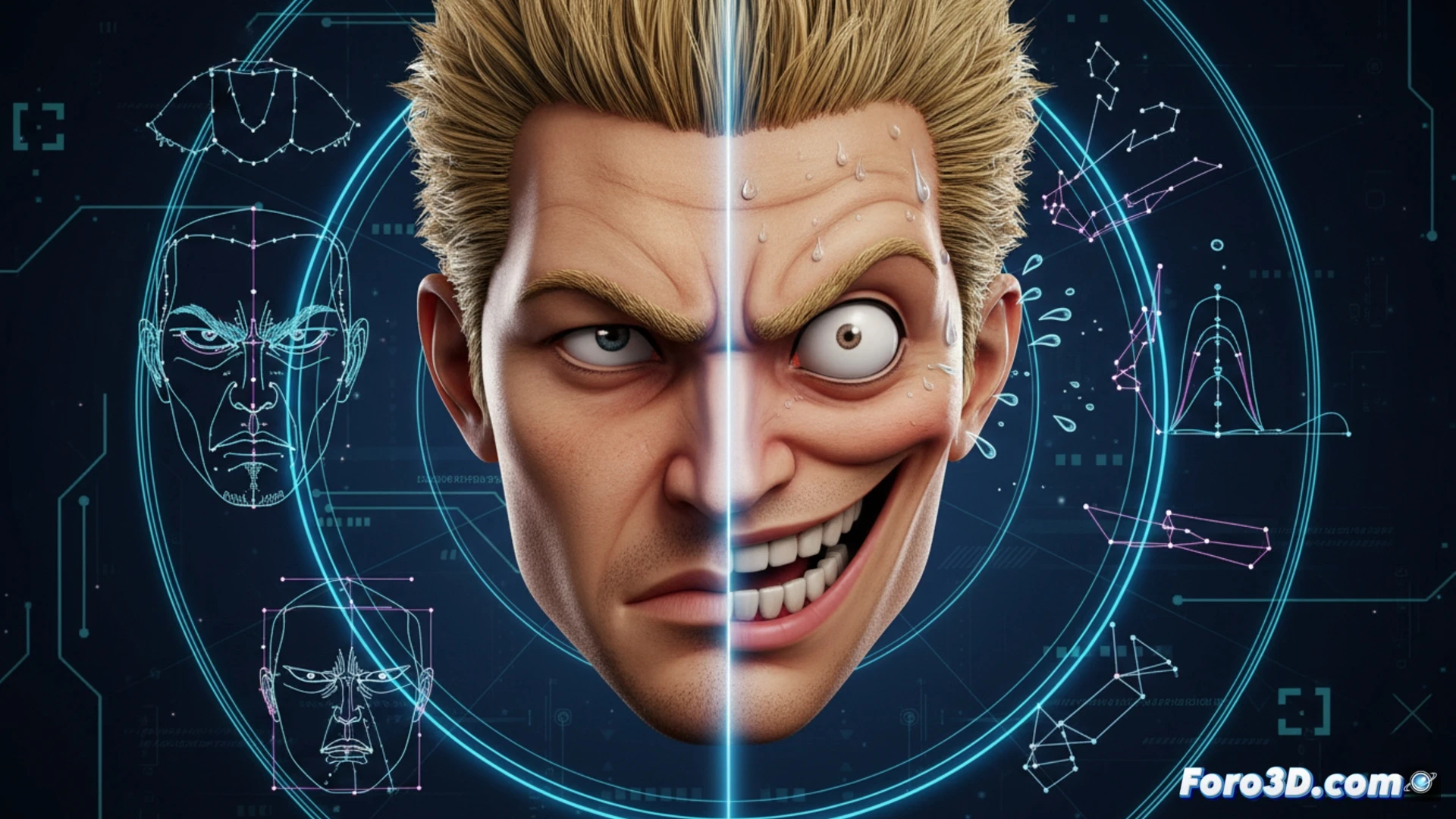
FACIAL RIGGING AND BLENDSHAPES FOR THE ICONIC GRIMACE 🎭
To recreate Onizuka's facial elasticity, the rigging must prioritize non-linear deformation. It is advisable to build a base of 40 to 50 key blendshapes, including extreme forms like the predator smile, the threatening frown, and the wide-eyed look of surprise. The technical key lies in the transition controllers: an interpolation system with smooth curves that allows blending a realistic state with a comedic one without artifacts. For example, when transitioning from his serious teacher gaze to his mocking laugh, the system should progressively activate the cheek and lower jaw blendshapes, maintaining the integrity of the cheekbones. Reference can be taken from the adaptation work of anime to 3D in titles like Kill la Kill IF, where a balance was achieved between exaggerated expressiveness and base anatomy, although Onizuka demands an even greater range of deformation, especially in the mouth and eyebrows.
THE CHALLENGE OF EMOTIONAL CONTRAST IN 3D ANIMATION ⚡
GTO's greatest strength is its abrupt change in tone, and in 3D this translates into rigging that does not penalize speed. To emulate the transition from a dramatic scene to a visual gag, it is vital to implement a system of saved poses or high-priority shape keys. The animator must be able to trigger Onizuka's grotesque pose (with tongue out and eyes rolled back) in a single keyframe, and then return to the neutral pose with an almost instantaneous ease-out. This requires facial rigging with independent controllers for each eye and jaw, and a bone hierarchy that allows extreme deformation without breaking the model's topology. Onizuka's expressiveness is not just technical; it is the soul of his character.
How can Onizuka's explosive personality and characteristic micro-expressions, such as his sly smile or furrowed brow, be effectively translated into 3D animation without losing naturalness in transitions?
(PS: Animating characters is easy: you just have to move 10,000 controls to make them blink.)