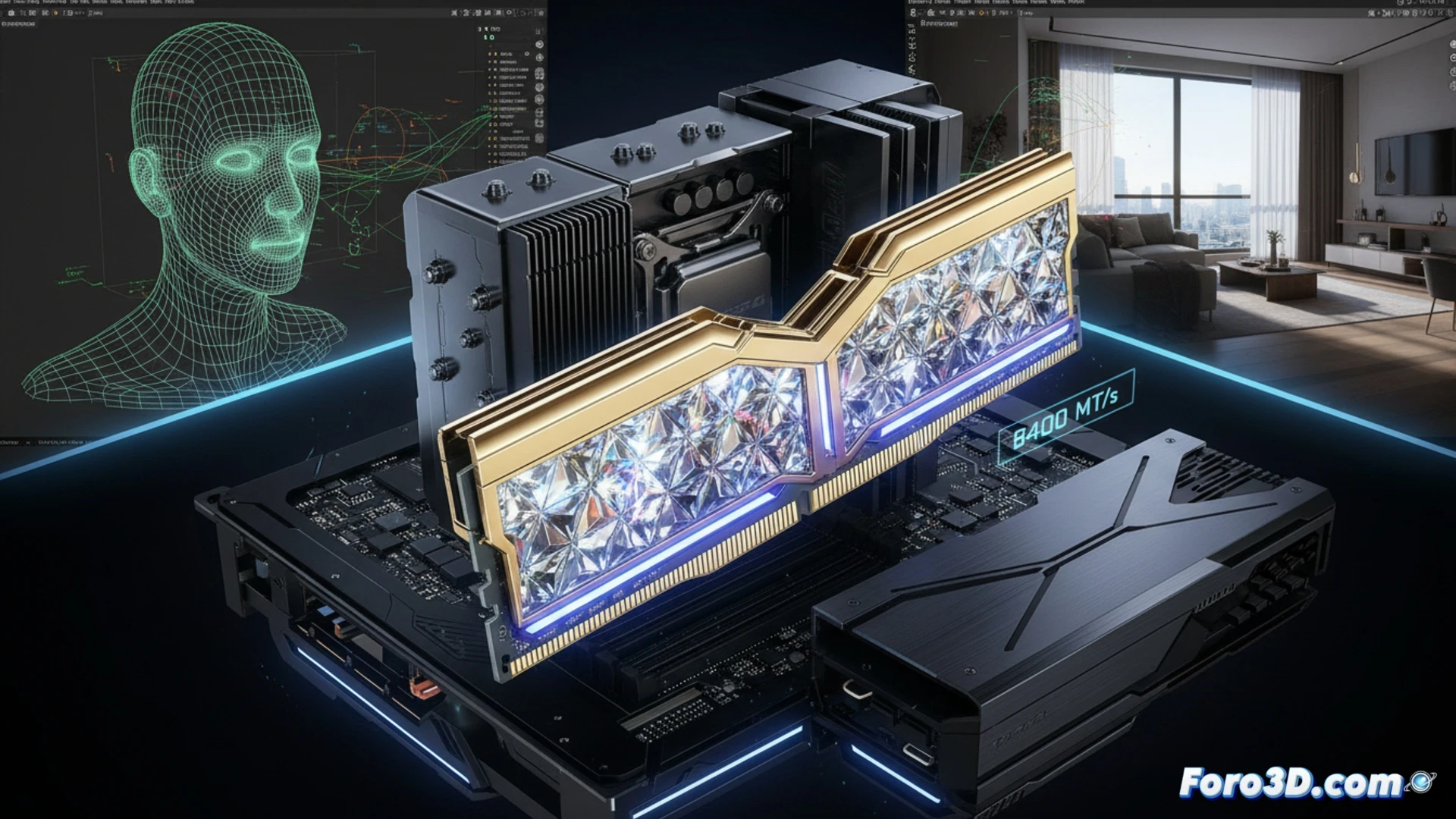
The G.Skill Trident Z5 Royal RAM arrives on DDR5, maintaining its characteristic crystalline light bar and gold or silver finishes. However, beyond its luxurious aesthetics, this module promises speeds of up to 8400 MT/s. For a 3D professional, the question is not whether it looks good, but whether those extreme frequencies translate into a real advantage when rendering with Cycles or V-Ray, or when navigating complex viewports in Blender.
Technical Analysis: Frequency vs. Latency in Viewport and Render 🚀
In 3D workloads, RAM speed (MT/s) directly impacts viewport smoothness when handling meshes with millions of polygons. The Trident Z5 Royal at 8400 MT/s, combined with CL34 or CL36 latencies, offers higher bandwidth than standard 6000 MT/s kits. In practical tests with Blender, texture and geometry data transfer accelerates, reducing micro-stutters when rotating complex scenes. For final rendering, the impact is smaller but measurable: in V-Ray, the reduction in scene export times with many 4K textures can be up to 5-8% compared to slower memory, provided the CPU or GPU is not the main bottleneck.
Reflection: Aesthetics or Real Performance for the Studio? 💡
The Trident Z5 Royal DDR5 is undoubtedly a striking component. But for a 3D studio seeking cost-effectiveness, the investment must be justified. If you work with massive scenes and applications that saturate bandwidth (like real-time simulations or 8K video editing), this memory makes a difference. If your workflow depends more on total capacity (64GB or 128GB) than speed, a more modest kit might suffice. Ultimately, this module is a statement of intent: top-tier performance for those who want no compromises, technical or aesthetic.
It is possible that a memory kit like the G.Skill Trident Z5 Royal with speeds of 8400 MT/s offers a tangible improvement in render times or in managing complex scenes with high polygon density and textures in 3D applications like Blender or 3ds Max, or the main benefit is limited to system stability in extreme overclocking and hardware aesthetics.
(PS: Your CPU runs hotter than the Blender vs. Maya debate)