Lyten has introduced a lithium-sulfur battery that promises to revolutionize energy storage through the use of three-dimensional graphene. This breakthrough eliminates dependence on nickel and cobalt, critical and expensive materials, offering significantly higher energy density. For microfabrication specialists, the challenge lies not only in the chemistry but also in how to model and build the internal architecture of the electrode at the nanoscale.
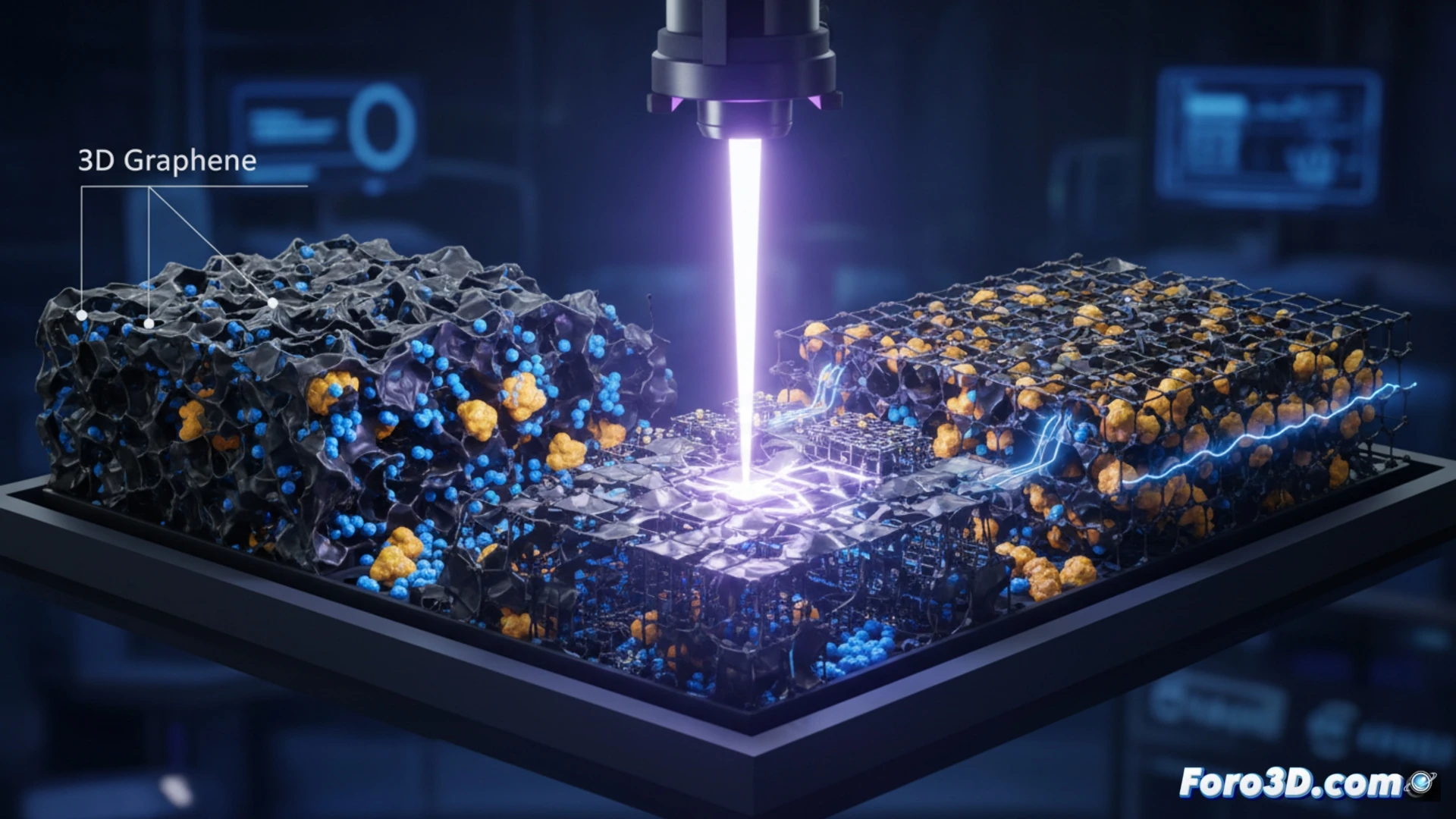
3D Modeling of the Internal Architecture of the Solid Electrolyte ⚡
The technical key lies in the structure of 3D graphene, which acts as a three-dimensional conductive skeleton. Using finite element simulation software and volumetric modeling, engineers can visualize the distribution of sulfur in the cathode and predict volumetric expansion during charge cycles. This approach allows optimizing the material's porosity, maximizing the reaction surface area and minimizing degradation. 3D simulation is essential for designing lithium ion diffusion pathways that prevent dendrite formation, a common problem in high-density batteries.
A Real Shift Towards Sustainability in Semiconductors? 🌱
The reduction of critical materials like cobalt not only lowers costs but also decouples battery production from geopolitically complex supply chains. For the microfabrication industry, this advancement implies rethinking chemical deposition processes and layer assembly. If 3D modeling can accurately predict the long-term behavior of the solid electrolyte, we will be facing a paradigm shift that will render traditional lithium-ion batteries obsolete in high-performance applications.
Considering that 3D graphene solves sulfur conductivity, how does this affect theoretical energy density and cycle life compared to current solid-state batteries?
(PS: integrated circuits are like exams: the more you look at them, the more lines you see)