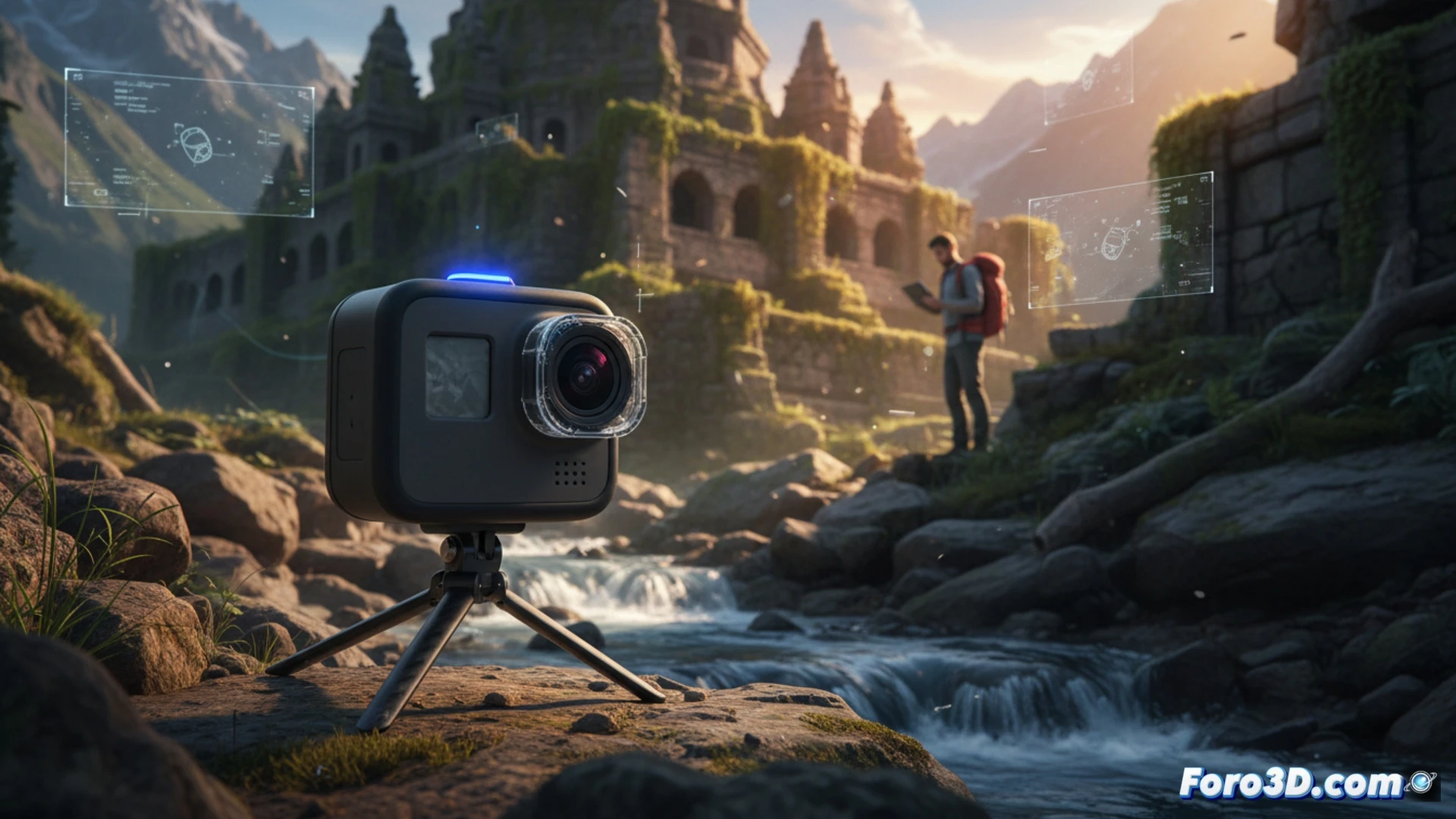
The new GoPro Hero 2024, nicknamed Tiny for its ultra-compact format, bursts into the 3D hardware market not as a conventional action camera, but as a strategic capture instrument for modeling and photogrammetry professionals. Its water-resistant body and featherweight design make it the perfect ally for fieldwork where portability is critical.
Technical performance for photogrammetry and reference workflows 🎥
The HyperSmooth engine of the GoPro Hero 2024 not only stabilizes action video; for the 3D professional, this technology drastically reduces motion blur in handheld shots, improving the quality of frames extracted for 3D reconstruction. Native 4K recording at 60fps allows capturing textures and geometries with enough detail for light scans or as visual reference in polygonal modeling. Although its sensor does not match the resolution of dedicated photogrammetry mirrorless cameras, integration with GoPro Quik facilitates clip synchronization and the export of clean image sequences, ready for import into software like RealityCapture or Meshroom. Its water resistance without a housing makes it ideal for hostile environments where a DSLR camera would be unfeasible.
Portability vs. power: the pocket scanner dilemma ⚖️
The key reflection for the 3D artist is the balance between absolute quality and accessibility. The GoPro Hero 2024 will not replace a high-end photogrammetry camera, but its tiny format allows capturing references in situations impossible for large equipment: in the rain, in tight interiors, or during extreme travel. For the industrial designer or digital archaeologist, this camera represents a leap in logistical efficiency, allowing documentation of complex geometries without sacrificing the technical backpack. It is, in essence, a stylus for the field modeler.
Considering the reduced size of the GoPro Hero 2024 Tiny, how does its thermal dissipation and battery life affect high-resolution 3D video recording during long field sessions?
(PS: Your CPU heats up more than the debate between Blender and Maya)