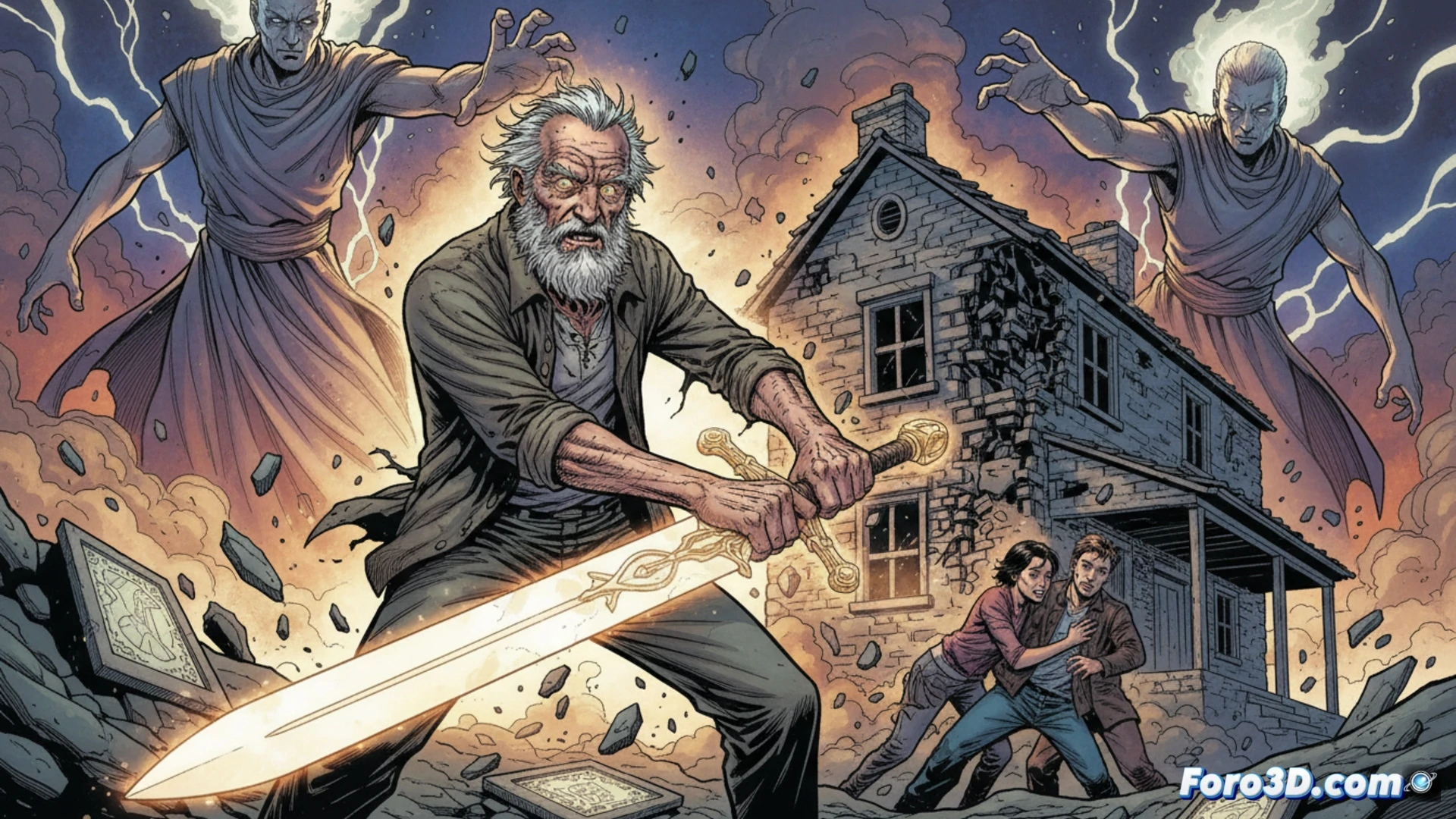
The work God Country, created by Donny Cates and Geoff Shaw, bursts onto the independent comic scene as a raw reflection on physical decay and the resilience of the human spirit. The plot follows an elderly man with Alzheimer's who regains his lucidity by wielding a magical sword, a MacGuffin of divine scale that unleashes a conflict between his family and deities eager to reclaim it. This premise, far from being a simple epic fantasy, serves as a vehicle to explore the fragility of memory and the cost of power.
Visual scale as a narrative tool in 3D modeling 🎨
Shaw uses a visual approach reminiscent of 3D rendering in his handling of scale and lighting. The deities are not simple humanoid figures; they are living architectures, with proportions that crush the frame and generate a sense of vertigo. This treatment recalls digital modeling techniques where the relative size of an object defines its narrative power. The lighting, with harsh contrasts and elongated shadows, isolates the protagonist, underscoring his solitude in the face of cosmic forces. In the realm of digital art for social causes, this technique could be applied to visually represent the crushing feeling a patient experiences with a degenerative disease, translating emotional oppression into a geometric metaphor.
Human fragility and visual activism against oblivion 🧠
The comic directly connects with digital activism by humanizing a disease often treated with cold statistics. By showing an elderly man reclaiming his agency through a fantastical object, the work suggests that identity is not entirely lost, but can be reclaimed. For a 3D content creator, this is a reminder that facial detail, the modeling of wrinkles, and a stooped posture are not aesthetic errors, but political tools. Depicting old age with dignity in a medium dominated by perfect bodies is an act of visual resistance that God Country executes masterfully.
How can the portrayal of old age and memory loss in God Country be interpreted as a critique of absolute power and a call to action within digital activism?
(PS: digital political art is like an NFT: everyone talks about it but no one really knows what it is)