In the history of anime, certain names shine less than others. Gisaburo Sugii is one of those cases. Trained at Mushi Pro alongside Osamu Tezuka, this director developed his own style where pauses and landscapes carry as much weight as the characters. His most famous work, Night on the Galactic Railroad, is a visual and philosophical experience that few forget. But he was also responsible for adapting Street Fighter II to film, proving that his artistic sensibility could be applied to any material.
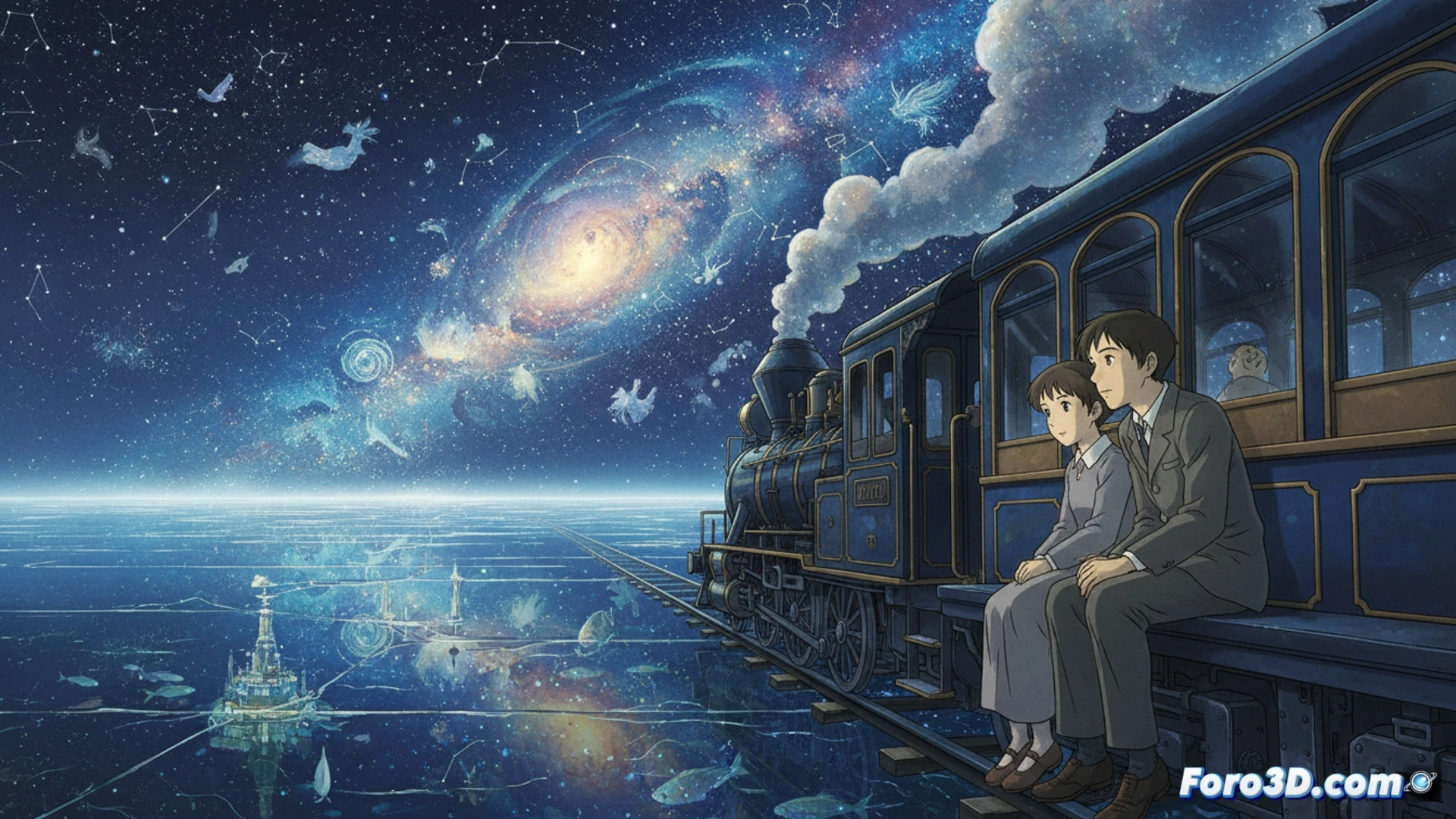
The technique of contemplative animation: cells and silences 🎨
Sugii worked in an era where animation was done by hand, with acetate cells and backgrounds painted in watercolor. His method was unusual: he devoted as much time to the backgrounds as to the characters, achieving a visual symbiosis. In Night on the Galactic Railroad, the nocturnal landscapes resemble moving paintings, with slow transitions that force the viewer to observe. This technique, which today might seem uneconomical, was his way of exploring themes like death or the passage of time. Digital animation has made the process more efficient, but few current directors understand the value of visual silence as he did.
When an anime poet had to animate Ryu and Ken 🥊
Imagine the director of a philosophical film about cats and star trains receiving the assignment to adapt Street Fighter II. The result was strangely fascinating: Sugii treated the fights with the same seriousness as an existential drama. The characters sweat, gaze at the horizon, and even have moments of introspection between flying kicks. Bison looks like a Bergman villain. The film is a rare object: a fighting movie that takes itself too seriously, but precisely for that reason has become a cult classic.