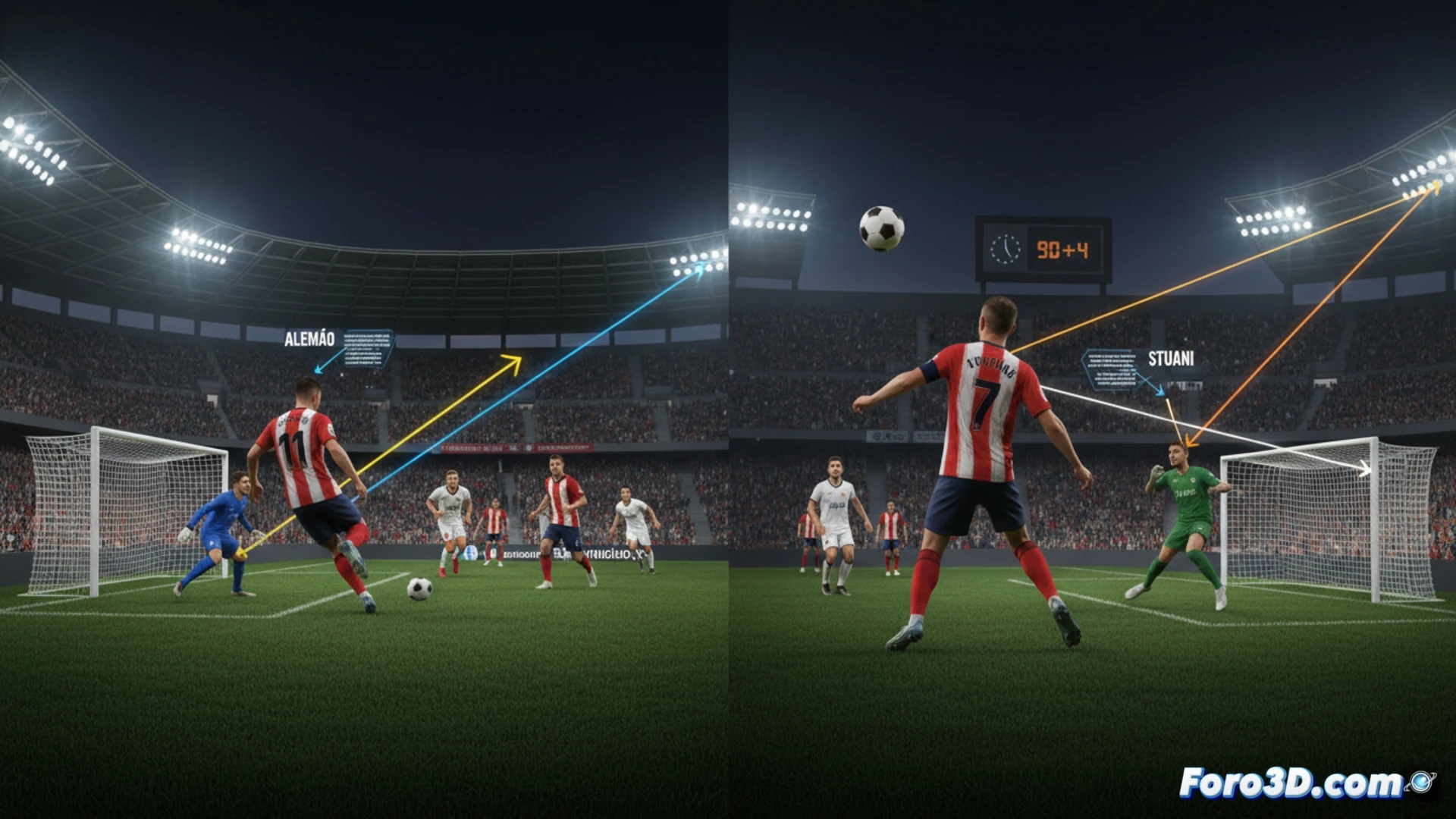
Girona snatched a point in Vallecas by drawing 1-1 in the 90+4th minute, following a match on matchday 35 of LaLiga EA Sports. Rayo Vallecano took the lead in the 86th minute with a goal from Alemao, who deflected a shot from Unai López. However, in stoppage time, Cristhian Stuani headed in a corner served by Tsygankov to level the score. We analyze both actions using three-dimensional models and tactical simulations.
Technical analysis of the trajectory and defensive positioning 🧠
In the first play, the 3D model shows Unai López receiving the ball at the edge of the area. Girona's defensive line is pushed up and lacks cohesion. The simulation reveals that López's shot, initially centered, is deflected by Alemao, who intervenes at the last moment. The trajectory model indicates that the ball changes its direction by 15 degrees, beating goalkeeper Gazzaniga. In the second action, Tsygankov's corner rises with a 45-degree profile. The 3D reconstruction of the area shows Stuani making a breaking run, getting past Mumin's marker. The jump model calculates a height of 1.85 meters, enough to connect with the ball and direct it to the far post, out of Dimitrievski's reach.
The tactical lesson of a dramatic draw ⚽
The simulation of the key plays demonstrates that Girona did not create clear chances during the first 85 minutes, but their effectiveness from set pieces was lethal. The positioning of Rayo's defenders at the corner, too close to the goal line, left spaces at the penalty spot. Stuani, with his spatial intelligence, exploited that gap. This 3D reconstruction not only explains the result but also highlights how precision in off-the-ball movements and timing in the jump are differentiating factors in LaLiga. A point that tastes like little for Rayo and a lot for the visitors.
How can the 3D reconstruction of the key plays in the draw between Girona and Rayo Vallecano improve tactical analysis and real-time refereeing decision-making?
(PS: VAR in 3D: now with replays from angles that didn't even exist)