Ghostrunner 2 is not just a festival of parkour and combat; it is a showcase of graphical engineering. The studio uses Unreal Engine 4 as its foundation, but the secret to its intricate urban landscapes lies in a synergy of tools. Houdini procedurally generates the megacities, Substance Painter applies metallic wear to every surface, and Ray Tracing brings the neon lights to life. We analyze the workflow that makes the game a visual benchmark. 🎮
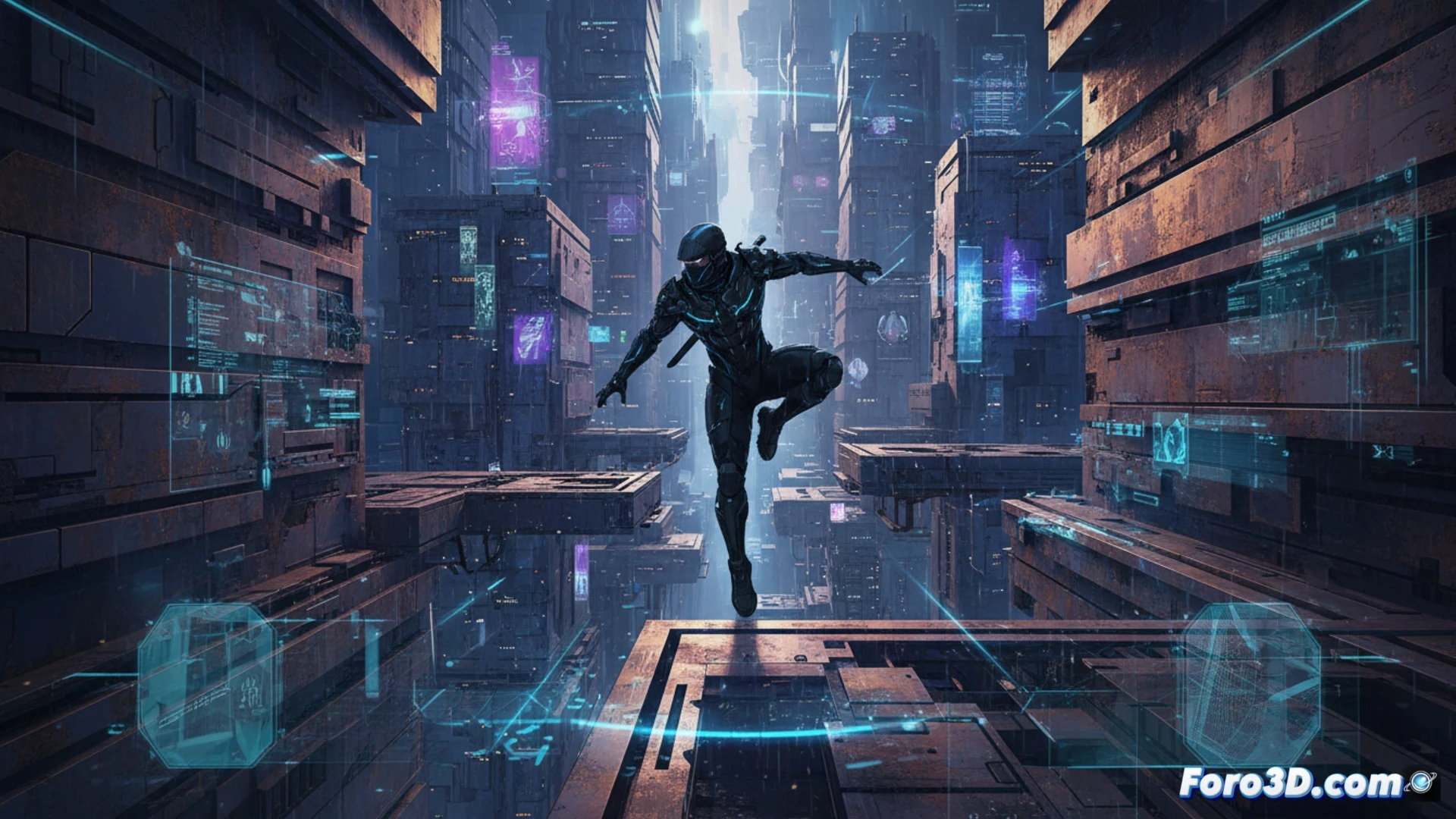
Workflow: Houdini, Substance, and Ray Tracing 🔧
The technical pipeline of Ghostrunner 2 begins in Houdini, where artists define mathematical rules to generate urban structures. Instead of modeling every pipe or walkway by hand, the software creates infinite variations of skyscrapers and alleyways. These assets move to Substance Painter, where PBR (Physically Based Rendering) textures are applied with a focus on rusty metallic surfaces and worn panels. Finally, Unreal Engine 4 processes everything with Ray Tracing enabled, calculating precise reflections in puddles of rain and sharp shadows under neon lights, achieving an immersion that traditional rasterization cannot match.
Why does this combination define the cyberpunk genre? 💡
The cyberpunk aesthetic demands visual saturation and gritty realism, a challenge that few engines manage without sacrificing performance. The key to Ghostrunner 2 is its procedural efficiency: Houdini avoids model repetition, Substance Painter unifies the metallic style, and Ray Tracing provides the layer of lighting verisimilitude. This technical trident allows every corner of the game to feel unique and tangible. For developers, it is a lesson in how to combine procedural authoring tools with commercial engines to build dense worlds without collapsing the production budget.
How does One More Level achieve the illusion of a vast procedural cyberpunk world in Unreal Engine 4 without sacrificing the precision of parkour and real-time performance?
(PS: optimizing for mobile is like trying to fit an elephant into a Mini Cooper)