In the arid desert of California, three colossal figures up to 50 meters in length lie etched into the ground. The Blythe Geoglyphs, depicting a human, an animal, and a hybrid creature, are an archaeological enigma. Without precise dating and with theories ranging from shamanic rituals to astronomical markers, their study has been limited by the fragility of the terrain and the effects of erosion.
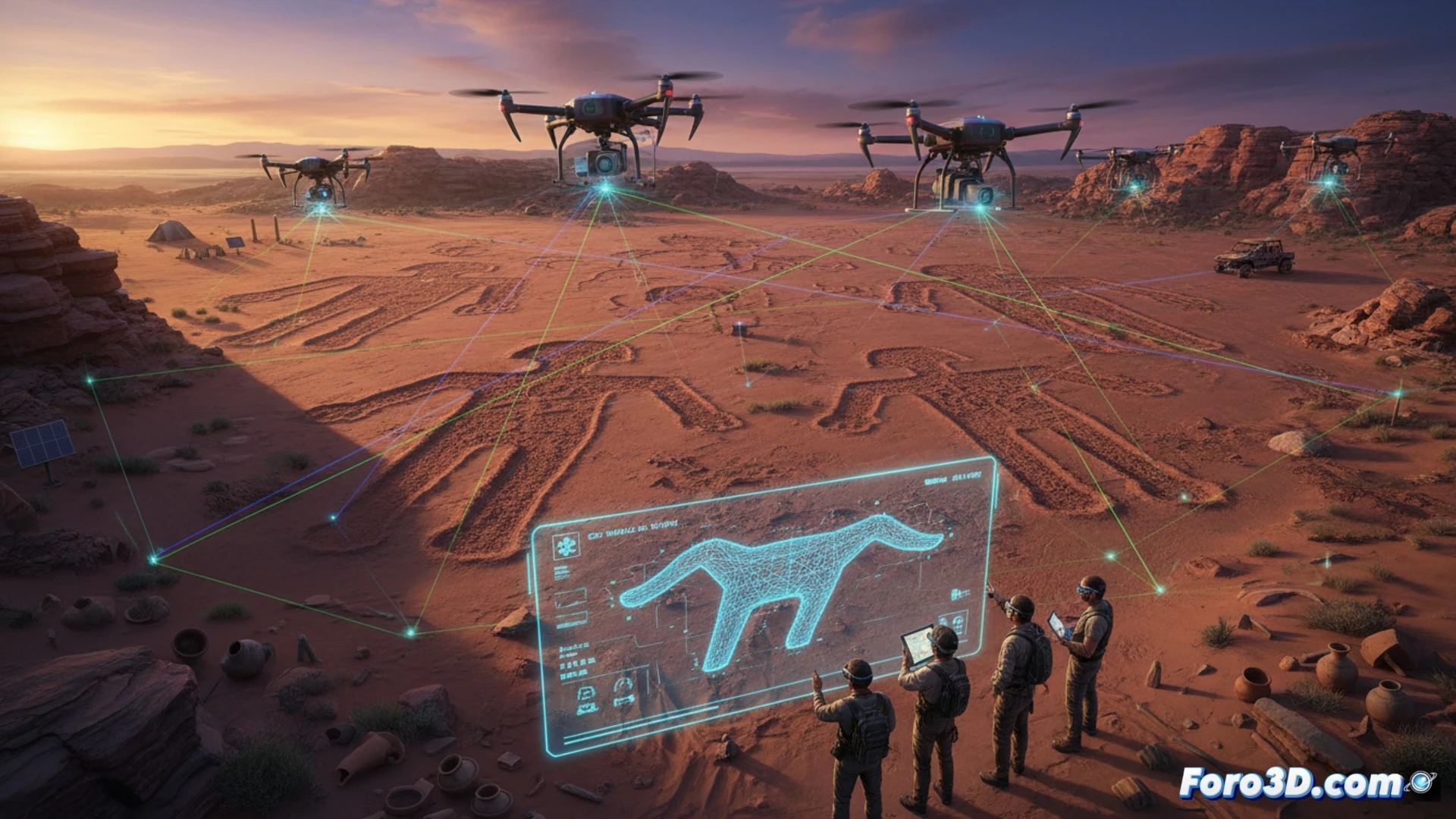
Aerial Photogrammetry and Volumetric Reconstruction of the Site 🏜️
The solution to addressing this mystery without damaging the heritage is the generation of a digital twin through drone-based photogrammetry. Flying at low altitude, hundreds of images are captured with 80% overlap, which the Structure from Motion software triangulates to create a precise point cloud. This geo-referenced 3D model allows for accurate measurement of the ground incisions, calculation of the volume of displaced material, and simulation of solar illumination at any time of year. Thus, it can be determined whether the figures align with solstices without the need for excavation, and monitor millimeter-scale deterioration caused by wind and off-road vehicle traffic.
The Digital Fingerprint as a Tool for Cultural Interpretation 🧩
Beyond metrics, the 3D model acts as a virtual laboratory for digital archaeology. By isolating terrain layers, researchers can identify overlapping construction patterns or later alterations. This technology allows native tribes and archaeologists to collaborate remotely, debating the ritual or territorial purpose of the geoglyphs without interfering with sacred ground. The digital twin not only preserves the current state of the monument but also offers a platform for formulating hypotheses about its true age and origin.
Just as LiDAR scanning and photogrammetry can reveal details of the Blythe Geoglyphs that are invisible to the naked eye and have gone unnoticed for centuries
(PS: and remember: if you can't find a bone, you can always model it yourself)