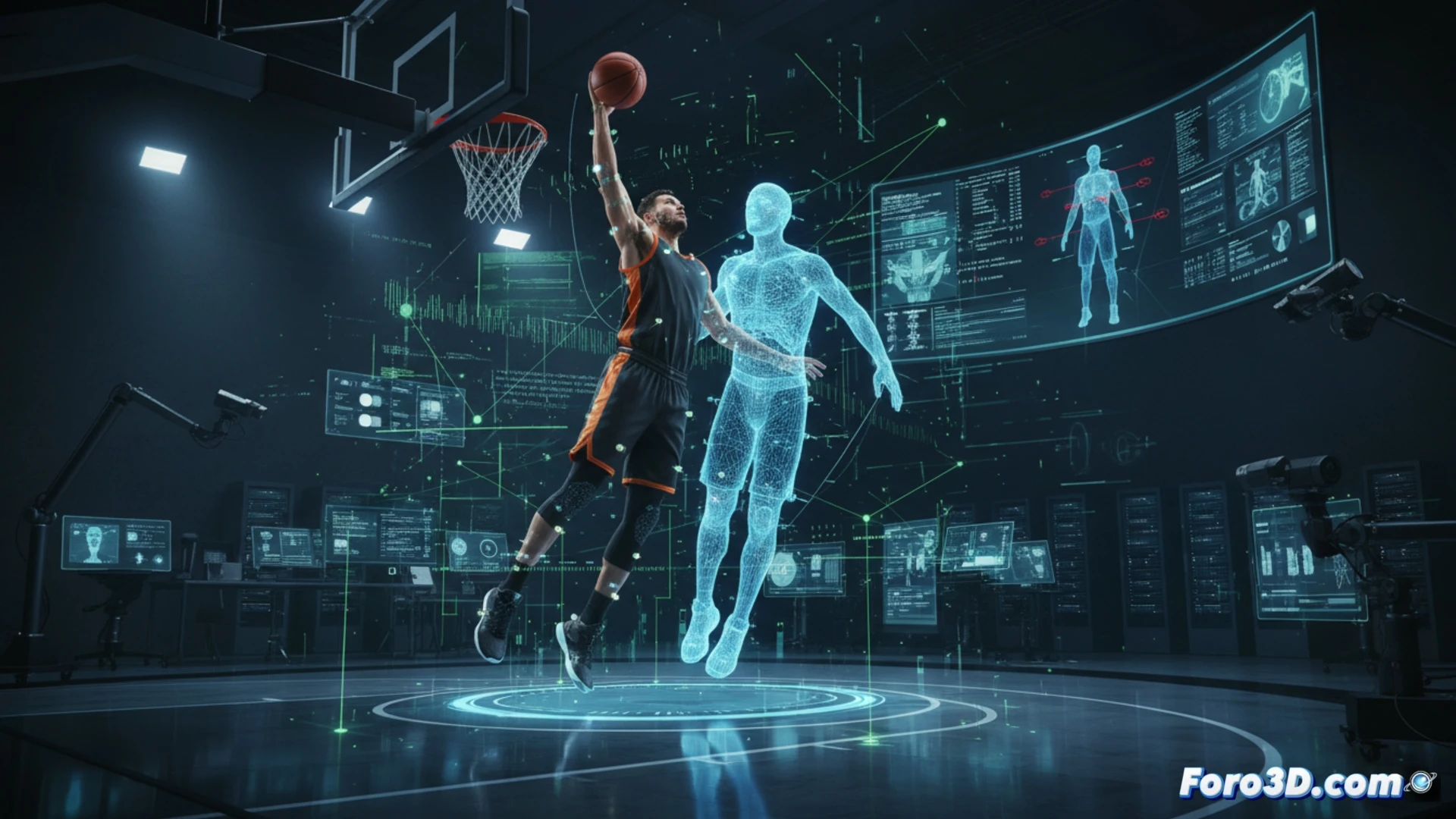
The occupational risk analysis of the professional basketball player reveals a catalog of almost mechanical injuries: ankle sprains, anterior cruciate ligament tears, patellar tendinitis, and concussions. Faced with this reality, 3D technology has ceased to be a marketing tool and has become an active prevention system. Using photogrammetry cameras and motion capture sensors, medical teams can reconstruct every jump, every step, and every turn of the athlete in a virtual environment.
Biomechanical modeling: from digital twin to preventive diagnosis 🏀
Motion capture (mocap) allows generating a digital twin of the player with millimeter precision. By simulating a risky play, such as a jump shot or a sudden change of direction, the software can calculate the exact tension on the anterior cruciate ligament or predict the ankle inversion angle that causes a sprain. Elite clubs already use these models to personalize training loads: if the simulation shows muscle fatigue in the patellar tendon, the intensity of jumps is reduced to avoid tendinitis. Additionally, the 3D reconstruction of impacts allows analyzing the propagation of force in a fall, helping to design wrist guards and footwear with better absorption.
Beyond the physical: fatigue, stress, and the human factor in 3D 🧠
3D technology not only prevents physical injuries; it also addresses mental wear and tear. By monitoring the variation in jump height and stride length over a season, digital twins reveal fatigue patterns that correlate with competitive stress. If a player shows a 10% loss in their joint range of motion for three consecutive games, the system alerts the staff to schedule active rest. Thus, three-dimensional simulation becomes a shield against concussions and elbow trauma, by predicting collisions before they occur on the real court.
Since injuries in basketball, like ankle sprains, are almost mechanical, how accurate is a digital twin powered by 3D capture in predicting the exact moment of joint failure before it happens on the court
(PS: player tracking is like following your cat around the house: lots of information and little control)