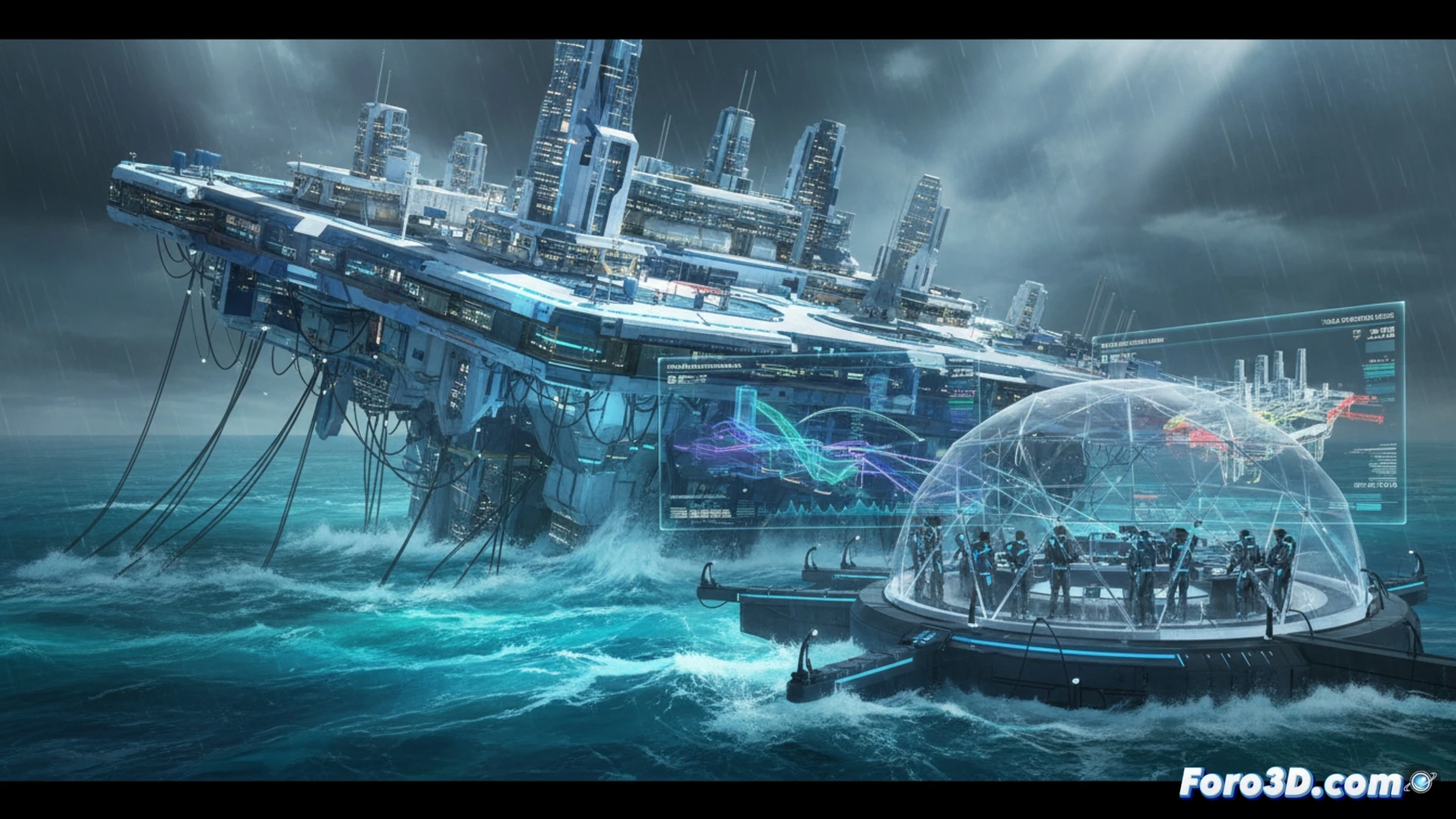
The main platform of Neo-Atlantis, a floating megacity, presents a dangerous structural tilt after a storm. Engineers have turned to 3D digital twins to prevent disaster. The system integrates underwater IoT sensors with simulation models in OrcaFlex and Tekla Structures, allowing real-time analysis of the interaction between waves and anchoring. This case demonstrates how the convergence of data and visualization saves critical infrastructure.
Workflow: from ReCap to Twinmotion in real time 🌊
The process begins with Autodesk ReCap, which captures the exact geometry of the platform and its anchors through underwater laser scanning. This point cloud is integrated into OrcaFlex, specialized software for marine system dynamics, which simulates hydrodynamic forces and cable fatigue. In parallel, Tekla Structures models the structural detail of steel and concrete, calculating stresses and deformations under load. Finally, Twinmotion visualizes the digital twin in real time, overlaying data from IoT sensors (tilt, tension, wave action) so operators can identify points of imminent failure before they occur.
Lessons for future floating infrastructure 🏗️
Neo-Atlantis is not an isolated case. The integration of digital twins with IoT and predictive simulation marks a before and after in marine civil engineering. Where previously reactions occurred after collapse, now instability is anticipated. The key lies in the synchronization between OrcaFlex, Tekla, and Twinmotion, which enables a continuous feedback loop: sensors update the model, the model predicts failure, and engineers act. The future of floating cities will depend on this ability to simulate chaos before it becomes real.
How accurate was the Neo-Atlantis digital twin's prediction of structural collapse, and how were the simulation models adjusted after the storm to avoid false positives in future emergencies?
(PS: My digital twin is right now in a meeting, while I am here modeling. So technically, I am in two places at once.)