Workplace safety in aeronautical maintenance is critical due to risks such as falls from platforms or wings, entrapment in moving parts, exposure to fuels and solvents, intense noise, cuts, burns, and work in confined spaces. Digital twins offer an innovative solution: precise virtual replicas of aircraft and hangars where these hazards can be simulated without exposing technicians to real conditions. This article explores how to build a digital twin for immersive training in risk prevention. 🛠️
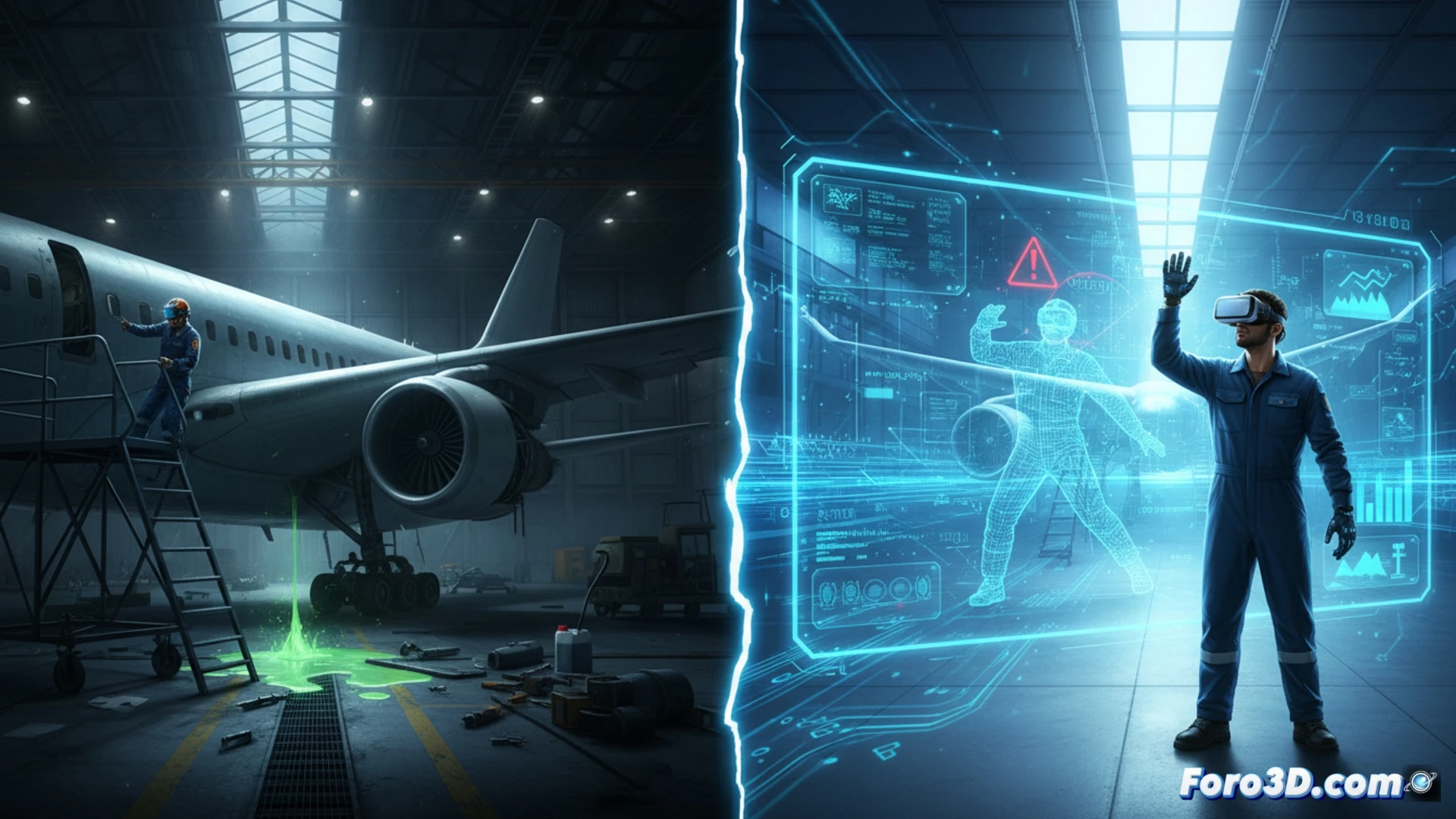
Technical process for creating the digital twin 🖥️
Development begins with a 3D scan of the hangar and aircraft using LiDAR sensors or photogrammetry, capturing exact geometries of wings, landing gear, work platforms, and tools. The model is refined in CAD software to add functional details such as valves, panels, and fuel systems. Subsequently, it is imported into a game engine (Unity or Unreal Engine) where realistic physics are integrated: simulation of falls from heights, entrapment in moving surfaces, dispersion of chemical vapors, and noise levels. The result is an interactive environment where the mechanic practices safety protocols, such as the correct use of harnesses or the ventilation of confined spaces, receiving immediate feedback on errors.
Reflection on the impact on safety culture 💡
Beyond technology, this approach transforms preventive training by allowing mistakes without real consequences. The mechanic can experience a simulated fall or virtual chemical exposure, internalizing the risk viscerally. Companies reduce accidents and associated costs, while workers gain confidence by facing complex scenarios. The digital twin does not replace human supervision, but acts as a safe laboratory where theory becomes repeatable practice, raising the safety standard in a sector where every failure can be fatal.
How a digital twin can simulate and anticipate the risks of entrapment or falls from platforms to improve safety protocols in aircraft maintenance
(PS: don't forget to update the digital twin, or your real twin will complain)