Dental hygiene is a profession with high exposure to biomechanical and biological risks. Forced postures of the neck and back, blood and saliva aerosols, needlesticks, ultrasound noise, and latex dermatitis are daily threats. 3D simulation and digital twins offer a new way to analyze these hazards without exposing the professional.
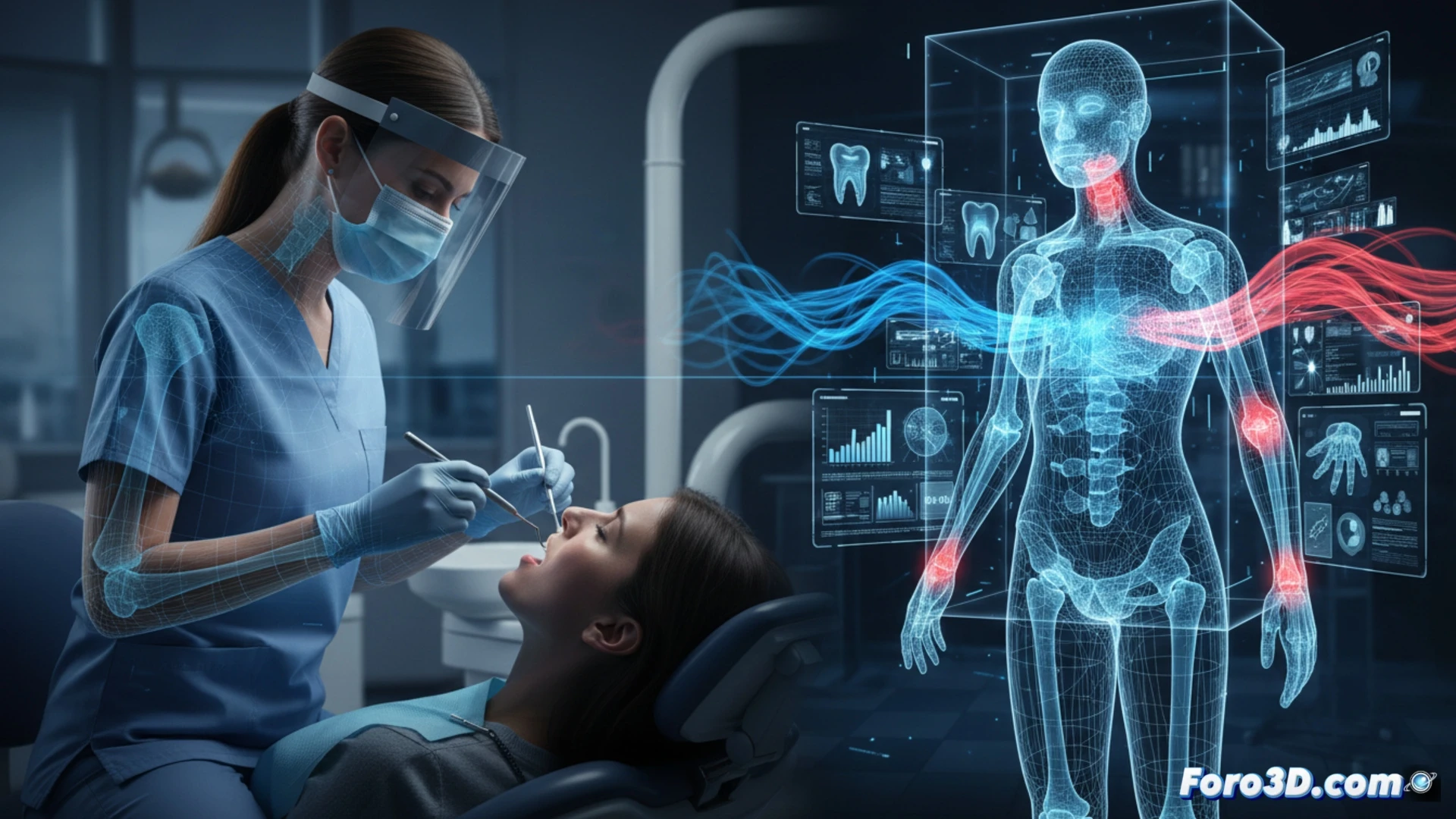
Ergonomic modeling and aerosol visualization 🦷
Through motion capture and simulation software, a digital twin of the hygienist can be created. This model allows for analyzing joint angles of the neck and back during scaling procedures, identifying risky postures before they cause injuries. Additionally, computational fluid dynamics (CFD) integrated into 3D environments visualizes the dispersion of biological aerosols generated by ultrasounds. This allows for redesigning the position of extractors and physical barriers, optimizing operator and patient safety without the need for real-world testing.
3D printing as a barrier against fatigue 🖨️
3D printing allows for manufacturing custom adapters for hand instruments, reducing grip force and hand overexertion. Lightweight face shields with expanded fields of view can also be designed to mitigate visual fatigue. Combining digital twins with printed prototypes accelerates the validation of ergonomic solutions, transforming occupational risk prevention into an iterative process based on objective data.
What segmentation software do you recommend for this medical data?