Orthodontics demands millimeter precision, but this same physical requirement turns the professional into a high-risk patient. Forced postures, eye strain from fine detail work, and exposure to wire punctures are part of the daily routine. In response, 3D technologies offer a qualitative leap: it is no longer just about correcting the patient's bite, but about modeling and optimizing the specialist's work environment to prevent chronic wear and tear.
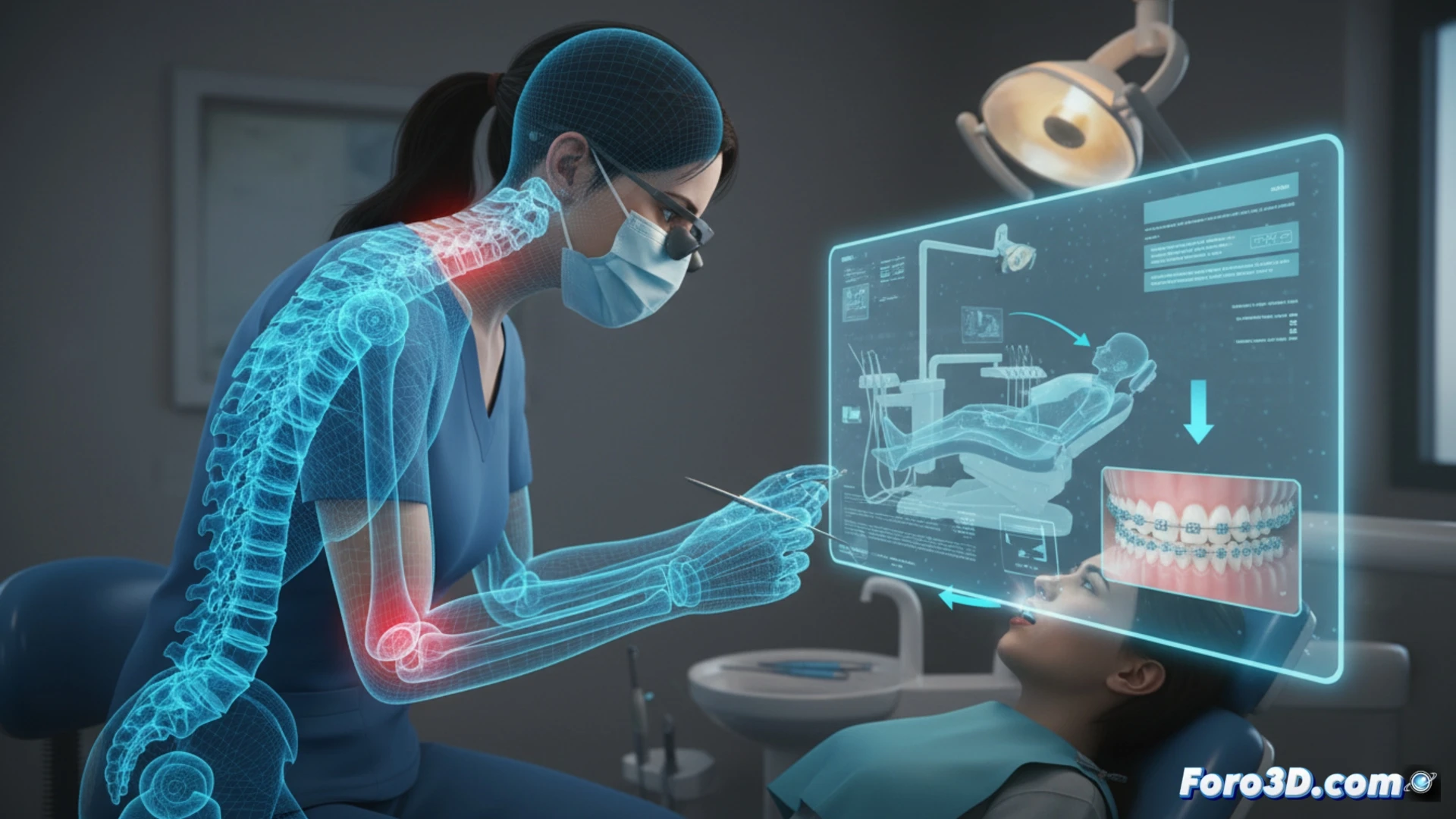
3D Simulation of Biomechanical Loads and Ergonomics 🦷
3D modeling allows for the creation of digital twins of the orthodontist's workstation. Through volumetric scanning of the chair, instrument tray, and the professional's position, it is possible to simulate the cervical angle and tension in the trapezius muscle during bracket placement. These simulations identify critical points of hyperflexion or forced neck rotation, enabling the redesign of furniture layout. Furthermore, 3D printing of ergonomic tool handles, customized to the dentist's anthropometry, reduces hand fatigue and prevents musculoskeletal disorders such as carpal tunnel syndrome.
Immersive Training for Active Prevention 🥽
Virtual reality (VR) based on 3D models allows the orthodontist to experience their workday from an objective perspective. Visualizing in first person the repetitive bending of the torso or exposure to biological aerosols in a controlled environment changes the perception of risk. The result is a stronger prevention culture: the professional not only knows they must take care of their posture, but understands, in a three-dimensional space, why and how to do it, integrating active breaks and wrist rotations into their real workflow.
Can a digital twin trained with orthodontist biomechanics predict the exact point of postural failure before lower back or neck pain appears in real clinical practice?
(PS: If you 3D print a heart, make sure it beats... or at least doesn't cause copyright issues.)