Solar noon represents the critical point for any large-aperture telescope. The recent failure in the leveling system of a ground-based observatory, where the loss of focus was total, highlighted a gap in thermal compensation. Subsequent analysis revealed that local refraction of hot air and deformation of the primary mirror, induced by heat, exceeded the corrective capacity of the adaptive optics software. This incident underscores the need to anticipate environmental variables.
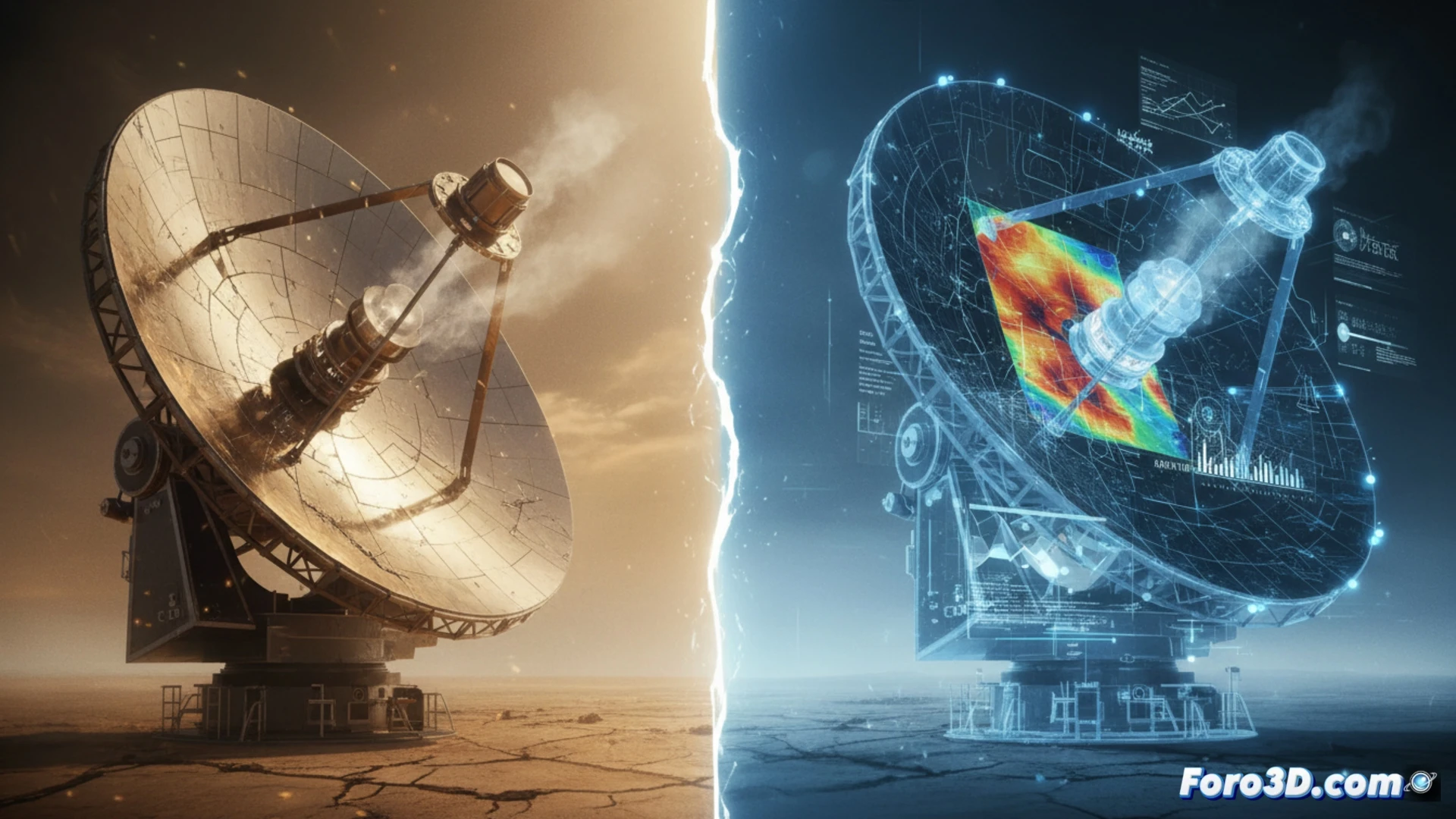
Integration of CAD, LiDAR, and numerical control data 🔧
An effective digital twin for this telescope would have integrated three critical data sources. First, the geometric and structural model from SolidWorks, which defines the stiffness and expansion coefficients of the mount and mirror. Second, the high-precision point clouds captured with Leica Cyclone, essential for calibrating the actual position of each component after assembly. Third, the MATLAB control loop, which processes sensor signals. By feeding the twin with real-time weather data, the model could have simulated the differential deformation of the mirror and the distortion of the optical path due to thermal gradients, generating a predictive correction signal for the secondary mirror before focus degraded.
Lessons for the adaptive optics of the future 🌡️
The error was not in the hardware, but in the predictive model. Adaptive optics reacts, but does not anticipate. A digital twin, calibrated with LiDAR data and running thermal simulations in MATLAB, would have identified that the support structure expanded asymmetrically, creating an astigmatism not accounted for in the software. The lesson is clear: the next generation of solar telescopes must integrate a digital twin that acts as a predictive co-pilot, merging materials physics with 3D metrology to maintain focus even under the midday sun.
Which parameters of the digital twin were most effective in anticipating the thermal failure at solar noon in the telescope's leveling system?
(PS: don't forget to update the digital twin, or your real twin will complain)