The Spanish state has secured the exhibition of 25 masterpieces from the Mauritshuis museum in The Hague at the Museo Nacional Thyssen-Bornemisza in Madrid for 378.8 million euros. The exhibition, titled Thyssen-Bornemisza & Mauritshuis. A love story between two museums, will open in October and run until January 2027. This exchange of permanent collections presents an ideal scenario for applying 3D technologies, allowing the public to digitally explore every brushstroke and historical context beyond the physical limits of the gallery.
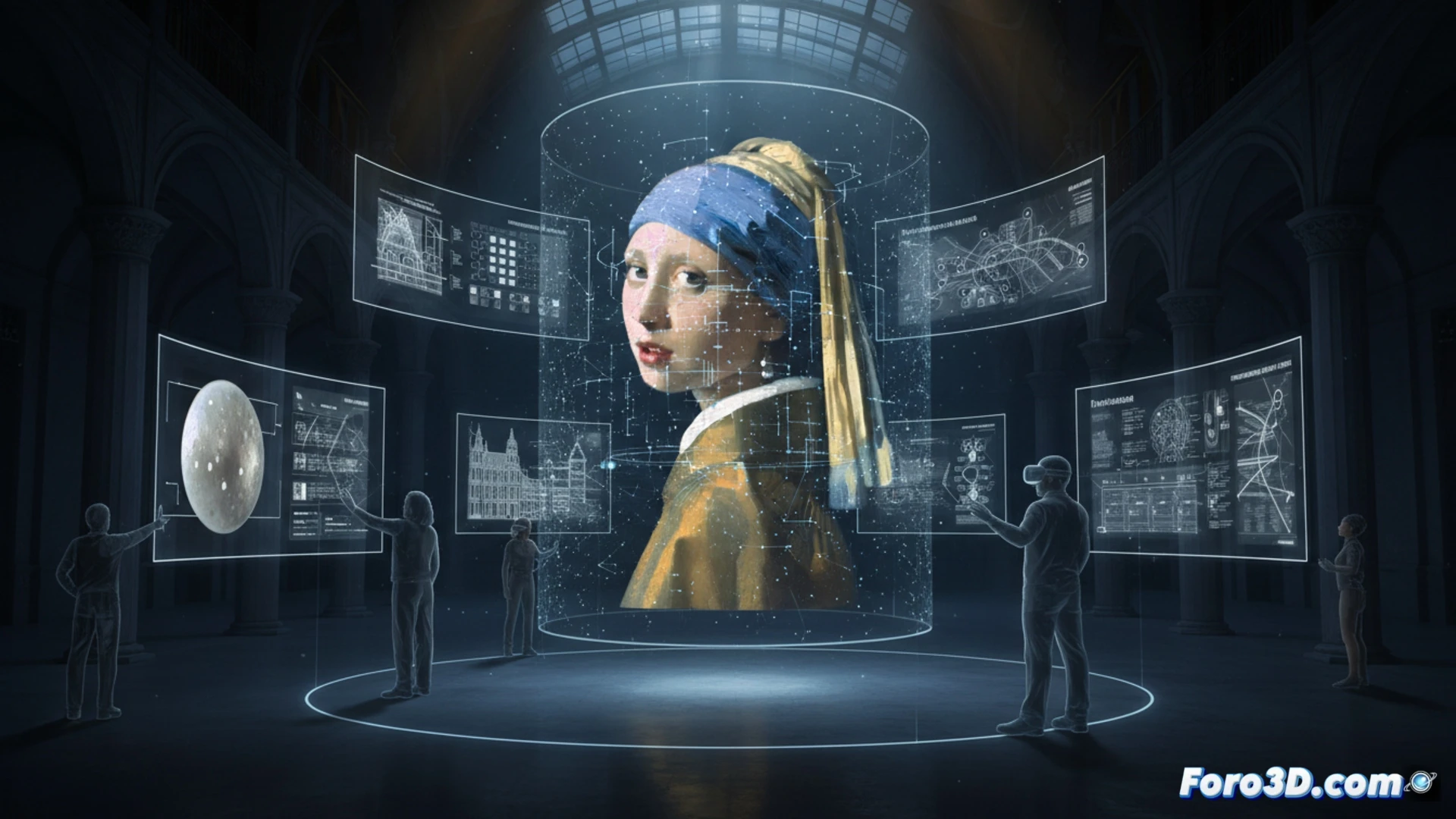
Photogrammetry and modeling for educational conservation 🖼️
To maximize the educational value of this exchange, creating 3D digital twins of the 25 works is strategic. Using high-resolution photogrammetry and structured light scanners, textures, varnish reliefs, and craquelure can be captured with micrometric precision. These models would allow the development of interactive virtual tours where users can zoom into specific areas of the canvas, activate information layers about the artist's technique, or visualize the restoration process. Additionally, an augmented reality app could superimpose these works onto the real museum space, facilitating direct comparison between pieces from both institutions without physically moving the artworks.
Democratizing access to pictorial heritage 🌍
Beyond the spectacle of the economic agreement, the true legacy of this collaboration lies in its educational potential. If the Thyssen-Bornemisza integrated these digital twins into its online platform, students and researchers worldwide could analyze the brushstrokes of Vermeer or Rembrandt as if they had the work in front of them. 3D technology does not replace the in-person experience, but it does democratize it, allowing those who cannot travel to Madrid or The Hague to access a level of detail that even the human eye cannot achieve behind museum glass.
How can the generation of digital twins with 3D scanning technologies improve educational access to masterpieces like those in the Thyssen-Mauritshuis exhibition without compromising the conservation of the original pieces
(PS: Teaching with 3D models is great, until students ask to move the pieces and the computer freezes.)