Last month, a suborbital tourist shuttle suffered the detachment of several ceramic tiles during its reentry. Forensic analysis using ultrasound and 3D scanning with FARO Scene revealed that the cause was outgassing of the carbon substrate under vacuum, which degraded the adhesive. This incident, fortunately without casualties, underscores a key lesson for the industry: the need for digital twins that integrate material behavior under extreme conditions.
Technical workflow: from scanning to predictive simulation 🛠️
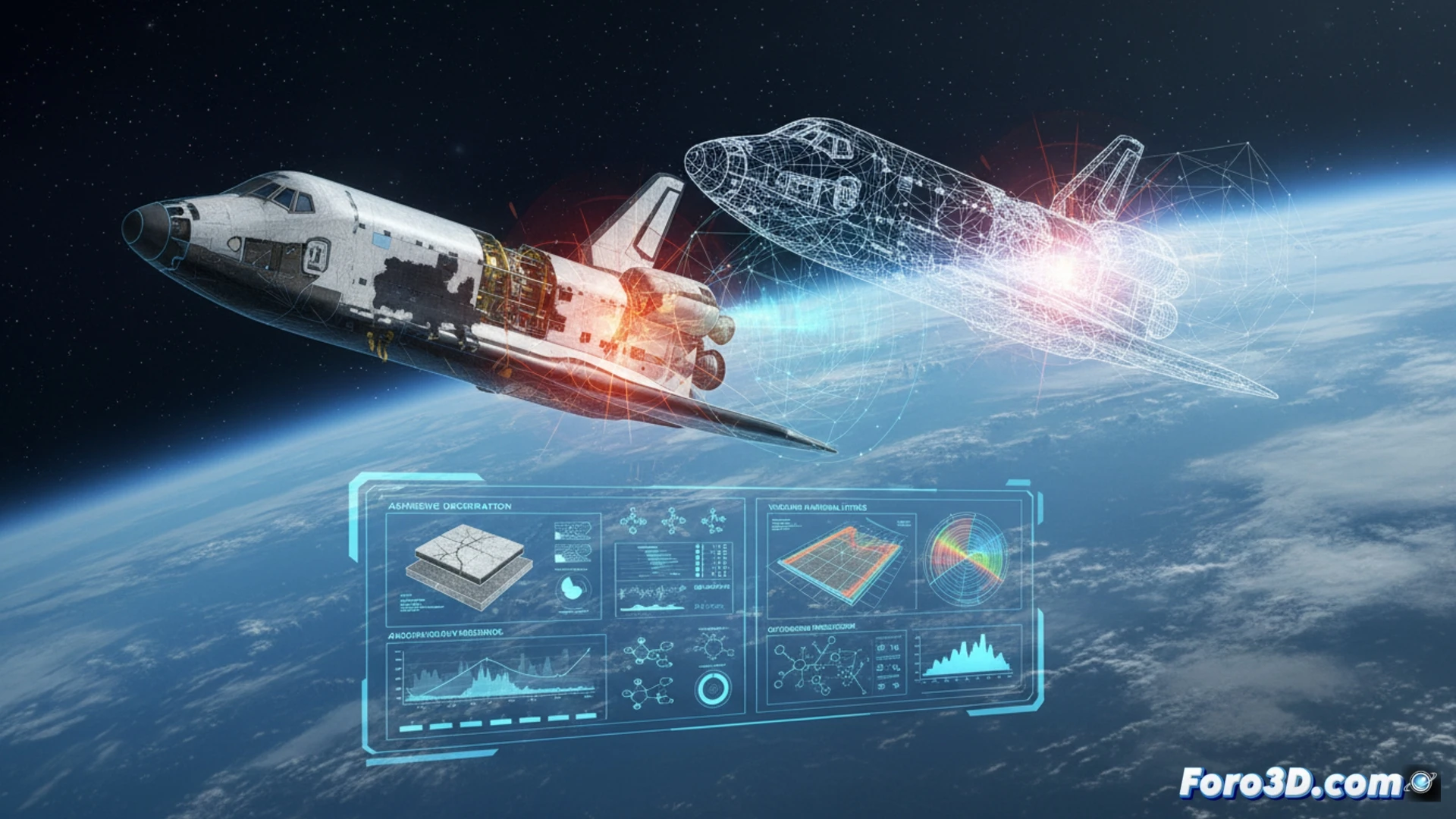
To prevent this failure, the ideal process begins with a precise scan of the structure using FARO Scene, generating a point cloud of the fuselage. This model is imported into Siemens Simcenter, where the adhesive is defined as a viscoelastic material with outgassing properties. Simultaneously, Maya is used for thermal mapping, assigning reentry temperatures to each tile. The coupled simulation allows predicting adhesion loss before flight, adjusting the adhesive formulation or joint design.
The digital twin as a life insurance policy in space 🚀
Beyond repair, this case demonstrates that a digital twin is not just a static 3D model, but a living system that integrates sensor data, fatigue simulations, and vacuum conditions. Implementing this technology would have saved millions in review costs and, most importantly, would have ensured crew safety. In the new space race, prediction through digital twins is no longer an option but becomes an industrial standard.
How a digital twin replicates in real-time the thermal and structural stress of ceramic tiles during reentry to predict their detachment before it occurs
(PS: don't forget to update the digital twin, or your real twin will complain)