A high-enthalpy geothermal plant begins to lose pressure inexplicably. Performance drops, and technicians suspect internal blockages. Using a digital twin powered by 3D scanning, the culprit is identified: silica crystals that precipitate and block the flow. This article details the technical workflow for diagnosing the chemical alteration of the fluid and optimizing predictive maintenance.
Workflow: Digitization, Simulation, and Diagnosis 🔧
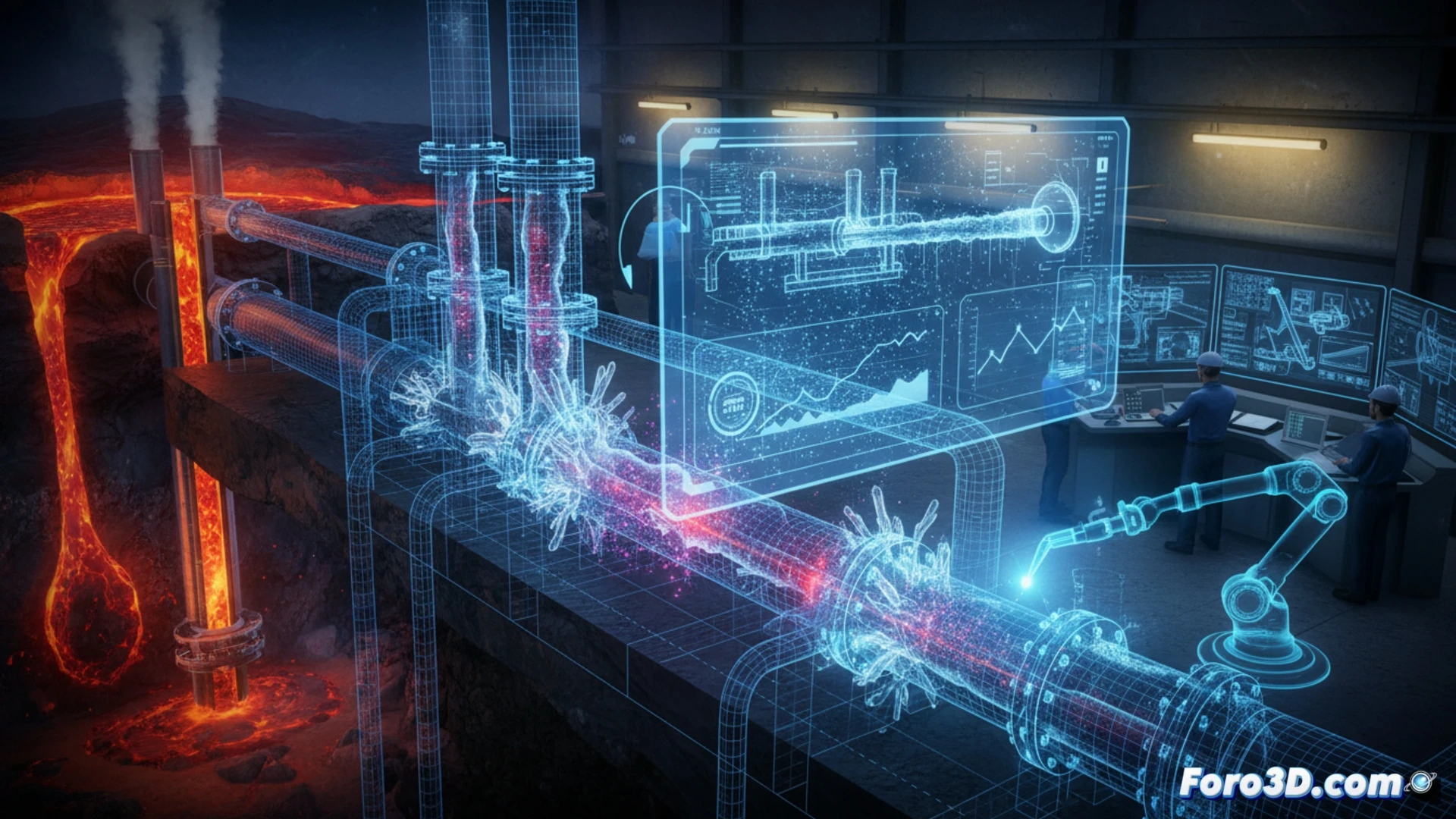
The process begins with capturing the internal geometry of the pipes and valves using a Leica Cyclone laser scanner, generating a high-precision point cloud. This cloud is imported into CloudCompare for alignment, noise cleaning, and segmentation of critical areas where scaling is suspected. Subsequently, the clean geometric model is transferred to Ansys Fluent for computational fluid dynamics (CFD) simulations. Here, the geothermal fluid is modeled with its real thermochemical properties. The simulation reveals low-velocity, high-temperature zones where silica tends to nucleate and grow, correlating the pressure loss with the crystalline blockage. The digital twin is updated with this data, allowing prediction of deposit evolution and planning of localized cleaning interventions.
The Predictive Value of the Virtual Chemical Model ⚗️
Beyond detecting the blockage, the digital twin allows evaluating the chemical alteration of the fluid over time. By integrating scan data with CFD simulation, the silica saturation index can be modeled, and critical precipitation points can be anticipated. This transforms reactive maintenance into a predictive strategy, reducing unplanned downtime and extending component lifespan. The synergy between Leica Cyclone, CloudCompare, and Ansys Fluent demonstrates that a digital twin not only replicates geometry but also simulates the process chemistry.
Can a digital twin integrate historical production data and predictive models to distinguish between a silica blockage and a mechanical failure in a downhole pump in real time?
(PS: My digital twin is currently in a meeting, while I am here modeling. So technically, I am in two places at once.)