The recent appearance of an apocryphal painting attributed to Vincent van Gogh reopens the debate on authenticity in art. Beyond the expert's eye, 3D modeling and digital analysis are emerging as key tools to unmask fraud. This article explores how technology allows the creation of digital twins of artworks to compare every millimeter of canvas with the certified pieces of the Dutch master.
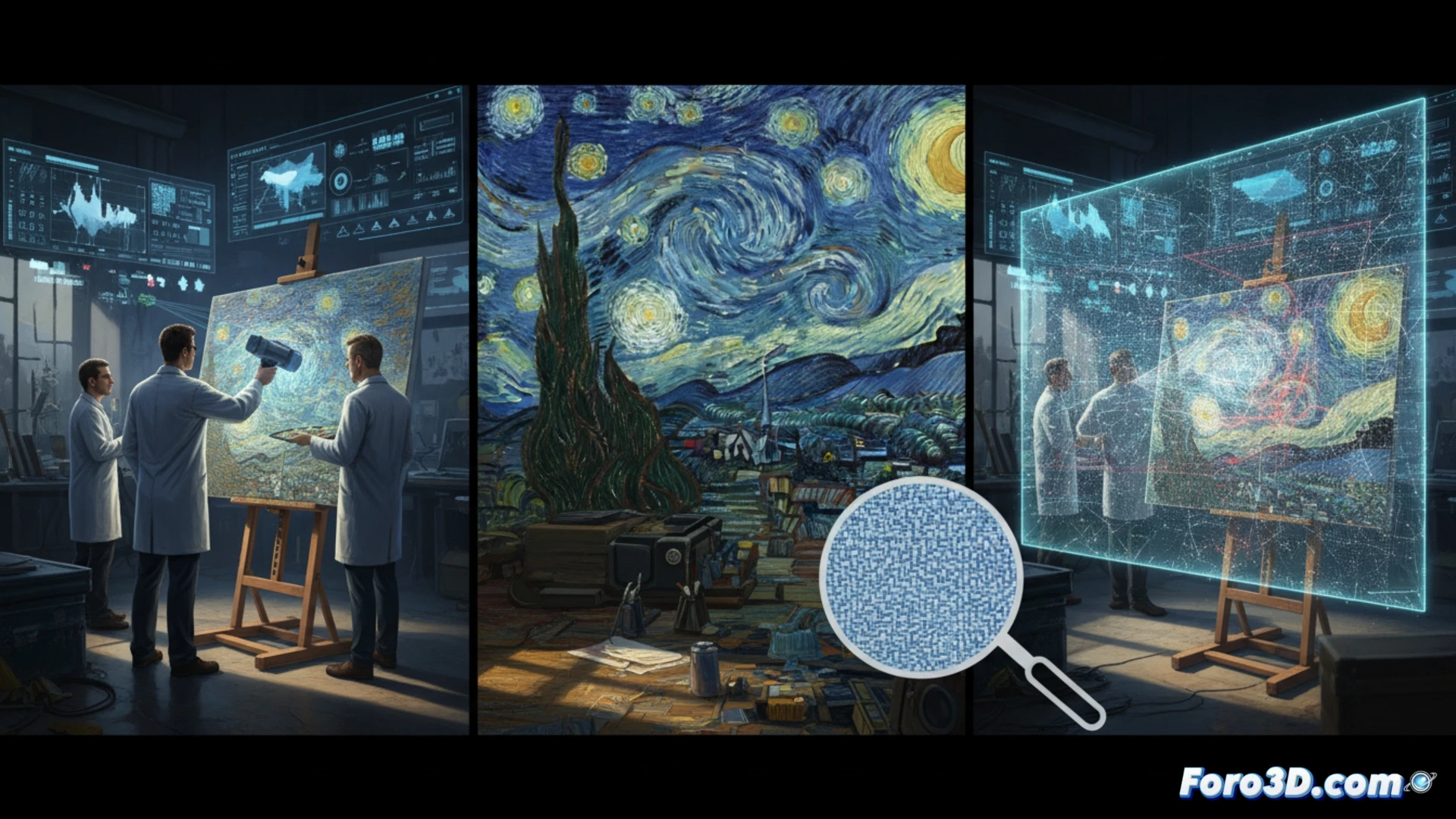
Photogrammetry and spectral analysis in verification 🎨
The process begins with capturing the artwork using high-resolution photogrammetry, generating a three-dimensional model that records the thickness of the impasto and the exact direction of each brushstroke. This digital twin undergoes spectral analysis that breaks down pigments into specific wavelengths. By comparing this data with that of authenticated Van Gogh works, such as Sunflowers, machine learning algorithms detect anomalies in the chemistry of colors or brush patterns that the human eye does not perceive. The 3D texture reveals whether the paint application corresponds to the artist's frenetic technique or a meticulous but flat imitation.
Digital activism against the fraud market 🔍
The democratization of these scanning and analysis tools is transforming artistic activism. Now, groups of historians and technicians can create public databases of digital twins of masterpieces, functioning as a decentralized verification seal. This pressures galleries and auction houses to be more rigorous, as a work that does not pass 3D textural analysis immediately loses value. The fight against forgery no longer depends solely on an expert, but on an open digital ecosystem that protects the integrity of cultural heritage.
Can the creation of a hyper-realistic digital twin of a Van Gogh painting become the definitive tool to unmask forgeries without the need for invasive analysis?
(PS: if your virtual reality installation doesn't change the world, at least let it not lag)