A structural failure in a road tunnel caused cracks in the ceiling slabs due to low-frequency acoustic vibrations. The cause was Helmholtz resonance: the air vibrated at the same natural frequency as the slabs, amplifying the energy until it damaged the concrete. The solution did not come from manual calculations, but from a precise digital twin that replicated every meter of the tunnel to simulate the behavior of the air.
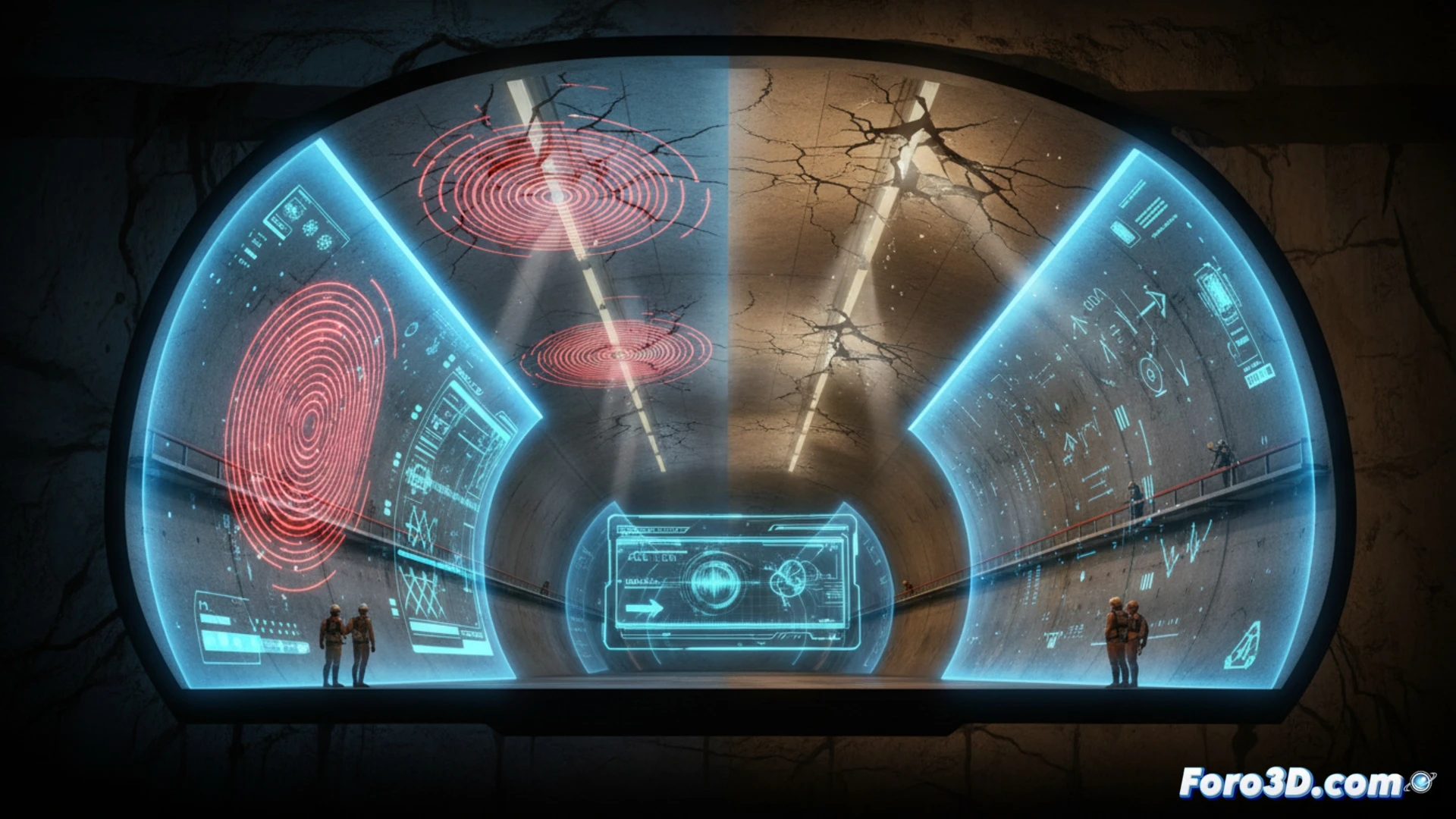
Workflow: from LiDAR scanning to acoustic simulation 🎯
The process began with a laser scan using FARO Scene, capturing the actual geometry of the tunnel with a high-density point cloud. This data was imported into Revit to build a detailed BIM model that included every joint, plenum, and existing silencer. With the geometry validated, the model was exported to Actran, where an acoustic finite element analysis was performed. The software identified that the resonance frequency of the air volume exactly matched the natural frequency of the ceiling slabs, confirming the failure due to acoustic-structural coupling.
Validated redesign without drilling a single slab 🛠️
With the calibrated digital twin, engineers simulated multiple acoustic silencer configurations in Actran. The final solution consisted of installing Helmholtz resonant panels at strategic points in the duct, shifting the air resonance frequency away from the critical frequency of the slabs. The digital twin allowed the redesign to be validated without the need for destructive testing or tunnel closures, demonstrating that simulation based on real data is the ultimate tool for infrastructure engineering.
As an engineer, what key lessons did you learn from this real case about using a digital twin to diagnose and mitigate acoustic resonance problems, such as Helmholtz resonance, that would not have been evident with traditional simulation methods?
(PS: My digital twin is currently in a meeting, while I am here modeling. So technically, I am in two places at once.)