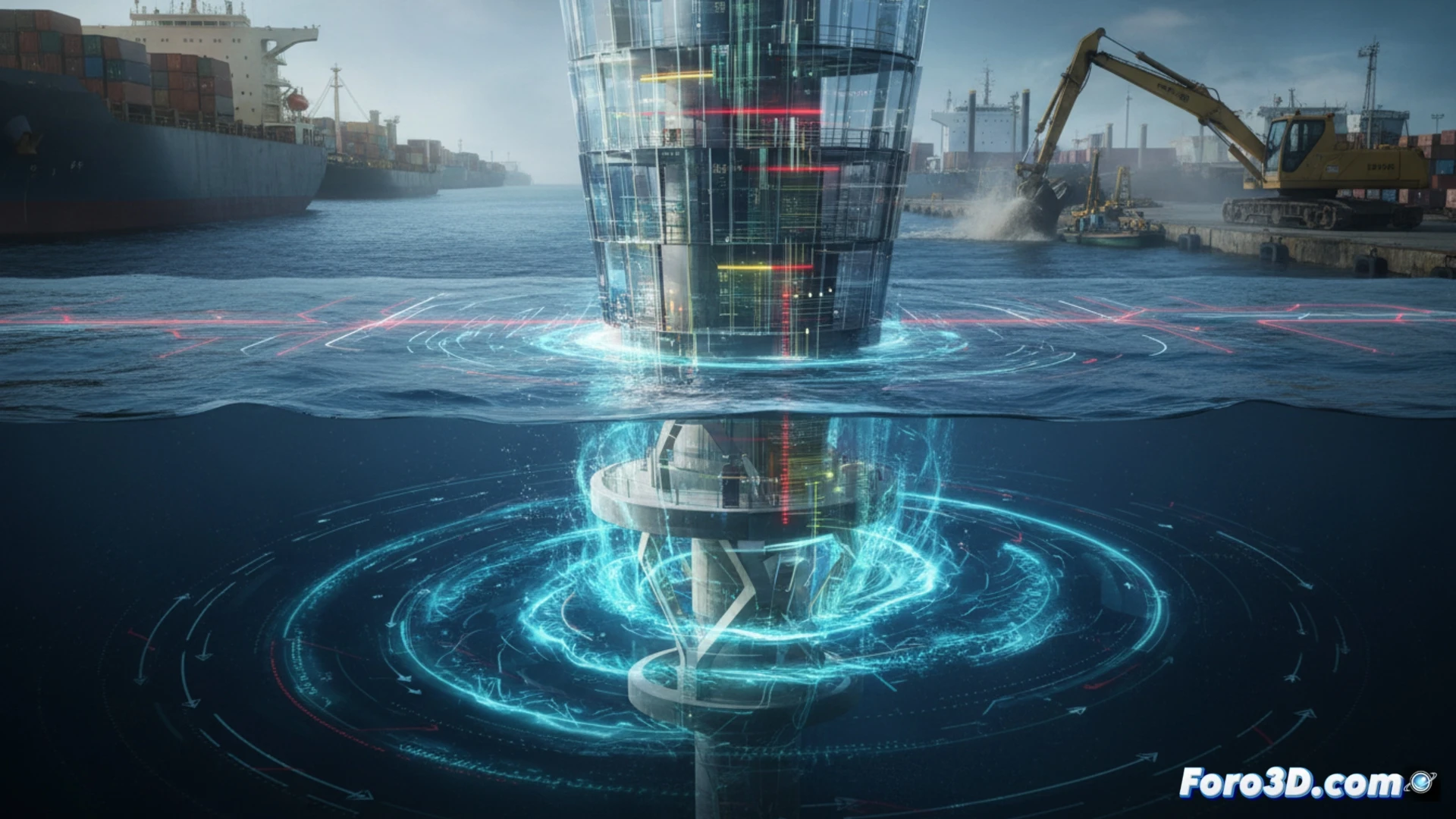
A 50-meter sensor tower at the Deep Water Port began vibrating dangerously without apparent cause. The 3D modeling of its underwater foundation, combined with LiDAR scanning, revealed the true threat: recent dredging had altered the water flow, generating Von Kármán vortices that struck the structure like a hydraulic hammer. The tower's digital twin allowed this phenomenon to be detected and simulated before a collapse occurred.
Technical workflow: from LiDAR to hydrodynamic simulation 🛠️
The process began with high-precision LiDAR scanning using Leica Cyclone, capturing the exact geometry of the tower and its submerged foundation. This data fed a model in MecaStack for structural analysis, while Bentley OpenFlows recreated the port's hydrodynamic environment. The simulation revealed that the dredging had created a narrowing in the channel, accelerating currents and generating a street of alternating vortices. These vortices, upon detaching from the base, synchronized their frequency with the tower's natural frequency, amplifying vibrations to critical levels. The digital twin allowed the hypothesis to be validated by comparing real vibration data with model predictions, confirming the root cause.
Lessons for coastal infrastructure engineering 📘
This case demonstrates that digital twins are not just visualization tools, but early warning systems. The integration of MecaStack and Bentley OpenFlows allowed the foundation design to be corrected with vortex dissipators, avoiding a costly replacement. For engineers, the lesson is clear: any modification to the seabed, even routine dredging, can trigger fluid-structure interaction phenomena that only a complete digital model can anticipate.
How were the vibration sensor data modeled in the digital twin to identify the hidden vortices that were not detectable with traditional simulation methods?
(PS: don't forget to update the digital twin, or your real twin will complain)