A telescopic seating system in a multi-purpose arena suffered a critical lockup during an event with 5,000 attendees on board. The failure, which left the structure immobile and created a safety emergency, had no obvious cause in the manual. The solution came from the system's digital twin: a virtual model created with 3D scanning and simulation software that identified a torsional deformation in the rails, caused by an undocumented uneven weight distribution.
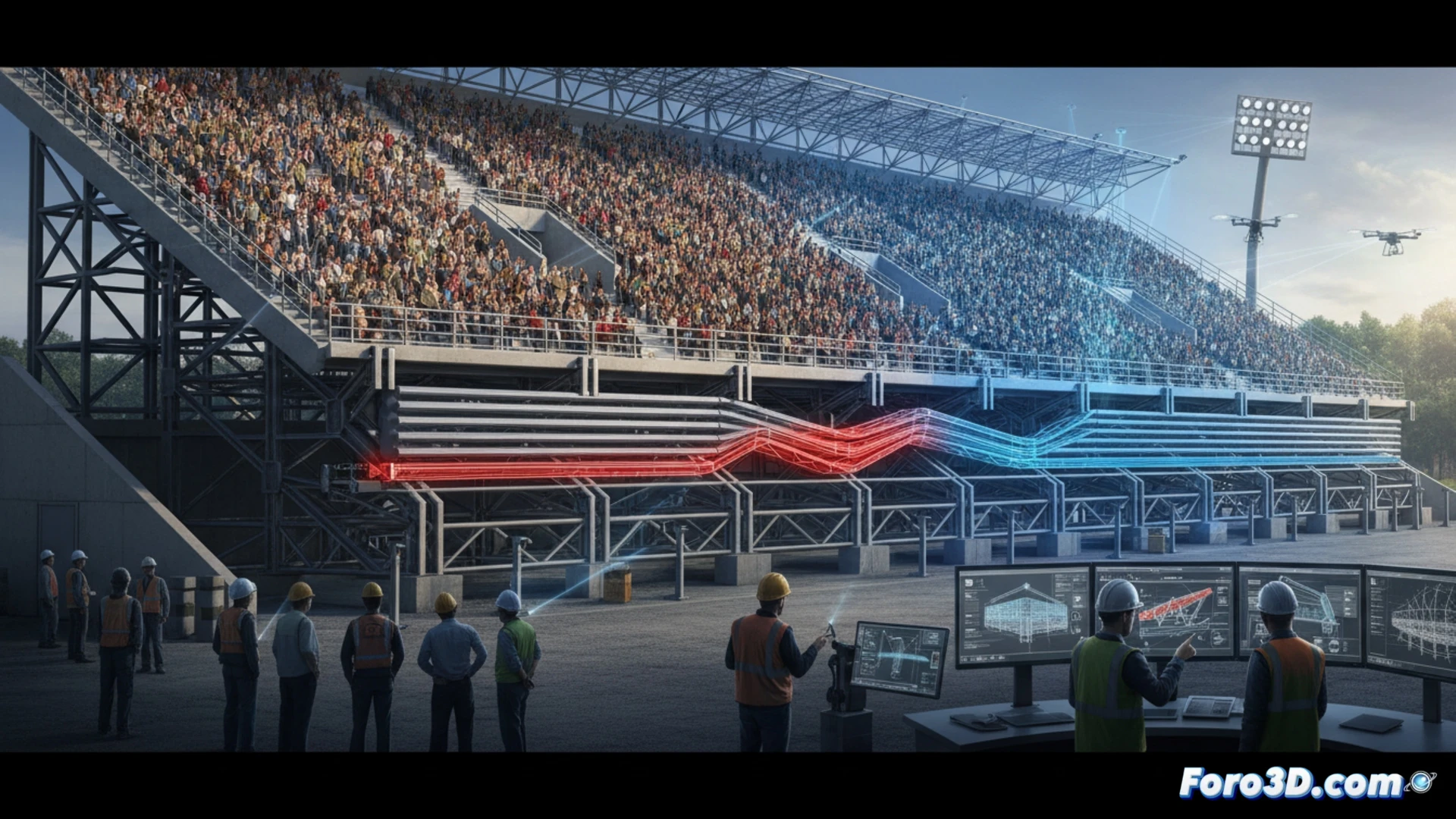
Workflow: scanning, modeling, and simulation in FARO Scene, Tekla Structures, and Autodesk Inventor 🛠️
The process began with a high-precision laser scan using FARO Scene, which captured the real geometry of the telescopic rails and support structure. The resulting point cloud was imported into Tekla Structures to model the structural digital twin, including the joints and metal profiles. With that base model, the geometry was transferred to Autodesk Inventor to perform dynamic load simulations. There, the real event conditions were applied: 5,000 people distributed asymmetrically across the side sections. The simulation revealed a 3.2-degree torsion in the left rail, a value the safety manual did not account for because it assumed a uniform load. This deformation, though small, was enough to lock the deployment mechanism.
Lesson for mass event infrastructure: the digital twin must be updated with real usage data 💡
This case demonstrates that a digital twin is not a static model, but a living tool that must be fed with real operational data. The safety manual failed because it was based on ideal load conditions. The torsional deformation was only detected by comparing the virtual behavior with the post-failure scan. For future events, the arena has already updated its digital twin with real occupancy patterns, enabling predictive simulations that warn of dangerous weight distributions before a lockup occurs. Safety in multi-purpose infrastructure depends on this constant feedback between the physical world and its digital replica.
How is hidden torsion simulated in a telescopic seating structure with 5,000 people on board to prevent critical lockups in live events using a digital twin?
(PS: My digital twin is currently in a meeting, while I'm here modeling. So technically, I'm in two places at once.)