A superficial crack in the concrete of a cryopreservation laboratory concealed a much larger problem: the rupture of the vapor barrier beneath the floor. The resulting thermal gradient threatened the stability of the samples. Instead of resorting to costly destructive testing, the technical team opted to build a digital twin of the pavement, integrating LiDAR data and thermography to simulate subsurface behavior and precisely locate the exact point of failure in the insulating membrane.
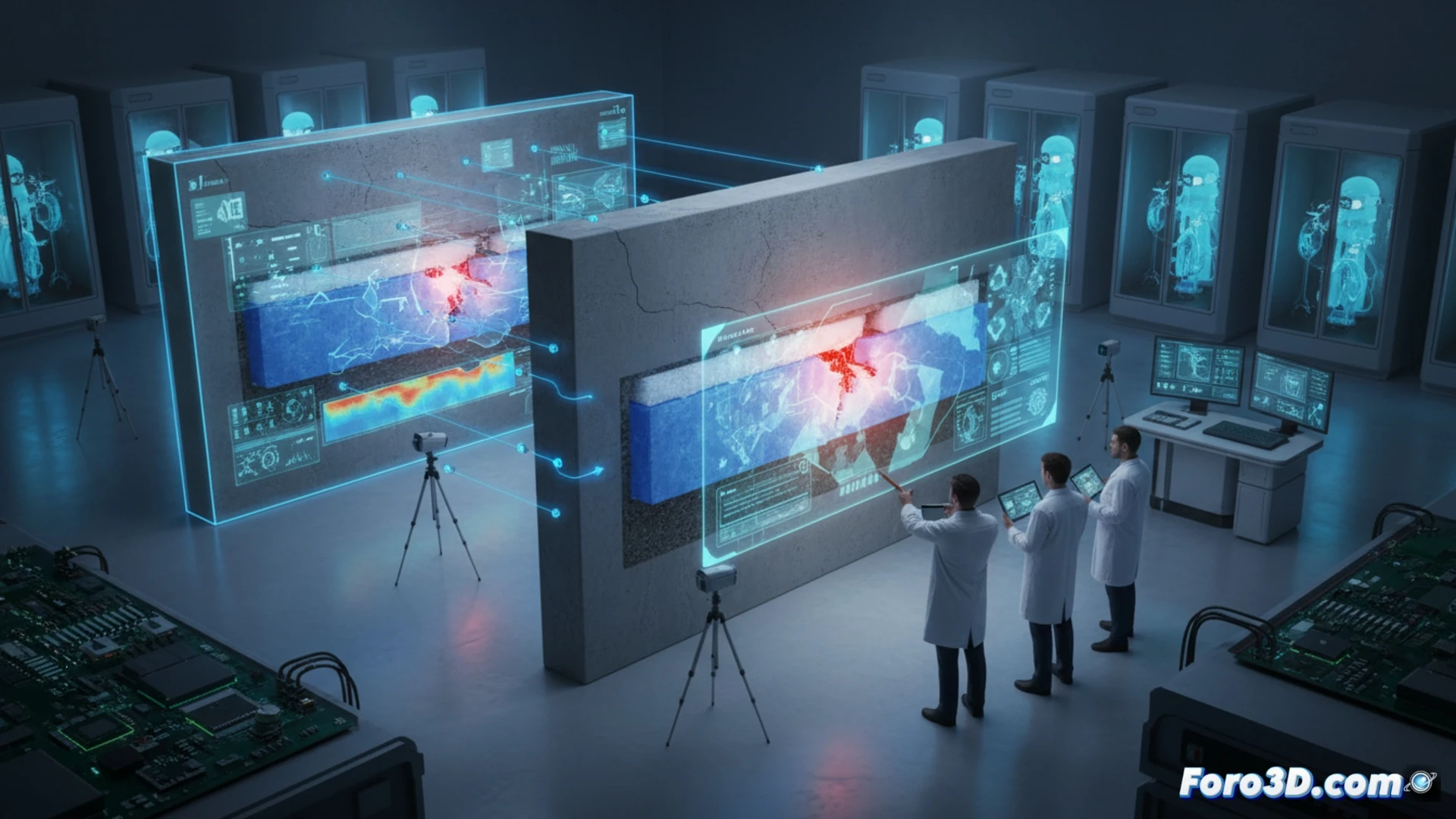
Workflow: from point cloud to thermal diagnosis 🔥
The process began with a hybrid scan combining a high-precision LiDAR scanner with a calibrated thermal camera. The resulting point cloud, georeferenced and with temperature associated to each vertex, was processed in Pix4D to generate a thermal orthomosaic and a surface model. This dataset was imported into Revit, where the concrete slab and underlying insulation layer were modeled as parametric elements. In AutoCAD, the geometries of the suspected expansion joint were adjusted. The thermal gradient simulation in the digital twin revealed a 4.2-degree Celsius anomaly within a 30 cm radius, delineating the membrane rupture zone without needing to lift the pavement.
The value of simulating failure before intervening 🛠️
This case demonstrates that a digital twin is not just a visual model, but a predictive simulation tool. By cross-referencing the precise LiDAR geometry with the thermal data from Pix4D, it was possible to recreate the physical behavior of the subsurface and locate the vapor barrier defect with an error margin of less than 5 cm. The intervention was limited to a small core sample at the identified point, saving weeks of work and avoiding contamination of the cryogenic environment. The lesson is clear: in critical facilities, the digital twin becomes the first scalpel of diagnosis.
How did the digital twin manage to identify the rupture of the cryogenic membrane from a simple superficial crack in the concrete without the need for demolition or destructive testing?
(PS: My digital twin is right now in a meeting, while I am here modeling. So technically, I am in two places at once.)